Showing posts with label Ultraman Taro. Show all posts

Wednesday, December 4, 2024

Eizo Yamagiwa, Director of Various Ultra-Shows, Passes Away at 92

Eizo Yamagiwa in July 2022. Photo by Brett Homenick.

Longtime Ultra-series director Eizo Yamagiwa passed away on November 28 at a Tokyo hospital from sepsis due to old age. A private funeral has already been held. He was 92. 

Born on July 22, 1932, Eizo Yamagiwa began his career in the film industry at Shintoho in the mid-1950s as an assistant director. During his time at the studio, he worked on the seventh entry in the Starman film series, Super Giant: The Space Mutant Appears (1958), which was one of the three Starman features that was eventually edited into the American release Evil Brain from Outer Space

Ultra-series alumni Shozo Uehara (left), Toshihiro Iijima (center), and Eizo Yamagiwa enjoy a chat in March 2016. Photo by Brett Homenick.

Yamagiwa-san also worked as an assistant director under Teruo Ishii at Shintoho before launching his career as a director of film and television. At Tsuburaya Productions, Yamagiwa-san directed episodes 15, 16, 17, 22, 23, 28, 29, 34, and 35 of Return of Ultraman (1971-72), episodes 3, 4, 9, 10, 15, 16, 21, 22, 28, 29, 38, and 39 of Ultraman Ace (1972-73), episodes 1, 2, 3, 10, 11, 14, 20, 21, 24, 25, 39, 40, 47, 48 (as well as episode 28 as special effects director) of Ultraman Taro (1973-74), and episodes 50 and 51 of Ultraman Leo (1974-75).

Mitsuhiro Sano, Keiji Takamine, Eizo Yamagiwa, and Shigemitsu Taguchi gather at an Ultraman Ace reunion in February 2019. Photo by Brett Homenick.

He also helmed episodes 3, 4, 14, and 15 of Silver Kamen (1971-72), episode 4 of Horror Theater Unbalance (1973), episodes 11 and 13 (as well as episode 11 as co-scriptwriter with Ei Ogawa) of Jekyll and Hyde (1973), and episodes 8, 9, 16, and 17 of the Submersion of Japan TV series (1974-75).

I first met Yamagiwa-san in March 2016 at a book-launch party for an Ultra Q (1966) tome. There were numerous luminaries in attendance from the world of tokusatsu, and Yamagiwa-san was among them. Even though I didn't know who he was at the time, Yamagiwa-san seemed surprised that an American was at the event, so he approached me. He gave me his business card, and, bowled over that he would come up and introduce himself to me, I asked that we take a picture together. Of course, it didn't take long for me to become familiar with Yamagiwa-san's work.

Eizo Yamagiwa in February 2019. Photo by Brett Homenick.

Over the years, we met several times at events and a couple of times on a personal level. In fact, a month after we first met, we went to a Chinese restaurant in Shibuya together and ate dinner. At that dinner, Yamagiwa-san signed and gave me a book about Return of Ultraman in which he participated as an interviewee. We also talked about various movies from around the world we enjoyed. One title I recall that Yamagiwa-san cited was 8 1/2 (1963). However, when I mentioned Ed Wood (1994), another movie about moviemaking, he wasn't familiar with it, which was to be expected.

Shigemitsu Taguchi (left), Eizo Yamagiwa (center), and Akihiko Iguchi gather to discuss their work on the '70s Ultra-series in November 2016. Photo by Brett Homenick.

As Yamagiwa-san got older, however, it became more and more difficult to meet up. I'd still catch him at an event here and there, but, when I would call him, we couldn't seem to get our schedules to match.

Eizo Yamagiwa interviewed at his home in November 2020. Photo by Brett Homenick.

In 2020, I began doing interviews again in a big way, and I was pleased that Yamagiwa-san agreed to do one with me. In fact, in the beginning, he wasn't sure he would participate at all. I guess he felt he'd given enough interviews on his work in the Ultra-series and wasn't too keen on doing any more. So he wanted to see a sample of the questions I wanted to ask before accepting.

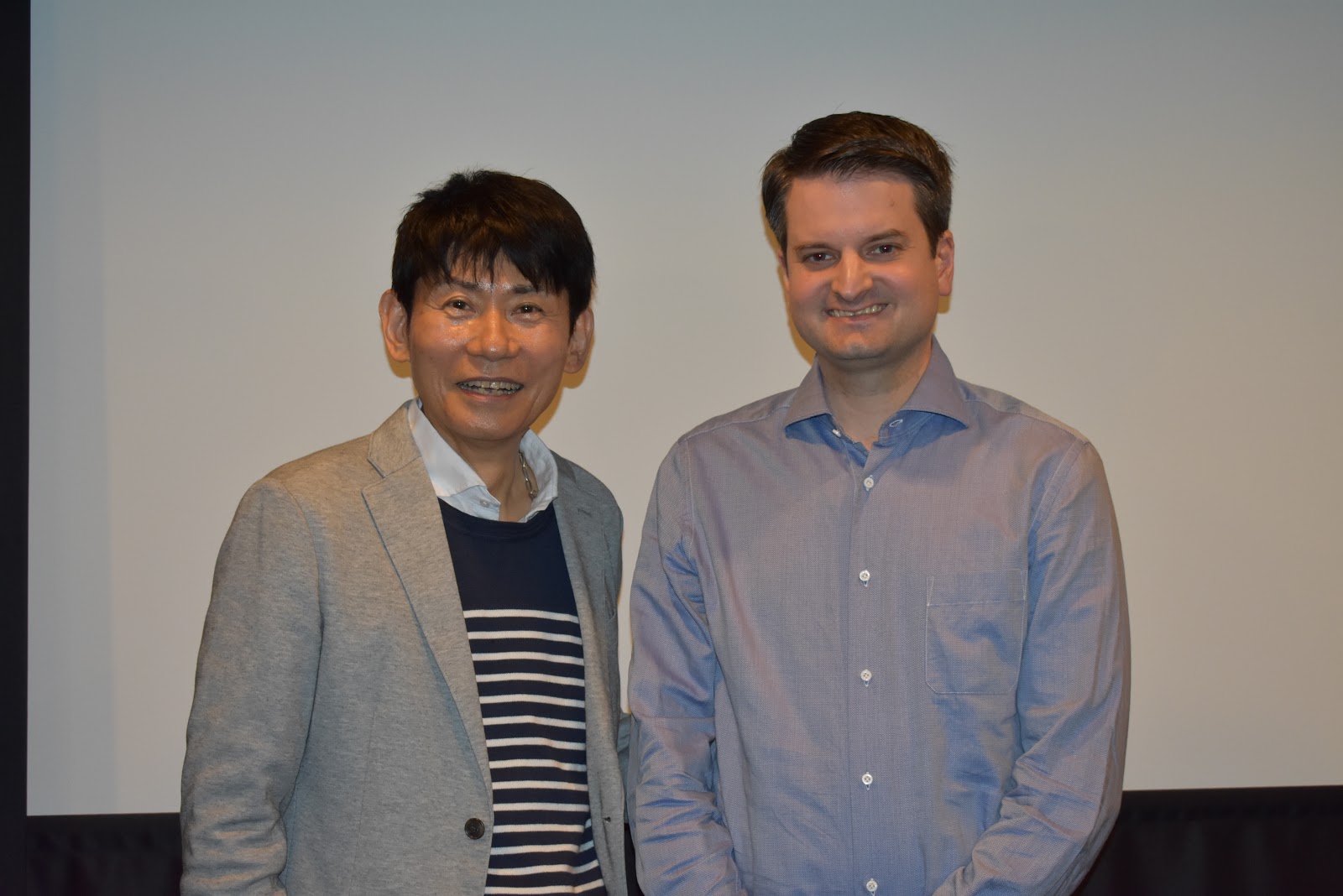
With Eizo Yamagiwa in June 2018.

My translator mailed him the translated version of my questions, which covered a wide variety of topics, including his early life and his work at Shintoho, with the Starman series. It was apparently enough to get him to agree to the interview, as we conducted it just a few weeks later.

Eizo Yamagiwa next to his bookshelf in November 2020. Photo by Brett Homenick.

We did the interview at Yamagiwa-san's home in Eifuku. It was a fascinating history, and I'm very glad he shared it with me. I was especially interested in hearing about his work on the Starman series. In fact, after the interview, I told Yamagiwa-san how I first saw clips of the Starman movies on the old Muppet Babies cartoon show in America. I wanted to point out how the Starman movies became part of American pop culture in surprising ways. His reaction? I'll do my best at an exact quote from memory: "If that had been Japan, I would have tried to sue them." I guess my anecdote didn't go over very well.

Ultra-series veterans Susumu Kurobe (left), Mitsuko Hoshi (center), and Eizo Yamagiwa share the stage in June 2018. Photo by Brett Homenick.

My other memory from the interview is that Yamagiwa-san wanted his photo taken next to his bookshelf so that people could see his collection. I guess he was quite proud of it!

I last saw Yamagiwa-san at an event in July 2022. It was great to see him again there, and I finally was able to get him to sign something Starman-related. I had a DVD sleeve made from cardstock from an old Mill Creek 50-movie pack that included Evil Brain from Outer Space. I brought it for Yamagiwa-san to sign, and I told him it was the U.S. version of the Starman movie he worked on. I remember he did a great job of reading the U.S. title out loud from the DVD sleeve, which was fun to see.

After the event, I bumped into him again by chance as he was getting into a taxi as he was leaving. I said goodbye to him again as he entered the vehicle to go home. Little did I know I'd never see him in person again.

With Eizo Yamagiwa in November 2020.

To the best of my memory, I called him in May 2023, asking to meet up. He told me he was too old, so he had to decline my request. When I knew I was leaving Japan, I asked a mutual friend to try to arrange a meeting, hoping he would have better luck, but that didn't work, either. I wish I could have met him again before I left.

With Eizo Yamagiwa in July 2022.

Rest in peace, director. Your legacy in film lives on.

Sunday, October 9, 2022

An Evening with One of Tokusatsu's Most Prolific Scriptwriters!

Shigemitsu Taguchi with a LaserDisc of the anime feature The Wonderful Adventures of Nils (1982). Photo by Brett Homenick.

Earlier today, I attended a special event headlined by tokusatsu scriptwriter Shigemitsu Taguchi. I've met Taguchi-san many times over the year, but, since the pandemic, my chances to see him have been few and far between. I had a chance to meet him last December, but our talk was much shorter than I'd hoped. So this was a great opportunity to spend more time with him.

Among other series, Taguchi-san has written for Return of Ultraman (1971-72), Mirrorman (1971-72), Ultraman Ace (1972-73), Jumborg Ace (1973), Ultraman Taro (1973-74), and Ultraman Leo (1974-75). Of course, he has written for many other TV programs, including anime, but his tokusatsu connections are extensive.

Shigemitsu Taguchi. Photo by Brett Homenick.

Taguchi-san, as always, was a lot of fun to see. At first, I asked him about his adorable dog Stella, but of course I wanted to ask him about various tokusatsu topics. He hasn't seen Shin Ultraman (2022) or even Shin Godzilla (2016). He described director Eizo Yamagiwa as a "gentleman," and, when I asked him about the strictest director at Tsuburaya Productions, he talked about the detailed shots that Akio Jissoji would set up and how Jissoji liked doing close-ups. He also greatly admires the kaiju designs of Tohl Narita. Moreover, Taguchi-san was worried because I wasn't eating, so he offered me some of his pasta. It was very kind of him, but I just wasn't hungry!


Taguchi-san was a bit surprised to see me at the event and asked how I found out about it. Of course, I keep my eyes peeled for any event with cool guests, even if the event itself doesn't have a tokusatsu theme. So, when I saw that Taguchi-san would be attending, that was good enough for me. He then asked me if I took the train to attend, which of course I did. 

Taguchi-san, on the other hand, explained that a driver would be taking him home -- very lucky! I also told Taguchi-san about my neighborhood, but, right after that, the event wrapped. It was great to visit Taguchi-san again, who is also very much a gentleman.

Friday, August 12, 2022

A New Interview About Classic Tokusatsu on Vantage Point Interviews!

With Minoru Kujirai in November 2021.

My interview with animator Minoru Kujirai has just been posted on Vantage Point Interviews. In the interview, Mr. Kujirai discusses working for Toei Animation in the mid-1960s, on which he worked on the animated series King Kong (1967). From there, Mr. Kujirai would briefly work on a few Toei tokusatsu series, including the original Kamen Rider (1971-73), but it would be his work at Tsuburaya Productions throughout the 1970s, including the Ultraman series, that would define his tokusatsu career. Read all about it on Vantage Point Interviews where content is king!

Wednesday, November 24, 2021

Lunch with an Animation Legend!

Minoru Kujirai. Photo by Brett Homenick.

Today, I enjoyed a pleasant lunch with animator and tokusatsu veteran Minoru Kujirai, whose career in animation and tokusatsu is quite impressive. He worked on tokusatsu projects for Toho, Toei, Tsuburaya Productions, and beyond.

It was my first time to visit with Kujirai-san since the pandemic, so it had been quite a while. Hopefully, we can do it again much sooner!

Monday, May 31, 2021

Eizo Yamagiwa Q&A Now Up at Vantage Point Interviews!

With Eizo Yamagiwa.

Another brand-new interview is now live at Vantage Point Interviews: my November 2020 Q&A with Tsuburaya Productions director Eizo Yamagiwa. Yamagiwa-san discusses his early life during World War II, as well as his start at Shintoho in the mid-1950s. At Shintoho, he worked on the seventh Starman actioner Super Giant: The Space Mutant Appears (1958), which was later edited into the cult classic Evil Brain from Outer Space.

At the end of the 1960s, Yamagiwa-san joined Tsuburaya Productions as a director, helming such TV programs as Return of Ultraman (1971-72), Ultraman Ace (1972-73), Ultraman Taro (1973-74), and Ultraman Leo (1974-75), among others. He also directed episodes of Silver Kamen (1971-72) and the Submersion of Japan TV series (1974-75). Yamagiwa-san discusses these productions and much more in our interview. 

With such incredible, in-depth interviews, Vantage Point Interviews continues to prove that content is king!

Masao Nakabori Q&A Now on Vantage Point Interviews!

With Masao Nakabori in June 2019.

My September 2019 interview with tokusatsu cinematographer Masao Nakabori has finally been completed and is now available at Vantage Point Interviews. In the interview, Nakabori-san talks about his work on the classic tokusatsu series Ultraman (1966-67), Ultra Seven (1967-68), Operation: Mystery! (1968-69), Silver Kamen (1971-72), and Ultraman Taro (1973-74), as well as his big-screen collaborations with famed director Akio Jissoji, including the films Tokyo: The Last Megalopolis (1988) and Ultra Q: The Movie (1990). 

The interview covers a lot of territory that you usually don't get to read about in English. Don't miss out!

Wednesday, November 18, 2020

An Ultra-Afternoon with an Ultra-Director!

Eizo Yamagiwa in his home. Photo by Brett Homenick.

I had the distinct privilege today of conducting a lengthy interview with Ultra-series director Eizo Yamagiwa in his home. We covered a variety of topics -- not just on his work on the '70s Ultra-series, but also going back to working at Shintoho in the 1950s. We covered all that and much more.


It was a very enlightening interview with one of the most accomplished directors in TV tokusatsu history.  I'm very excited to share it on Vantage Point Interviews in the near future.

Monday, July 15, 2019

Getting into Focus with Nakabori-san!

Masao Nakabori answers questions. Photo by Brett Homenick.

On Sunday, July 14, I attended a talk event with cameraman Masao Nakabori. He has truly seen and done a lot in the realm of tokusatsu for Tsuburaya Productions, but his credits extend well beyond just tokusatsu.

Masao Nakabori. Photo by Brett Homenick.

Nakabori-san is a cameraman whose credits include Ultra Seven (1967-68) and Ultraman Taro (1973-74). His other tokusatsu works are such programs as Silver Kamen (1971-72), Tokyo: The Last Megalopolis (1988), Ultra Q: The Movie (1990), and the decidedly non-toku Maborosi (1995).


The recent news from Mill Creek about the Blu-ray releases of Ultra Q and Ultraman was reason enough to celebrate, but truthfully, I take any opportunity I can to visit with Nakabori-san.

Sunday, June 30, 2019

A New Interview on Vantage Point Interviews

 Shigemitsu Taguchi. Photo by Brett Homenick.

My interview with Tsuburaya Productions scriptwriter Shigemitsu Taguchi has has been posted at Vantage Point Interviews. In the Q&A, Mr. Taguchi talks about his history at Tsuburaya Productions and his memories of writing the various superhero shows there in the 1970s. He was the main writer of Ultraman Taro (1973-74) and Ultraman Leo (1974-75). 


Check it out and spread the word. But most of all, enjoy!

Saturday, April 27, 2019

An Ultra-Good Afternoon!

Shigemitsu Taguchi. Photo by Brett Homenick. 

On Wednesday, April 24, I had the privilege of spending an afternoon in the company of former Tsuburaya Productions scriptwriter Shigemitsu Taguchi. Taguchi-san penned episodes of Return of Ultraman (1971-72), Mirrorman (1971-72), Ultraman Ace (1972-73), Jumborg Ace (1973), Ultraman Taro (1973-74), and Ultraman Leo (1974-75), among several other tokusatsu programs.


It was certainly fascinating learning more about Taguchi-san's prolific career. It was a fun afternoon, and I hope I get to do it again sometime soon!

Wednesday, April 3, 2019

Ultraman Taro's Toyoyuki Kimura Passes Away at Age 71

Toyoyuki Kimura poses with Ultraman Taro in November 2017. Photo by Brett Homenick. 

According to his What Is Youth? (1965-66) co-star Yumi Mizusawa, actor Toyoyuki Kimura, who played ZAT member Tadao Nambara on Tsuburaya Productions' Ultraman Taro (1973-74), has passed away at age 71. Prior to his role on Ultraman Taro, Mr. Kimura acted in several Toho movies during the 1960s and '70s, especially ones directed by Kihachi Okamoto, namely Fort Graveyard (1965), Epoch of Murder Madness (1967), Red Lion (1969), and Battle of Okinawa (1971).He can also be seen in The Crazy Cats' Big Explosion (1969), which was Teruyoshi Nakano's first work as special effects director.

Series writer Shigemitsu Taguchi (left) poses with Toyoyuki Kimura at an event promoting the release of Ultraman Taro on Blu-ray in Japan. Photo by Brett Homenick.

I was fortunate enough to meet Mr. Kimura at a signing event in November 2017 and had a pleasant chat with him. 

No other details are available at this time. 

Rest in peace, Mr. Kimura.

UPDATE (4/9): According to his Japanese Wikipedia page, Mr. Kimura passed away on April 3. However, there is still no cause of death given.

Sunday, May 13, 2018

LIGHT SPEED ESPER! A Day in the Company of One of Japan's Youngest Heroes!

 Kiyotaka Mitsugi. Photo by Brett Homenick.

Today was all about the the Senkosha-produced superhero TV series Light Speed Esper (1967-68). I attended an event today during which three episodes of the series were screened (from the Blu-ray), which was followed by an interview with the star of the show, Kiyotaka Mitsugi.

Of course, Mitsugi-san starred as the titular hero in Light Speed Esper, but he'd probably be better known in the West for his portrayal of ZAT member Jiro Nishida in Tsuburaya Productions' Ultraman Taro (1973-74). Super Sentai fans may recognize Mitsugi-san from his role as Dr. Hoshikawa on Chikyu Sentai Fiveman (1990-91). 


I asked Mitsugi-san about the difference between working on Esper and Ultraman Taro. He said that, as an adult, he was able to make requests of the crew, but even though he was the star of Esper, as a 14-year-old boy he felt he couldn't make such requests.

As you'd expect, it was a fun afternoon, and I certainly enjoyed meeting Mitsugi-san for the first time. I hope it won't be the only time!

Sunday, April 15, 2018

Ultra-Guests Assemble on Friday the 13th!

Ultraman Jack himself, Eiichi Kikuchi, strikes his trademark pose. Photo by Brett Homenick. 

On the night of Friday the 13th, I was able to attend an Ultra-cool event in Tokyo. This event featured no fewer than four special guests, all related to the Ultra-series in one way or another.


The first guest was none other than Eiichi Kikuchi, who is principally known as Ultraman Jack's suit actor in Return of Ultraman (1971-72). Kikuchi-san also donned the Ultra Seven suit in Ultra Seven (1967-68) for two episodes (14 and 15). He also tussles with Sean Connery in You Only Live Twice (1967).

Shigemitsu Taguchi. Photo by Brett Homenick. 

Another major guest was Shigemitsu Taguchi. Taguchi-san has written episodes of Return of Ultraman, Mirrorman (1971-72), Ultraman Ace (1972-73), Jumborg Ace (1973), Ultraman Taro (1973-74), Ultraman Leo (1974-75), among many others.


I've met Taguchi-san a couple of times before, and he's always a warm and friendly gentleman. His credits in television are oustanding, as he had in just about all the best programs from Tsuburaya Productions in the 1970s.

Kazuya Konaka. Photo by Brett Homenick. 

Kazuya Konaka was on hand, not just as a guest, but also as an emcee. Konaka-san has directed episodes of Ultraman Dyna (1997-98), Ultraman Cosmos (2001-02), Ultraman Nexus (2004-05), Ultraman Mebius (2006-07), Ultraseven X (2007), Ultraman Ginga S (2014), and Ultraman Orb: The Origin Saga (2016-17). As for films, Konaka-san directed Ultraman Zearth 2 (1997), Ultraman Tiga and Ultraman Dyna (1998), Ultraman Gaia: The Battle in Hyperspace (1999), Ultraman (2004), Mirrorman Reflex (2006), and Ultraman Mebius and Ultra Brothers (2006).

Masahiko Shiraishi. Photo by Brett Homenick.

Last but not least was Masahiko Shiraishi, an author and researcher who has recently written books about the early Ultra-series. Shiraishi-san is himself a veteran of the world of tokusatsu, as he worked under SFX director Koichi Kawakita on the Heisei Godzilla series.

And that's a wrap! What a fun evening it was.

Wednesday, January 31, 2018

Actress Sachiko Kozuki Passes Away at Age 87

Sachiko Kozuki in 2017. Photo by Brett Homenick. 

The Japanese media is reporting that actress and Takarazuka Revue icon Sachiko Kozuki passed away on January 24 of heart failure. She was 87.

Kozuki-san was a regular on the Toho tokusatsu TV program Zone Fighter (1973) as Mrs. Sakimori, the mother of the show's three main heroes. Her other SFX credits include appearances on Mirrorman (1971-72), Ultraman Taro (1973-74), Ultraman Leo (1974-75), and Kamen Rider W (2009-10).

Sachiko Kozuki shares memories with screenwriter Fumio Ishimori. Photo by Brett Homenick.

In April 2017, I attended a special event in which Kozuki-san reminisced about Zone Fighter with one of the series' writers, Fumio Ishimori (pictured above). 

Rest in peace, Kozuki-san.

Sunday, November 19, 2017

ULTRAMAN TARO COMES TO BLU-RAY! A Special Event in Shibuya Helps Promote the Release!

Writer Shigemitsu Taguchi (left) and actor Toyoyuki Kimura pal around with an old colleague onstage. Photo by Brett Homenick. 

In order to help promote the upcoming Blu-ray release of Tsuburaya Productions' Ultraman Taro (1973-74), a special event was hosted by Cast Co. in Shibuya that was all about the sixth Ultra-series.


Two episodes from the series were screened, and after that, Ultra-series scribe Shigemitsu Taguchi and actor Toyoyuki Kimura (who played ZAT member Tadao Nambara) took the stage to answer questions about their work on the program.


After that, audience members could pose for photos with Ultraman Taro and get autographs from the two guests. In particular, Kimura-san was surprised to see an American at this event, and even though the signings were a bit rushed by the staff, he made took the time to ask me some questions about myself. That gesture was truly appreciated.


Aside from his regular appearances on Ultraman Taro, Kimura-san acted in several Toho movies during the 1960s and '70s, especially ones directed by Kihachi Okamoto, namely Fort Graveyard (1965), Epoch of Murder Madness (1967), Red Lion (1969), and Battle of Okinawa (1971).He can also be seen in The Crazy Cats' Big Explosion (1969), which was Teruyoshi Nakano's first work as special effects director.

Monday, November 7, 2016

ULTRA-LEGENDS GATHER! Three Major Figures from the 1970s Discuss Ultraman!

Shigemitsu Taguchi, Eizo Yamagiwa, and Akihiko Iguchi gather to discuss their work on the '70s Ultra-series. Photo by Brett Homenick.

On Sunday, November 6, I was excited to attend an event that focused on the '70s Ultra-series. The guests of honor were three gentlemen who were instrumental in guiding the series in such a direction that they remain popular to this day. They were director Eizo Yamagiwa, writer Shigemitsu Taguchi, and designer Akihiko Iguchi. 

Akihiko Iguchi discusses his kaiju designs. Photo by Brett Homenick.

The event opened with screenings of an episode from three separate Ultra-series: Return of Ultraman (1971-72), Ultraman Ace (1972-73), and Ultraman Taro (1973-74). All three episodes were directed by Yamagiwa-san, written by Taguchi-san, and featured design work by Iguchi-san.

Shigemitsu Taguchi recalls writing the Ultra-series. Photo by Brett Homenick. 

The episodes were enjoyable, though I had already seen the Return of Ultraman and Ultraman Ace episodes that were screened. Following the screenings, a Q&A was held with all three guests in which they discussed their history with the various '70s Ultra-series and beyond.

Director Eizo Yamagiwa listens intently to a question. Photo by Brett Homenick.

When the Q&A wrapped, it was time for autographs. I had two Ultraman Taro DVD sleeves signed by all three guests. While taking pictures of the proceedings, Iguchi-san (whom I've met several times over the years) asked me to e-mail him copies of the photos I was taking. Consider it done!

Yours truly with all three guests of honor.

It was another excellent event. I'd met Iguchi-san and Yamagiwa-san several time in the past, but I met Taguchi-san for the first time. I was very pleased to meet him.

Hanging with Akihiko Iguchi. 

Shigemitsu Taguchi is a television writer whose credits cover most of what made '70s TV as cool as it was. He wrote episodes of Return of Ultraman, Mirrorman (1971-72), Ultraman Ace, Jumborg Ace (1973), Ultraman Taro, Ultraman Leo (1974-75), and many others. Taguchi-san was very friendly and happy to share his ideas that went into the Ultra-series.

With director Eizo Yamagiwa. 

For most of the evening, I sat with Iguchi-san and Yamagiwa-san during dinner. Iguchi-san in particular was a blast to hang out with. He's always has a great sense of humor! Toward the end of the evening, I joined Taguchi-san and got to speak with him about the Christian symbolism in Ultraman Ace.

A first-time meeting with Shigemitsu Taguchi.

I'd imagine a gathering like this won't happen very often again in the future, so whenever there's a chance to attend such events, I do my best to go. This one was another treat. Many thanks to everyone involved!