 |
| Masao Nakabori. Photo by Brett Homenick. |
Today (Sunday, March 17), I received a very kind invitation from former Tsuburaya Productions script supervisor Atsuko Tanaka to join a special event in Jimbocho. The topic of the event was a breakdown of the various film techniques used to create Citizen Kane (1941), hosted by Japanese cinematographer Masao Nakabori.
What made this invitation special in particular is that she offered to meet me about 40 minutes before the start of the event so that we could spend some time together prior to the event. She also invited me to the after-party, which was even more generous of her. But, as it turned out, that wasn't all.
 |
| Atsuko Tanaka. Photo by Brett Homenick. |
She told me that another Tsuburaya Productions script supervisor, Noriko Shishikura (a.k.a. Noriko Suzuki) would be joining her. Shishikura-san doesn't do many appearances at events in Japan, and I'm not aware of her appearing at any other gathering. Suffice it to say, it was a rare opportunity!
 |
| Miyanobu Inori. Photo by Brett Homenick. |
First, let's take a closer look at the day's VIPs.
Atsuko Tanaka is a former Tsuburaya Productions scripter (known these days as a script supervisor), who worked on
Ultra Q (1966),
Ultraman (1966-67),
Ultra Seven (1967-68),
The Space Giants (1966-67), and
Kaiju Booska (1966-67). In fact, when I showed her my
Kaiju Booska DVD sleeve for her to sign, she was quite amused by it.
 |
| With Noriko Shishikura. |
Masao Nakabori is a cinematographer whose credits include
Ultraman,
Ultra Seven,
Operation: Mystery! (1968-69),
Silver Kamen (1971-72), and
Ultraman Taro (1973-74). On the big screen, Mr. Nakabori frequently collaborated with director Akio Jissoji, including the films
Tokyo: The Last Megalopolis (1988) and
Ultra Q: The Movie (1990).
Noriko Shishikura (born in 1937) has worn many hats in the Japanese film and television industry, having worked at different times as a scripter, screenwriter, director, and a producer. She was formerly married to Ultra-series director Toshitsugu Suzuki.
 |
| Atsuko Tanaka signs a Kaiju Booska DVD sleeve. Photo by Brett Homenick. |
As a scripter, Shishikura-san has worked on Ultra Q, Ultraman, Ultra Seven, Silver Kamen, Tokyo: The Last Megalopolis, and a bevy of Nikkatsu films from the 1960s, going as far back as 1961. After that, she directed Ultraman: Great Monster Decisive Battle (1979), which is essentially a clip show of previous Ultraman episodes with some new footage edited into it.
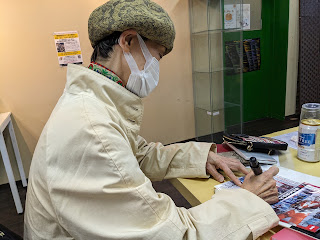 |
| Noriko Shishikura signs an Ultraman DVD sleeve. Photo by Brett Homenick. |
She also produced the Tsuburaya Productions TV series Star Wolf (1978), Nobuhiko Obayashi's Cute Devil (1982), Ultra Q: The Movie, and Ultraman Tiga (1996-97), though only with director Jissoji.
An even bigger surprise was meeting Miyanobu Inori, who worked on three Akira Kurosawa movies in the camera and electrical department. Inori-san had a few stories to share about his experiences.
On Dreams (1990), the staff had to create realistic-looking cherry blossoms. Kurosawa was pleased with the results and gave about one bottle per six staff members of White Horse, Kurosawa's favorite whiskey, for a job well done.
For the scene depicted on the poster of Rhapsody in August (1991), Inori-san was personally involved in putting film lights under the water to create the desired effect. (I didn't realize one would even do such a thing!)
Kurosawa liked shooting from far away with a zoom lens. On Madadayo (1993), there was an open set in Gotemba for a scene that took place right after the war. As you might imagine, it's difficult to light a scene from far away. They used a spotlight, with which the actors were fine. But Kurosawa didn't like it because it was too shiny and didn't look realistic.
A lot to write about, but that only scratches the surface! I had a great time today, and I must thank Tanaka-san for the invitation. It was truly remarkable!


