Showing posts with label Starman. Show all posts

Wednesday, December 4, 2024

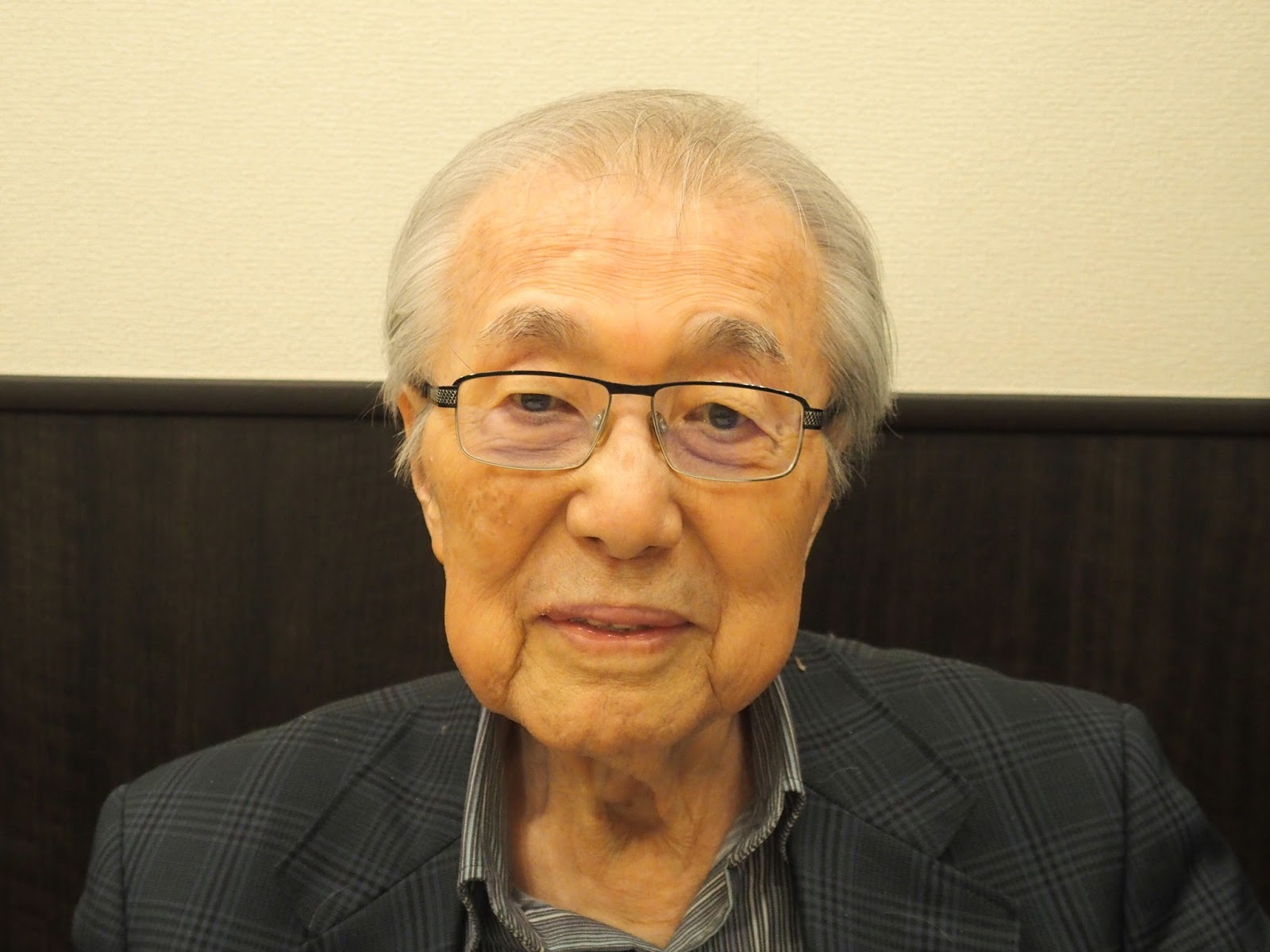
Eizo Yamagiwa, Director of Various Ultra-Shows, Passes Away at 92

Eizo Yamagiwa in July 2022. Photo by Brett Homenick.

Longtime Ultra-series director Eizo Yamagiwa passed away on November 28 at a Tokyo hospital from sepsis due to old age. A private funeral has already been held. He was 92. 

Born on July 22, 1932, Eizo Yamagiwa began his career in the film industry at Shintoho in the mid-1950s as an assistant director. During his time at the studio, he worked on the seventh entry in the Starman film series, Super Giant: The Space Mutant Appears (1958), which was one of the three Starman features that was eventually edited into the American release Evil Brain from Outer Space

Ultra-series alumni Shozo Uehara (left), Toshihiro Iijima (center), and Eizo Yamagiwa enjoy a chat in March 2016. Photo by Brett Homenick.

Yamagiwa-san also worked as an assistant director under Teruo Ishii at Shintoho before launching his career as a director of film and television. At Tsuburaya Productions, Yamagiwa-san directed episodes 15, 16, 17, 22, 23, 28, 29, 34, and 35 of Return of Ultraman (1971-72), episodes 3, 4, 9, 10, 15, 16, 21, 22, 28, 29, 38, and 39 of Ultraman Ace (1972-73), episodes 1, 2, 3, 10, 11, 14, 20, 21, 24, 25, 39, 40, 47, 48 (as well as episode 28 as special effects director) of Ultraman Taro (1973-74), and episodes 50 and 51 of Ultraman Leo (1974-75).

Mitsuhiro Sano, Keiji Takamine, Eizo Yamagiwa, and Shigemitsu Taguchi gather at an Ultraman Ace reunion in February 2019. Photo by Brett Homenick.

He also helmed episodes 3, 4, 14, and 15 of Silver Kamen (1971-72), episode 4 of Horror Theater Unbalance (1973), episodes 11 and 13 (as well as episode 11 as co-scriptwriter with Ei Ogawa) of Jekyll and Hyde (1973), and episodes 8, 9, 16, and 17 of the Submersion of Japan TV series (1974-75).

I first met Yamagiwa-san in March 2016 at a book-launch party for an Ultra Q (1966) tome. There were numerous luminaries in attendance from the world of tokusatsu, and Yamagiwa-san was among them. Even though I didn't know who he was at the time, Yamagiwa-san seemed surprised that an American was at the event, so he approached me. He gave me his business card, and, bowled over that he would come up and introduce himself to me, I asked that we take a picture together. Of course, it didn't take long for me to become familiar with Yamagiwa-san's work.

Eizo Yamagiwa in February 2019. Photo by Brett Homenick.

Over the years, we met several times at events and a couple of times on a personal level. In fact, a month after we first met, we went to a Chinese restaurant in Shibuya together and ate dinner. At that dinner, Yamagiwa-san signed and gave me a book about Return of Ultraman in which he participated as an interviewee. We also talked about various movies from around the world we enjoyed. One title I recall that Yamagiwa-san cited was 8 1/2 (1963). However, when I mentioned Ed Wood (1994), another movie about moviemaking, he wasn't familiar with it, which was to be expected.

Shigemitsu Taguchi (left), Eizo Yamagiwa (center), and Akihiko Iguchi gather to discuss their work on the '70s Ultra-series in November 2016. Photo by Brett Homenick.

As Yamagiwa-san got older, however, it became more and more difficult to meet up. I'd still catch him at an event here and there, but, when I would call him, we couldn't seem to get our schedules to match.

Eizo Yamagiwa interviewed at his home in November 2020. Photo by Brett Homenick.

In 2020, I began doing interviews again in a big way, and I was pleased that Yamagiwa-san agreed to do one with me. In fact, in the beginning, he wasn't sure he would participate at all. I guess he felt he'd given enough interviews on his work in the Ultra-series and wasn't too keen on doing any more. So he wanted to see a sample of the questions I wanted to ask before accepting.

With Eizo Yamagiwa in June 2018.

My translator mailed him the translated version of my questions, which covered a wide variety of topics, including his early life and his work at Shintoho, with the Starman series. It was apparently enough to get him to agree to the interview, as we conducted it just a few weeks later.

Eizo Yamagiwa next to his bookshelf in November 2020. Photo by Brett Homenick.

We did the interview at Yamagiwa-san's home in Eifuku. It was a fascinating history, and I'm very glad he shared it with me. I was especially interested in hearing about his work on the Starman series. In fact, after the interview, I told Yamagiwa-san how I first saw clips of the Starman movies on the old Muppet Babies cartoon show in America. I wanted to point out how the Starman movies became part of American pop culture in surprising ways. His reaction? I'll do my best at an exact quote from memory: "If that had been Japan, I would have tried to sue them." I guess my anecdote didn't go over very well.

Ultra-series veterans Susumu Kurobe (left), Mitsuko Hoshi (center), and Eizo Yamagiwa share the stage in June 2018. Photo by Brett Homenick.

My other memory from the interview is that Yamagiwa-san wanted his photo taken next to his bookshelf so that people could see his collection. I guess he was quite proud of it!

I last saw Yamagiwa-san at an event in July 2022. It was great to see him again there, and I finally was able to get him to sign something Starman-related. I had a DVD sleeve made from cardstock from an old Mill Creek 50-movie pack that included Evil Brain from Outer Space. I brought it for Yamagiwa-san to sign, and I told him it was the U.S. version of the Starman movie he worked on. I remember he did a great job of reading the U.S. title out loud from the DVD sleeve, which was fun to see.

After the event, I bumped into him again by chance as he was getting into a taxi as he was leaving. I said goodbye to him again as he entered the vehicle to go home. Little did I know I'd never see him in person again.

With Eizo Yamagiwa in November 2020.

To the best of my memory, I called him in May 2023, asking to meet up. He told me he was too old, so he had to decline my request. When I knew I was leaving Japan, I asked a mutual friend to try to arrange a meeting, hoping he would have better luck, but that didn't work, either. I wish I could have met him again before I left.

With Eizo Yamagiwa in July 2022.

Rest in peace, director. Your legacy in film lives on.

Monday, May 31, 2021

Eizo Yamagiwa Q&A Now Up at Vantage Point Interviews!

With Eizo Yamagiwa.

Another brand-new interview is now live at Vantage Point Interviews: my November 2020 Q&A with Tsuburaya Productions director Eizo Yamagiwa. Yamagiwa-san discusses his early life during World War II, as well as his start at Shintoho in the mid-1950s. At Shintoho, he worked on the seventh Starman actioner Super Giant: The Space Mutant Appears (1958), which was later edited into the cult classic Evil Brain from Outer Space.

At the end of the 1960s, Yamagiwa-san joined Tsuburaya Productions as a director, helming such TV programs as Return of Ultraman (1971-72), Ultraman Ace (1972-73), Ultraman Taro (1973-74), and Ultraman Leo (1974-75), among others. He also directed episodes of Silver Kamen (1971-72) and the Submersion of Japan TV series (1974-75). Yamagiwa-san discusses these productions and much more in our interview. 

With such incredible, in-depth interviews, Vantage Point Interviews continues to prove that content is king!

Tuesday, February 26, 2019

Chumei Watanabe Interview on VPI!

Composer Chumei Watanabe during his July 2018 interview. Photo by Brett Homenick.

My interview with Japanese film composer Chumei (a.k.a. Michiaki) Watanabe is now live at Vantage Point Interviews. Mr. Watanabe composed the scores for numerous Nobuo Nakagawa horror films at Shintoho in the 1950s and early '60s, as well as entries of the Starman (a.k.a. Super Giant) film series. At Daiei, Mr. Watanabe composed the scores for the yokai classics 100 Monsters (1968) and Along with Ghosts (1969). It's a Q&A full of history, so please enjoy.

Monday, September 24, 2018

NOBUO NAKAGAWA CELEBRATED! Attending a Special Event Honoring the Legendary Director!

Composer Chumei Watanabe answers questions during a Q&A. Photo by Brett Homenick.

On Sunday, September 23, I had the honor of attending a special event in Tokyo celebrating the career of director Nobuo Nakagawa. It was my first time to attend such an event, but I was really surprised at how impressive it was. There were quite a few luminaries on hand for the festivities -- much more than I expected.

Shinkichi Nakagawa, the son of director Nakagawa. Photo by Brett Homenick.

The event kicked off with a screening of Nakagawa's Ningyo Sashichi torimonocho: Oedo Ushimitsudoki (1957), which was scored by the event's guest of honor: 93-year-old composer Chumei Watanabe. I missed the film screening but arrived just in time for Watanabe-sensei's Q&A following the event.

With Shinkichi Nakagawa.

I was amazed when Watanabe-sensei mentioned my interview with him last July at the end of his interview session, during which he also discussed the interest his work has among many fans internationally. He's proud of the international following his work enjoys -- and rightfully so.

Actress Sumiko Abe. Photo by Brett Homenick. 

After Watanabe-sensei's interview, the group gathered in a nearby restaurant that had been reserved specifically for the event. The gathering was a veritable "who's who" of friends, family, and colleagues of director Nakagawa. I was quite surprised at just who was in attendance.

With actress Sumiko Abe.

The first person I was introduced to was the director's son, Shinkichi. I certainly wasn't expecting to meet him at the event! We exchanged greetings as well as business cards.

Director Masahisa Sakashita. Photo by Brett Homenick.

Also on hand was actress Sumiko Abe, whose credits are very impressive. She had just turned 88 years old on September 3, but you wouldn't have guessed it had you not already known. She was incredibly spry and in great spirits. Among her credits are: Toho's Love in a Teacup (1953), starring Toshiro Mifune and directed by Yasuki Chiba, Shintoho's The Depths (1957), directed by Nobuo Nakagawa, and Shochiku's Flag in the Mist (1965), directed by Yoji Yamada.

Akihide Tsuzawa. Photo by Brett Homenick. 

I also met Nikkatsu Studios veteran Masahisa Sakashita. While he worked his way up through Nikkatsu Studios during the 1970s, more recently he has worked as a freelance television director.

With Akihide Tsuzawa.

I also had a fun chat with actor Akihide Tsuzawa, best known for playing Hoshino on the original Ultraman (1966-67) TV series. I was pleased to find that Tsuzawa-san remembered me from our first meeting two years prior. He also called me cool, which coming from a veteran of the original Ultraman is quite a compliment. 

Chumei Watanabe. Photo by Brett Homenick. 

Suffice it to say, I met a lot more folks than I had ever anticipated. Toward the end of the event, while the MC was handing the microphone to the various special guests on hand, he offered me the microphone. I had no idea what to say, but I did my best to muster something. After saying a few things, I noticed Watanabe-sensei walking in my direction, so I handed him the mike. I was very thankful for his well timed assist!


What an afternoon! I elected to miss the latest Super Festival in order to attend, and I'm very glad I did. The more recent Super Festivals have been pretty lackluster (in my opinion, of course), but this event was anything but. One for the history books, for sure!

Sunday, July 8, 2018

Interviewing Chumei Watanabe

Composer Chumei Watanabe during our July 4 interview. Photo by Brett Homenick.

I'm pleased to announce that on Wednesday, July 4, I had the privilege of interviewing legendary composer Chumei Watanabe at his home in Tokyo. Watananbe-san began his film-composing career at Shintoho in the late 1950s, working on several Nobuo Nakagawa films, most notably Ghost of Yotsuya (1959) and Hell (1960). Watanabe-san returned to tokusatsu in the late 1960s with his scores to 100 Monsters (1968) and Along with Ghosts (1969). Watanabe-san would later achieve international fame with his scores to various anime and live-action tokusatsu TV programs. The 92-year-old composer stays busy to this day.

The interview lasted several hours and focused a great deal on his early years. I certainly learned a lot, and once it's published, so will you! Stay tuned.

Sunday, May 13, 2018

An Audience with Film Composer Chumei Watanabe

Chumei Watanabe. Photo by Brett Homenick.

On Saturday night, May 12, I was fortunate to get invited to another private gathering with legendary composer Chumei Watanabe. While his music for TV tokusatsu and anime programs are famous around the world, I'm much more familiar with his film compositions, which date back to the 1950s. Among his credits are: Shintoho's Starman (a.k.a. Super Giant) series, Black Cat Mansion (1958), Ghost of Yotsuya (1959), Hell (1960), Daiei's 100 Monsters (1968), and Along with Ghosts (1969).


Watanabe-san is a spry 92 years old, and he's just about as active as anyone half his age. The discussion covered a wide range of subjects, not just film music. Suffice it to say, it was a very enjoyable evening.

Sunday, November 12, 2017

AN EVENING WITH CHUMEI WATANABE! The Great Film Composer Meets His Fans!

Chumei Watanabe. Photo by Brett Homenick. 

Tonight, I had the privilege of spending the day with film and TV composer Chumei Watanabe (whose real name is Michiaki Watanabe) at a private gathering. Among Watanabe-san's film compsitions are: several entries of the Starman (a.k.a. Super Giant) series, Black Cat Mansion (1958), Ghost of Yotsuya (1959), Hell (1960), 100 Monsters (1968), and Along with Ghosts (1969). However, Watanabe-san is much more famous for his anime and TV tokusatsu scores, which are too numerous to list here. Film also composing runs in his family, as his son is Toshiyuki Watanabe, the composer for the '90s Mothra trilogy.


Watanabe-san began his film composing career at Shintoho in 1956, and at age 92 years old, he is still active writing music to this day. Watanabe-san was curious about American culture and how tokusatsu movies and TV programs are received in the West, and naturally I was happy to answer his questions.

Suffice it to say, it was a great evening!

Thursday, June 8, 2017

STARMAN FIGHTS THE INVADERS! Shintoho's Superhero Flies into Shibuya!

Poster art for Shintoho's Invaders from Space. Photo by Brett Homenick.

Tonight, I returned to Shibuya Cinemavera to catch a screening of the two-part Starman movie known in the U.S. as Invaders from Space (1957). The two-parter was released to television in the U.S. in the mid-1960s, well after its theatrical run in Japan. 

Unfortunately, the screening was digital (i.e., not a film print). That said, the picture quality wasn't bad, and it exceeded my (admittedly low) expectations. I haven't watched a Starman movie in many years, so I'd forgotten much of the action.

All in all, it was fun stuff. Great to revisit Starman after so many years!

Friday, March 14, 2014

SO LONG, STARMAN! Ken Utsui: 1931-2014

Actor Ken Utsui goes where Superman never dared in Shintoho's Starman series.

Starman actor Ken Utsui passed away on March 14, 2014, of chronic respiratory failure. He was 82. Although Utsui was a prolific actor for many decades, he is best known in the United States as Starman (a.k.a. Super Giant), the Shintoho superhero who fought a bevy of outlandish creatures in the late 1950s.

Rest in peace, Utsui-san.