Showing posts with label Akio Jissoji. Show all posts

Friday, July 17, 2026

An Evening of Song and Dance in Tokyo!

Yumi Yoshiyuki. Photo by Brett Homenick.

On Wednesday night, July 15, I attended a singing performance by director-actress Yumi Yoshiyuki, with whose work I am not too familiar, but I certainly hope to change that very soon. But who is Yumi Yoshiyuki, you might be asking yourself?


Yoshiyuki-san has directed numerous pink eiga since the 1990s but has also appeared onscreen herself in countless roles, including director Akio Jissoji's adaptation of an Edogawa Rampo story, Murder on D Street (1998), for which she won the Best Supporting Actress Award from the Yokohama Film Festival for her portrayal of Tokiko Sunaga, as well as playing Noriko Murakami in Takashi Shimizu's V-cinema horror classic Ju-On: The Curse (2000). She can also be seen in episode 40 of Ultraman Tiga (1996-97) and episode 37 of Ultraman Dyna (1997-98).


Yoshiyuki-san didn't know me from Adam when I arrived, but she invited me to sit next to her, which I did for the next two hours. I got to know her during the evening, and we had a fun chat after the show. I most definitely look forward to seeing her again!

Saturday, March 23, 2024

Actor Minori Terada, Veteran of Toho and Tsuburaya Productions, Passes Away at Age 81

Minori Terada in February 2020. Photo by Brett Homenick.

Actor Minori Terada, a prolific performer whose acting career dates back to 1961 and continued into the current year, passed away on March 14 due to lung cancer, his agency, CES Entertainment, has announced. He was 81.

Minori Terada in August 2019. Photo by Brett Homenick.

Born on November 7, 1942, Terada would join the theater company Bungakuza in 1961 and began performing onstage. By the mid-1960s, he started acting in movies, embarking on a decades-long career that saw him collaborate with some of Japan's most talented directors.


Terada stars in Kihachi Okamoto's The Human Bullet (1968) as "Him," but he is also known for his supporting parts in such films as Okamoto's Red Lion (1969), Zatoichi and Yojimbo (1970), Battle of Okinawa (1971), Station (1981), Hayao Miyazaki's Castle in the Sky (1986), Akio Jissoji's Tokyo: The Last Megalopolis (1988), and Ultra Q: The Movie (1990). On TV, he guest-starred in Ultraman (1966-67) episode 14 as the truck driver's assistant.


I was privileged to meet Mr. Terada twice. I remember that he wanted to talk to me about Akira Kurosawa movies, as well as the works of other Japanese directors. He was quite friendly and seemed genuinely interested in knowing my opinions. My second meeting with Terada-san is also notable because it was one of the last ones before the COVID-19 lockdowns started in Japan.


With his passing, Minori Terada leaves behind a body of work that few actors could hope to match. Rest in peace, and thank you very much for the decades of entertainment.

Sunday, March 17, 2024

Celebrating an American Classic with Three Tsuburaya Productions Legends!

Masao Nakabori. Photo by Brett Homenick.

Today (Sunday, March 17), I received a very kind invitation from former Tsuburaya Productions script supervisor Atsuko Tanaka to join a special event in Jimbocho. The topic of the event was a breakdown of the various film techniques used to create Citizen Kane (1941), hosted by Japanese cinematographer Masao Nakabori. 

What made this invitation special in particular is that she offered to meet me about 40 minutes before the start of the event so that we could spend some time together prior to the event. She also invited me to the after-party, which was even more generous of her. But, as it turned out, that wasn't all.

Atsuko Tanaka. Photo by Brett Homenick.

She told me that another Tsuburaya Productions script supervisor, Noriko Shishikura (a.k.a. Noriko Suzuki) would be joining her. Shishikura-san doesn't do many appearances at events in Japan, and I'm not aware of her appearing at any other gathering. Suffice it to say, it was a rare opportunity!

Miyanobu Inori. Photo by Brett Homenick.

First, let's take a closer look at the day's VIPs. Atsuko Tanaka is a former Tsuburaya Productions scripter (known these days as a script supervisor), who worked on Ultra Q (1966), Ultraman (1966-67), Ultra Seven (1967-68), The Space Giants (1966-67), and Kaiju Booska (1966-67). In fact, when I showed her my Kaiju Booska DVD sleeve for her to sign, she was quite amused by it.

With Noriko Shishikura.

Masao Nakabori is a cinematographer whose credits include UltramanUltra SevenOperation: Mystery! (1968-69), Silver Kamen (1971-72), and Ultraman Taro (1973-74). On the big screen, Mr. Nakabori frequently collaborated with director Akio Jissoji, including the films Tokyo: The Last Megalopolis (1988) and Ultra Q: The Movie (1990).


Noriko Shishikura (born in 1937) has worn many hats in the Japanese film and television industry, having worked at different times as a scripter, screenwriter, director, and a producer. She was formerly married to Ultra-series director Toshitsugu Suzuki.

Atsuko Tanaka signs a Kaiju Booska DVD sleeve. Photo by Brett Homenick.

As a scripter, Shishikura-san has worked on Ultra QUltramanUltra SevenSilver KamenTokyo: The Last Megalopolis, and a bevy of Nikkatsu films from the 1960s, going as far back as 1961. After that, she directed Ultraman: Great Monster Decisive Battle (1979), which is essentially a clip show of previous Ultraman episodes with some new footage edited into it.
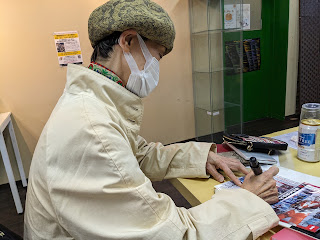
Noriko Shishikura signs an Ultraman DVD sleeve. Photo by Brett Homenick.

She also produced the Tsuburaya Productions TV series Star Wolf (1978), Nobuhiko Obayashi's Cute Devil (1982), Ultra Q: The Movie, and Ultraman Tiga (1996-97), though only with director Jissoji.


An even bigger surprise was meeting Miyanobu Inori, who worked on three Akira Kurosawa movies in the camera and electrical department. Inori-san had a few stories to share about his experiences. 

On Dreams (1990), the staff had to create realistic-looking cherry blossoms. Kurosawa was pleased with the results and gave about one bottle per six staff members of White Horse, Kurosawa's favorite whiskey, for a job well done.


For the scene depicted on the poster of Rhapsody in August (1991), Inori-san was personally involved in putting film lights under the water to create the desired effect. (I didn't realize one would even do such a thing!)

Kurosawa liked shooting from far away with a zoom lens. On Madadayo (1993), there was an open set in Gotemba for a scene that took place right after the war. As you might imagine, it's difficult to light a scene from far away. They used a spotlight, with which the actors were fine. But Kurosawa didn't like it because it was too shiny and didn't look realistic.

A lot to write about, but that only scratches the surface! I had a great time today, and I must thank Tanaka-san for the invitation. It was truly remarkable!

Friday, May 27, 2022

Ultra-Series Director Akio Jissoji Celebrated in Kawasaki!

Akio Jissoji celebrated at the movie theater Cinecitta in Kawasaki! Photo by Brett Homenick.

Last night, I went to a movie theater in Kawasaki, Kanagawa Prefecture, called Cinecitta in order to attend a special event honoring Ultra-series director Akio Jissoji. Episodes 15 and 23 of Ultraman (1966-67), both directed by Jissoji, were screened, as was a brand-new documentary about his career (featuring interviews with the likes of Bin Furuya, Hiroko Sakurai, Sandayu Dokumamushi, Toshihiro Iijima, and many others). After the documentary, actor Minori Terada (who appears in episode 14 of Ultraman) and veteran cameraman Masao Nakabori held an in-person Q&A about Jissoji.

Out in the hallway was a corner featuring several bits of memorabilia related to Jissoji's work on the Ultra-series. In particular, the French-inscribed Jamila plate from the last scene of Ultraman episode 23 ("My Home Is Earth") was on display, along with the French inscription as it appeared on the last page of the shooting script. Other scripts, storyboard drawings, and props were on display, as well. Below are a few of the photos I took of the gallery. Enjoy!


Monday, May 31, 2021

Masao Nakabori Q&A Now on Vantage Point Interviews!

With Masao Nakabori in June 2019.

My September 2019 interview with tokusatsu cinematographer Masao Nakabori has finally been completed and is now available at Vantage Point Interviews. In the interview, Nakabori-san talks about his work on the classic tokusatsu series Ultraman (1966-67), Ultra Seven (1967-68), Operation: Mystery! (1968-69), Silver Kamen (1971-72), and Ultraman Taro (1973-74), as well as his big-screen collaborations with famed director Akio Jissoji, including the films Tokyo: The Last Megalopolis (1988) and Ultra Q: The Movie (1990). 

The interview covers a lot of territory that you usually don't get to read about in English. Don't miss out!

Sunday, February 9, 2020

The Human Bullet Returns!

Minori Terada. Photo by Brett Homenick. 

Today, I attended a 35mm screening of the erotic drama Love Hotel (1985), a fairly well regarded film directed by the late Shinji Somai. I went into the film not knowing what to expect, but I have to admit that it left me cold. I just wasn't that impressed by what I saw, despite a few satisfying scenes. But I guess they can't all be winners.


Love Hotel stars Minori Terada, so it ought to come as no surprise that he was the evening's guest of honor. Terada-san stars in Kihachi Okamoto's The Human Bullet (1968), but he is also known for his supporting parts in such films as Okamoto's Red Lion (1969), Station (1981), Hayao Miyazaki's Castle in the Sky (1986), Akio Jissoji's Tokyo: The Last Megalopolis (1988), and Ultra Q: The Movie (1990). On TV, he guest-starred in Ultraman (1966-67) episode 14 as the assistant truck driver.


I met Terada-san last August for the first time, and given his resume in the world of cinema, I welcomed the chance to meet him again. During the evening, he gave out fliers for a concert devoted to the films of Akio Jissoji that will take place later this month. I'm not sure yet if I will attend, but I'll certainly give it some thought.

A great time was had by all, and I must thank Terada-san for being such a cool guest.

Sunday, August 4, 2019

THE HUMAN BULLET! An Evening in the Company of Minori Terada!

Minori Terada. Photo by Brett Homenick.

Today, I had the distinct privilege of meeting actor Minori Terada. Terada-san stars in Kihachi Okamoto's The Human Bullet (1968), but he is also known for his supporting parts in such films as Okamoto's Red Lion (1969), Station (1981), Hayao Miyazaki's Castle in the Sky (1986), Akio Jissoji's Tokyo: The Last Megalopolis (1988), and Ultra Q: The Movie (1990). On TV, he guest-starred in Ultraman (1966-67) episode 14 as the assistant truck driver.


Terada-san was a lot of fun to talk to. We spoke about Akira Kurosawa movies and Japanese movies in general. Suffice it to say, his acting resume is extremely impressive, so there was no shortage of topics to discuss.

Saturday, December 8, 2018

An Ultra-Good Evening!

From left to right: Masao Nakabori, Sojiro Uchino, and Hiroko Sakurai. Photo by Brett Homenick.

On Friday, December 7, I attended a follow-up event that likewise focused on the late director Akio Jissoji. Cinematographer Masao Nakabori returned to the event, as did former child actor Sojiro Uchino, who appeared in episodes of Ultra Q (1966) and Ultraman (1966-67). Uchino-san was directed by Akio Jissoji in episode 15 of Ultraman. Headlining the event was actress Hiroko Sakurai, who starred as Yuriko Edogawa in Ultra Q and Akiko Fuji in Ultraman.

Sojiro Uchino holds up the box for a limited-edition Akio Jissoji figure. Photo by Brett Homenick.

During the Q&A session, I was most interested in hearing Sakurai-san talk about becoming a Toho actress, which is a part of her career so often glossed over in interviews and articles about her career. Naturally, the conversation quickly moved on to Ultra-related topics, particularly her work with Akio Jissoji.

Between Masao Nakabori and Hiroko Sakurai.

Sakurai-san was very friendly and approachable as usual, and despite not having seen her in about two years, she remembered me from our previous encounters at various events. As expected, the event was at capacity to her presence, but she made sure everyone in attendance got what they needed. She's a true pro and a class act.

Sunday, December 2, 2018

An Evening with Tsuburaya Productions Alumni!

In between actor Koji Shimizu (left) and cinematographer Masao Nakabori. 

Earlier this evening, I attended a special celebration of the late director Akio Jissoji, whose work spanned everything from the Ultra-series to the big-budget fantasy Tokyo: The Last Megalopolis (1988).

Masao Nakabori. Photo by Brett Homenick. 

Masao Nakabori is a noted cameraman whose career dates back to the glory days of Tsuburaya Productions, including Ultra Seven (1967-68) and Ultraman Taro (1973-74). His other credits include Silver Kamen (1971-72), Tokyo: The Last MegalopolisUltra Q: The Movie (1990), and Hirokazu Koreeda's Maborosi (1995).


Nakabori-san is a true genre legend, and I was privileged to meet him. I was pleased to find that he was approachable and eager to talk about his work. I was particularly interested in hearing about his commercial work with Akio Jissoji on Nikka from the Barrel commercials.

Koji Shimizu. Photo by Brett Homenick. 

Also on hand was Koji Shimizu. Shimizu-san played the villainous Mushitaro Kuri in episode 4 of Ultraman Ace (1972-73), one of my favorite episodes of any of the Ultra-series. He also played Katsusuke Atobe in Akira Kurosawa's Kagemusha (1980) and Isao Akiba in Godzilla: Tokyo S.O.S. (2003). On TV, he was a regular on the Super Sentai series Choushinsei Flashman (1986-87), portraying the evil Great Doctor Lie Köpflen.


I spent much more of the evening in Nakabori-san's company, but I certainly enjoyed my encounter with Shimizu-san. I first saw his guest appearance on Ultraman Ace in 2005, and it's a performance I've always remembered. I'm glad to have had a chance to tell Shimizu-san how much I enjoyed it.