Showing posts with label Toei. Show all posts

Thursday, March 5, 2026

Seeing 'The Street Fighter' at the Theater!

A poster for The Street Fighter (1974) at Shin Bungeiza. Photo by Brett Homenick.

"The Cherokee fists of Sonny Chiba!" -- a quote certainly not used during this TV spot for Roaring Fire (1981)

On Thursday, March 5, I returned to the Shin Bungeiza theater to catch a screening of The Street Fighter (1974), the notorious Sonny Chiba actioner with some outlandish fight scenes. The presentation was clearly not a 35mm print, but whether it was 4K specifically is unknown to me. Unquestionably, however, it was a DCP, and it looked quite good. 

I first saw The Street Fighter in the fall of 2001 when I found it on the Diamond Entertainment double pack with Return of the Street Fighter (1974). I liked the movie and often revisited parts of it at the time, but I don't believe I ever sat down and watched the whole thing again in its entirety until about two years ago when I finally watched it again on DVD. There's a reason for that.

While the movie has genuine moments of bonkers brilliance, it can really drag the rest of the time. This screening only reconfirmed my view. Essentially, whenever Sonny Chiba is offscreen, the movie can become a bit of a chore. By no means is it horrible, but I guess you'd expect a bit more from a movie with this reputation.

The audience I saw the movie with was mostly silent, but there was a smattering of guffaws in the audience when Chiba gets his revenge on Chico Lourant. (If you know, you know.)

About two years ago, I read a post by some goofball on Twitter, who was asserting (without evidence, of course) that The Street Fighter was somehow an inspiration for Godzilla vs. Mechagodzilla (1974). In particular, the guy stated that Godzilla does "Chiba's chi redistribution pose" (his words, not mine) somewhere in the film. The only problem here is, the two movies were released about a month apart in Japan, making any similarities between the two about as purely coincidental as it gets. When I read nonsense like this, I wish genre research were based less on connecting dots and making assumptions and based more on, well, research.  

Overall, it was a fun experience, and, when I saw that they were showing The Street Fighter, I made sure to attend. The movie is good, but it wished it flowed much better than it does. 

Wednesday, March 4, 2026

Seeing 'The Ninja Hunt' in Ikebukuro!

The Ninja Hunt (1964) at the Shin Bungeiza. Photo by Brett Homenick.

On March 4, I saw a screening of the Toei actioner The Ninja Hunt (1964) at Ikeburkuro's Shin Bungeiza theater. Not only had I not seen this one before, I'm not sure I'd seen any Toei ninja film from this era, so I was particularly curious to see how I'd like it.

Overall, the movie is pretty good, but it's nothing too extraordinary. It's a typical action programmer that doesn't have huge ambitions beyond telling a simple story and delivering some excitement. The movie did surprise me, however, in just how explicit it was. It's very violent, especially by the standards of the time. Several characters experience Lucio Fulci-style eye trauma, and, even more shockingly, there's a teaspoon of nudity. (It's brief and semi-hidden, but you can definitely see it.)

The 35mm print was kind of rough in parts, but it was very watchable. Despite being made in 1964, it looks like it could have been shot 10 years earlier. I'm not sure if that was a film stock issue, but the movie looked much creakier and more antiquated than its year of production would suggest. 

The Ninja Hunt was a decent watch. Its bad guys were certainly bad, so you will likely find yourself rooting for their demise by the end. I look forward to seeing other offerings at this theater very soon!

Thursday, December 4, 2025

Toei Actress Yutaka Nakajima from the Grindhouse Classic 'The Street Fighter' Passes Away at 73

Yutaka Nakajima in November 2019. Photo by Brett Homenick.

Veteran Toei actress Yutaka Nakajima (sometimes credited as Doris Nakajima in the West) passed away at her Kanagawa Prefecture home on November 27 after a years-long struggle with colon cancer. She was 73. 

Born on October 5, 1952, Ms. Nakajima co-stars alongside Sonny Chiba in The Street Fighter (1974) as Sarai Chuayut. She also can be seen in Teruo Ishii's The Executioner (1974) and The Executioner 2 (1974) as Emi, The Killing Machine (1975) as Kiku Sakamoto, and Detonation! Violent Games (1976) as Akemi.

Photo by Brett Homenick.

Ms. Nakajima's other credits include Kazuki Omori's Orange Road Express (1978), Toru Murakawa's The Resurrection of the Golden Wolf (1979), Haruki Kadokawa's The Last Hero (1982), and the J-horror shocker Tomie: Re-birth (2001) as Tomoko Hosoda.


I was able to meet Ms. Nakajima at an event in November 2019, Unfortunately, I don't have any particular memories from the meeting, other than the fact that she was pleasant and polite. I ended up reaching out to her management in early 2024, prior to my leaving Tokyo, to request an interview but never heard back. Considering that she had been diagnosed with colon cancer circa 2022, that's not a surprise.


The Street Fighter remains one of the most popular exploitation movies of the '70s, and Yutaka Nakajima played a substantial role in making that film the enduring success that it is. May she rest in peace.

Saturday, June 14, 2025

Fumio Ishimori, Writer of 'Kamen Rider,' 'Zone Fighter,' and 'Ultraman Ace,' Passes Away at 93

Fumio Ishmimori with a Zone Fighter DVD in April 2017. Photo by Brett Homenick.

According to his official Facebook page, screenwriter Fumio Ishimori (sometimes credited as Shiro Ishimori) passed away on June 9. He was 93.

Born on July 31, 1931, Mr. Ishimori began his screenwriting career in the early 1960s, primarily working for Nikkatsu Studios during most of the 1960s, before transitioning to Shochiku before the end of the decade.

With Fumio Ishimori in April 2017.

In total, Mr. Ishimori wrote more than 70 movie screenplays, penning the scripts for the films Fearless Comrades (1966), A Warm Misty Night (1967), Toshio Masuda’s Monument to the Girl’s Corps (1968), The Rendezvous (1972), Journey into Solitude (1972), Toho’s Horror of the Wolf (1973), Galaxy Express 999 (1979), and Nobuhiko Obayashi’s The Rocking Horsemen (1992).

Fumio Ishimori stands outside a theater in Asakusa where a play he had written was performed in September 2016. Photo by Brett Homenick.

In terms of TV tokusatsu, he wrote Kamen Rider (1971-73) episodes 47, 50, 76, 83, 89, and 90, Ultraman Ace (1972-73) episodes 37 and 44, and Zone Fighter (1973) episode 20 (under the pen name Shiro Ishimori).

But his tokusatsu connections run even deeper — his maternal cousin was famed manga artist Shotaro Ishinomori. 

Fumio Ishimori in Asakusa after his play was performed in January 2020. Photo by Brett Homenick.

In November 2020, I had the distinct privilege of interviewing Mr. Ishimori about his prolific screenwriting career. I had come to respect and admire Mr. Ishimori since our first meeting in early 2016 that I was determined to share his story in English with the rest of the world. Mr. Ishimori was, without a doubt, one of the kindest gentlemen I met while I was in Japan. 

With Fumio Ishimori in October 2020.

As he got older, he became much less active, and I never met him again after we completed our interview. Mr. Ishimori stopped going out, although he continued to offer screenwriting lectures via Zoom. I wanted to meet him one last time before leaving Japan, but it was sadly not to be. I'm pleased that I was able to record Mr. Ishimori's screenwriting memories in my interview with him.

Rest in peace, Ishimori-sensei. Thank you for your kindness.

Saturday, September 21, 2024

'Green Slime' Actor Jack Morris Passes Away at Age 84

Jack Morris (right) poses with Robert Horton. Photo courtesy of Jack Morris. The Green Slime © 1968, Toei Co., Ltd.

According to a longtime friend of the actor, Jack Morris, who appeared as Lt. Morris in the made-in-Japan cult classic The Green Slime (1968), passed away last night, September 20. He was 84.

John Robert Morris was born on April 29, 1940, in Winnipeg, Manitoba, Canada. Mr. Morris moved to Japan in 1967 and eventually returned to Canada in 1972. Mr. Morris spoke extensively about his memories making The Green Slime in my 2021 interview with him, which you can find here.

He is survived by his wife Kyoko, as well as his children James, John, and Mika. 

Rest in peace to a friendly gentleman. Sincere condolences to Mr. Morris' family and friends.

Thursday, July 4, 2024

Actor Makoto Akatsuka, Who Appeared in the Ultraman and Kamen Rider Series, Passes Away at Age 73

Makoto Akatsuka in November 2022. Photo by Brett Homenick.

Film and television actor Makoto Akatsuka passed away on July 4 at a hospital in Ibaraki Prefecture of esophageal cancer. He was 73.

Mr. Akatsuka, who was born on March 19, 1951, began his professional film career in 1967 with Toho, playing youthful character in a variety of productions. He plays Sangoro in the film Double Suicide (1969), Mamoru Watanabe in Wet Sand in August (1971), Chuji Saito in Yoji Yamada's The Village (1975), the grandson in the Tora-san film Tora's Pure Love (1976), a chimpira in The Yellow Handkerchief (1977), Otomatsu Kawase in Nomugi Pass (1979), Makoto in Tora-san Goes North (1987), a policeman in Tora-san Makes Excuses (1992), and Yazaki in the Oscar-nominated The Twilight Samurai (2002).


On television, he appears uncredited in episode 12 of Ultraman Ace (1972-73), episode 11 of Jekyll and Hyde (1973) as a toy factory worker, Fight! Dragon (1974) as Kojiro Musashi, the all-star TV movie Tokyo Earthquake Magnitude 8.1 (1980) as Hiroshi Sakaki, episode 28 of Kamen Rider Black (1987-88) as Tsunekichi Koyama, and Kamen Rider Black RX (1988-89) as the recurring character Shunkichi Sahara.

I met Mr. Akatsuka only once in November 2022. It was after a stage performance in Daikanyama, Tokyo. I approached him after the show to introduce myself and mentioned my interest in tokusatsu productions, specifically mentioning Ultraman Ace. He was very kind, and I enjoyed meeting him.

His acting resume was impressive enough that I did consider reaching out to him for an interview, but, given his recent health issues, it probably wasn't very likely, anyway. I'm sure he had many fascinating stories to tell.

Rest in peace, Mr. Akatsuka.

Monday, March 25, 2024

ONE YEAR LATER! Hanging Out with Yamamoto-san Again in Koenji!

Hiroshi Yamamoto. Photo by Brett Homenick.

Today (Monday, March 25), I was pleased to spend a couple of hours with Hiroshi Yamamoto. We met up near his home in Koenji and went to cafe to have a lengthy discussion about his career in the entertainment industry. Back in April of 2023, we hung out again for the first time in about eight years, so I'm glad we managed to get together before another eight years had passed.

Hiroshi Yamamoto poses with a VHS copy of Gamera Super Monster (1980) from his personal collection. Photo by Brett Homenick.

Yamamoto-san and I first met at an event for the late Sonny Chiba in April 2013 and have kept in touch on and off since then. Yamamoto-san worked in the post-production end of numerous tokusatsu productions, both on film and television, from the late 1970s through the early '90s.


Of particular note, Yamamoto-san has worked with director Kinji Fukasaku on projects like Message from Space (1978), Samurai Reincarnation (1981), and Legend of the Eight Samurai (1983). Some of his other credits include Gamera Super Monster (1980), G.I. Samurai (1979), and numerous Toei superhero programs, lending those projects his company's expertise in video techniques.


One interesting tidbit I learned was that Yamamoto-san is especially proud of his work on Samurai Reincarnation, and it's his favorite of his own work. I've never seen that film, so now I've got to check it out.

Before we parted ways, Yamamoto-san gave me a VHS copy of the live-action tokusatsu actioner 8 Man (1992), on which he worked as a producer. Yamamoto-san insisted I take it, and, since he has another copy at home, I felt it was OK to accept. 

It was a great afternoon with a wonderful gent. I hope we'll get a chance to hang out again someday.

Tuesday, March 19, 2024

THE NAGASAWA FILTRATION PLANT REVISITED! A Filming Location for Many Tokusatsu Productions!

The Nagasawa Filtration Plant. Photo by Brett Homenick.

Today (Tuesday, March 19), I braved heavy winds to pay another visit to the Nagasawa Filtration Plant (a.k.a. the Nagasawa Purification Plant) in Kawasaki, Kanagawa. This particular building was used as a filming location for countless tokusatsu movies and TV programs dating back to the early 1960s.

Among other titles, it has been featured in Invasion of the Neptune Men (1961), Gorath (1962), episode 2 of Ultraman (1966-67), the Super Sentai series, and perhaps most famously as Jounan University's Institute of Biochemistry in Kamen Rider (1971-73).

I last visited the plant back in March 2016. Hard to believe it's been eight years, but there you go. At any rate, I clearly remember that you aren't allowed to get too close to the building without prior approval (such as joining an official tour of the facility), so I made sure to stay outside the gate. 

Still, as tokusatsu buffs, we're more concerned with the outside of the building than the inside since that's what we saw in our favorite flicks. It was great to see the plant again after so long. It isn't exactly the easiest spot to visit since it's quite far from any train station, which is the main reason it's taken me so long to return, but it's well worth seeing if you have the chance. Here are my snapshots from earlier today. Enjoy! 


Thursday, January 25, 2024

Revisiting Dracula's Former Abode in Tokyo!

The entrance to Kyu-Furukawa Gardens. Photo by Brett Homenick.

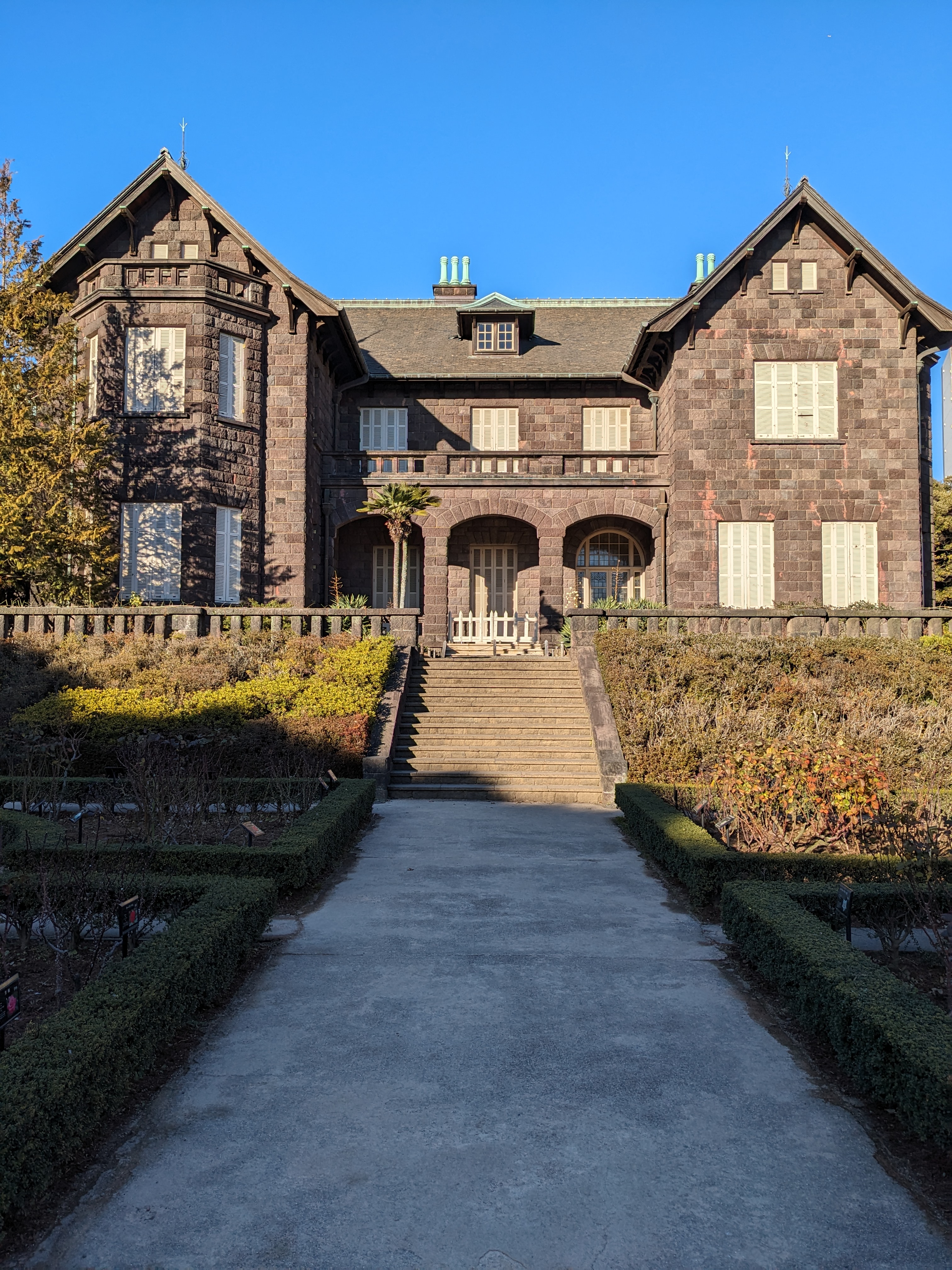
Today (Thursday, January 25), I braved freezing temperatures and strong winds to pay another visit to Kyu-Furukawa Gardens in Kita, Tokyo. I go into more details about the location here, but, suffice it to say, it has been used as a filming location for a number of movies -- most notably Evil of Dracula (1974). 

What I wasn't expecting was that the Western-style house on the property, which of course is the filming location in question, would be under renovation. Still, it was a rather unique sight to behold, so it was interesting to see. (You can see those photos below.) A staff member I spoke with told me the renovations will be going on until March, so maybe I'll return around that time to see the finished renovations. I guess we'll see how that goes.

Until then, here's what I saw today. Enjoy!