Showing posts with label Godzilla vs. Hedorah. Show all posts

Monday, August 18, 2025

DEEP DIVE: Why Did Godzilla Series Screenwriter Kaoru Mabuchi Sour on Toho Kaiju Films?

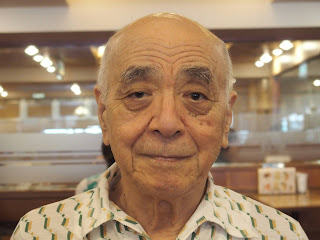
The only known photo of Kaoru Mabuchi.

Kaoru Mabuchi (1911-1987) was one of Toho's most important and prolific screenwriters during the Showa era, and he remains one of its most enigmatic figures. Under the pen name Takeshi Kimura, Mabuchi wrote or co-wrote a number of Toho's best and most successful tokusatsu productions, including Rodan (1956), The Mysterians (1957), The H-Man (1958), The Human Vapor (1960), The Last War (1961), Gorath (1962), and Matango (1963).

Under his given name, Mabuchi wrote or co-wrote a number of entertaining kaiju films, such as Frankenstein Conquers the World (1965), The War of the Gargantuas (1966), King Kong Escapes (1967), Destroy All Monsters (1968), and Godzilla vs. the Smog Monster (1971).

The reason Mabuchi stopped writing under his pen name and began writing scripts under his real name (while seeming to lose his motivation for the genre) has remained a mystery for decades, but perhaps we have an answer. Let's explore.

Yoshimitsu Banno in July 2016. Photo by Brett Homenick.

According to Yoshimitsu Banno, who co-wrote the screenplay for Godzilla vs. the Smog Monster with the celebrated Toho scriptwriter, Mabuchi revealed the reason to him. As the story goes, during the production of Matango, director Ishiro Honda cut the film's pre-title sequence in accordance with producer Tomoyuki Tanaka's wishes, despite Mabuchi's protests to keep it intact. Mabuchi argued the sequence was too important to cut, but his pleas ultimately fell on deaf ears. After getting overruled, Mabuchi gave up, and he never wrote another pure science-fiction movie for the studio.

Banno's own experience with the screenwriter was likely even more volatile than what Honda encountered. In spite of Mabuchi's mercurial personality, however, the two managed to hammer out a screenplay for Smog Monster that not only satisfied Banno but still entertains audiences around the world more than 50 years later. Based on Banno's descriptions of events, here's how the process went.

Just before the end of Expo '70, producer Tanaka showed Banno a copy of Mabuchi's first draft of Godzilla vs. the Smog Monster. Banno was shocked at the lack of quality of the script, labeling it "terrible" and "not interesting at all." 

Nakasendo station Magome-juku (located in Nakatsugawa, Gifu Prefecture) in June 2013, which is where Banno completely rewrote Mabuchi's first draft. It proved the perfect location to find inspiration for a story featuring hallucinating hippies. Photo by Brett Homenick.

Completely unsatisfied with Mabuchi's efforts, Banno decided to rewrite the screenplay from scratch. After the conclusion of Expo '70, Banno traveled along Nakasendo via Nagoya by car, stopping at Magome-juku in Nakatsugawa, Gifu Prefecture, to overhaul the script in a hotel by himself. 

Following that rewrite, with the approval of producer Tanaka, Banno and Mabuchi stayed at a cheap, remote hotel in Nagano Prefecture for a week to revise the script together. It was during this time that Banno and Mabuchi had a conversation that revealed Mabuchi's lack of enthusiasm and motivation. According to Banno, the conversation went like this:
“Why did you write such a boring story?”
“I was cutting corners.”
“What do you mean by that?”
After the two started speaking honestly and directly, Mabuchi explained, "I've worked on several projects with new directors, but they all failed. I figured this one would fail, too, so I just wrote it off lightly."
 
Yoshimitsu Banno signs a Godzilla vs. Hedorah (1971) DVD sleeve in August 2012. Photo by Brett Homenick.

Banno saw this project as a once-in-a-lifetime opportunity, so cutting corners wasn't an option for him. Banno spoke to Mabuchi about his determination to make Smog Monster a success, after which Mabuchi became properly motivated to work on it. It was no easy task, however, as Banno recalled that it took "heated debates and thorough discussions" to make it so. Banno continues:

Once that happened, Mr. Mabuchi proved to be highly logical, meticulous, and careful in his writing, which was both reliable and engaging. 

But the writing process moved slowly. Banno provides this example to illustrate:
For the scene in which the main character, [Dr. Toru] Yano, is attacked by Hedorah underwater, I had diving experience, so I continued writing quickly. When Mabuchi saw this, he angrily shouted, "If you're going to write it alone, I'm going home!" [I replied,] "Please wait!"
Banno was able to calm Mabuchi down, and the pair successfully completed the screenplay.

Yoshimitsu Banno with a copy of The Man Who Made Godzilla Fly in November 2016. Photo by Brett Homenick. 

The information in this blog post about Mabuchi's involvement with Matango comes from a conversation Banno and I had together, supported by contemporaneous notes. The material regarding Banno's working relationship with Mabuchi comes from both English- and Japanese-language drafts of what ultimately became Banno's memoir, The Man Who Made Godzilla Fly,* which was sent to me by Banno via email in November 2012 for my feedback and editing assistance. 

* According to Banno, the title of his memoir was derived from the title of the interview Damon Foster and I conducted in July 2005 with Banno when it appeared in a Godzilla-oriented fanzine the same year.

Monday, October 21, 2024

Saving the Earth in L.A.!

Adryan Russ. Photo by Brett Homenick.

On Sunday, October 20, I made my out to Los Angeles and had a great time there. The first meeting I had was with Adryan Russ, who performed the iconic "Save the Earth" song for the AIP release of Godzilla vs. the Smog Monster (1971). Even though I interviewed Ms. Russ way back in 2007, this was our first visit in person.


We met at the Lonny Chapman Theatre for a performance of The Orphan's Revenge, which was pretty enjoyable. The melodramatic show encouraged audience participation in the form of booing and hissing the villains and cheering the good guys. I don't think I'll ever forget the name of "Yack" Phillips.

"Save the Earth!" Photo by Brett Homenick.

After the show, we noticed a massive fire close to our vicinity. The smoke happened to be billowing from an area directly behind Joe's Smog Check, which, given the circumstances, was quite a coincidence. It looked like Godzilla and Hedorah were duking it out behind a sign warning the world about smog! If only Yoshimitsu Banno and his camera crew were there, it would have been complete.

It was great to meet Adryan in person and to chat about not just Smog Monster but a variety of other topics. I look forward to meeting up again in the future.

Sunday, December 11, 2022

CCP Pops Up in Seibu Shinjuku Station!

CCP Figure Shop in Seibu Shinjuku Station. Photo by Brett Homenick.

While using Seibu Shinjuku Station today, I passed by this pop-up shop with some interesting figures for sale, particularly Ultraman and Hedorah. The CCP Figure Shop will be there from December 1 until January 15, so collectors still have plenty of time to empty their wallets if they so wish. Here's what I saw.


Sunday, September 4, 2022

Catching 'Godzilla vs. the Smog Monster' on the Big Screen!

Eiichi Asada. Photo by Brett Homenick.

Earlier today, I had the distinct privilege of seeing Godzilla vs. the Smog Monster (a.k.a. Godzilla vs. Hedorah, 1971) in 35mm. The print was essentially perfect, and it was the best way to see this film. 

Eiichi Asada offers a toast to the memory of Teruyoshi Nakano. Photo by Brett Homenick.

While it's not among my favorite Godzilla movies of the '70s (the last three hold that honor), it's still a very good one. The pacing isn't the best (the final battle drags on a bit too long, in my opinion), but I'd take it in a heartbeat over most films from the '90s and beyond.

The guest of honor was special effects director Eiichi Asada, who directed Hedorah in his big comeback vehicle, Godzilla: Final Wars (2004). Asada-san was also an assistant director on numerous tokusatsu movies, starting with Godzilla vs. Megalon (1973). While he just missed out on working on Smog Monster, he certainly is well versed in how kaiju movies were made at Toho during that time.\

Eiichi Asada. Photo by Brett Homenick.

The screening was a tribute to the late SFX director Teruyoshi Nakano, who passed away just a couple of months. Asada-san worked as chief assistant director under Nakano-san, making him a perfect pick to headline the event.

Asada-san led the audience in a toast to the memory of Nakano-san. It was quite a moment.

After the screening, I sat next to Asada-san during the after-party. One thing I found out was that Asada-san loves pro wrestling. I was surprised when he mentioned the wrestling maneuver the lariat, but he couldn't remember which wrestler used it. When I mentioned Stan Hansen, that jogged his memory. Asada-san was also amused when I showed him a picture of Abdullah the Butcher on my phone, quickly exclaiming, "Butcher!"

We also talked about Toho assistant director Yoshio Tabuchi and the making of Smog Monster. It was another fun evening, and I'm very grateful I got to attend.

Eiichi Asada. Photo by Brett Homenick.

That's a wrap! See you next time.

Tuesday, July 5, 2022

Former Godzilla Series SFX Director Teruyoshi Nakano Passes Away at Age 86

Teruyoshi Nakano in August 2017. Photo by Brett Homenick.

The Japanese news media are reporting that longtime Toho special effects director Teruyoshi Nakano passed away on June 27 of sepsis. He was 86.

Teruyoshi Nakano with director Kazuki Omori in October 2017. Photo by Brett Homenick. 

Born in what is now Dandong, China, on October 9, 1935, Mr. Nakano repatriated to Japan shortly after the war and attended Nihon University College of Art's film department. He later joined Toho in 1959, intending to become a film director. However, he was moved over to the tokusatsu side of filmmaking and quickly moved up the ranks, becoming chief assistant director under Eiji Tsuburaya by 1963.

SFX directors Teruyoshi Nakano and Eiichi Asada team up to sing "Godzilla and Jet Jaguar: Punch! Punch! Punch!" from Godzilla vs. Megalon (1973) in October 2015. Photo by Brett Homenick.

In 1969, Mr. Nakano would serve as special effects director on his first film, The Crazy Cats’ Big Explosion. Mr. Nakano would direct the special effects on every Godzilla film between Godzilla vs. the Smog Monster (1971) and Godzilla 1985 (1984). He earned critical acclaim for his special effects work in Submersion of Japan (1973).

Teruyoshi Nakano poses with the posters of two of his most famous works in April 2015. Photo by Brett Homenick.

I really can't find the words to express what a devastating loss this is. It might even be possible to say I've visited him in the last 10 years more than any other Toho figure. He was always very approachable and friendly at any gathering he attended.

Teruyoshi Nakano strikes a familiar pose in June 2017. Photo by Brett Homenick.

While he started using a cane in recent years, he still seemed completely healthy, especially for a gentleman his age. That all seemed to change this year. Earlier this year, one of my Japanese friends showed me a photo taken of Mr. Nakano in his hospital bed.

Two heroes for the price of one: Teruyoshi Nakano in August 2017. Photo by Brett Homenick.

Apparently, he had just spent about a month there but had recently been discharged. Despite the shocking photo, I was assured that he was doing much better, so there was no need to worry. But I did.

Teruyoshi Nakano poses for a photo at a memorial event for Koichi Kawakita at Toho Studios in February 2015. Photo by Brett Homenick.

I wanted to believe it, but I couldn't. And now I know there was good reason not to believe it. I'll really miss Mr. Nakano's presence at future events. I tried my best to interview him in recent years, but he told me that he wanted to wait until after COVID to do it.

Teruyoshi Nakano plays around with his old colleague Zone Fighter in September 2017. Photo by Brett Homenick.

While I had the privilege of interviewing him twice in 2004 (which, strangely, I believe turned out to be his final appearance in the U.S.), I felt those interviews never did Mr. Nakano justice and wanted to do something much more in-depth. I wish it could have worked out.

Teruyoshi Nakano, Takashi Naganuma, and director Kensho Yamashita pose with a poster for Battle of Okinawa (1971) in July 2016. Photo by Brett Homenick.

There's so much to say, but I'll end with this. A few years ago, as Nakano-san and I were posing for a photo, we shook hands, and he said (in English), "Family." That's certainly how I felt.

Rest in peace, Mr. Nakano. Thank you so much for your work, your time, and your kindness.

Thursday, March 24, 2022

Vantage Point Interviews Returns with Excellent New Content!

Hiroyuki Kawase. Photo by Brett Homenick.

The first full-length, English-language interview with former child actor Hiroyuki Kawase has just been published on Vantage Point Interviews. In this brand-new Q&A, Mr. Kawase discusses how he got started as an actor, getting cast in Akira Kurosawa's Dodes'ka-den (1970), his memories of Godzilla vs. the Smog Monster (1971) and Godzilla vs. Megalon (1973), and much more!


Vantage Point Interviews proves once again that content is king. Check out this incredible interview today!

Thursday, February 3, 2022

Godzilla Tissue Dispensers (and Hedorah!) at Toho Cinemas Hibiya!

I went to Toho Cinemas Hibiya today and finally decided to snap a few photos of the Godzilla tissue dispensers on display, as well as the Hedorah figures there. I felt they were worthy of a blog post. Enjoy!


Saturday, November 20, 2021

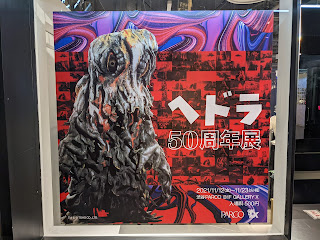
Shibuya Parco Pays Tribute to Hedorah on His 50th Anniversary!

Signage welcoming you to Shibuya Parco's Hedorah 50th anniversary exhibit. Photo by Brett Homenick.

From November 12 until November 23, Shibuya Parco's Gallery X is hosting a special 50th anniversary salute to Hedorah. Shibuya Parco and a pollution monster seem like an odd pairing, but it works for me, especially because the highlight was the diorama of Hedorah filming suit from Godzilla: Final Wars (2004) -- complete with psychedelic lighting.

Another cool aspect was seeing a bevy of production stills on display, many of which showed Yoshimitsu Banno directing a variety of scenes. Most of these shots were new to me, but, unfortunately, photography of these stills was not allowed. There's also a gift shop with some Hedorah goods, but I kept my wallet closed this time. After, the GFW Hedorah suit was the main attraction for me. Anyway, here's what I saw.


Tuesday, October 12, 2021

DEEP DIVE: Did Tomoyuki Tanaka Tell Yoshimitsu Banno He 'Ruined' Godzilla?

Yoshimitsu Banno in July 2016. Photo by Brett Homenick.

It's a story that just won't go away. For decades, it's been repeated countless times that, during the production of Godzilla vs. the Smog Monster (1971), producer Tomoyuki Tanaka, furious at Godzilla's flying scene, told writer-director Yoshimitsu Banno that he "ruined" Godzilla. 

But is that how it really happened? The yarn still gets spun to this day, but sources are rarely cited. In order to shed some much-needed light on this situation, let's take a look at what Yoshimitsu Banno and special effects director Teruyoshi Nakano have actually said about it. 

In an unpublished manuscript about his film career that Banno sent to me in November 2012, he described Tanaka's reaction after seeing Smog Monster in Japanese:
「ゴジラ対ヘドラ」の完成試写会が終わってから病院を出てこられた田中プロデューサーは、作品を観た後、私に向って不機嫌な顔で一言。「性格を変えられては困るんだよな」
In the English-language version of the manuscript Banno sent me to proofread, Banno described Tanaka's reaction this way (which is presented exactly as Banno sent it to me in November 2012):
Tanaka producer who came out the hospital after the completion film preview of “Godzilla vs. The Smog Monster” told me with an ill-humored face, "It is no good to change the character."
Banno has consistently told the story this way since I first met and interviewed him in July 2005. I've never heard or read Banno tell the story any other way, except when other Americans have purportedly quoted him on the matter. 

In my July 2005 interview with him, Banno states that he was unaware Tanaka was supposedly angry over the situation until he read about it in a book sometime after Tanaka's passing in 1997. 

According to another account recently told online, Tanaka was more upset at Banno for going around him to get approval for Godzilla's flying scene than he was over the flying scene itself, but, as demonstrated by the quotes above, this version is also false.

In 1978, Banno became director of Toho Eizo's planning section. In 1989, he became managing director of Toho Eizo Bijutsu, retiring from that position in 1994. Suffice it to say, this seems like an unusual career trajectory for someone who "ruined" one of Toho's most profitable franchises and was on the outs with a powerful producer like Tomoyuki Tanaka. 

Teruyoshi Nakano in June 2015. Photo by Brett Homenick.

We can safely rule out Banno as the source of the oft-repeated anecdote that he was told he "ruined" Godzilla. But I have also read that, while Banno himself may not have said it, SFX director Teruyoshi Nakano has been quoted as saying that Tanaka was angry and told Banno that Banno did indeed ruin Godzilla. 

On the evening of October 9, I was privileged to spend an evening with Mr. Nakano on his birthday. During the evening, I had an opportunity to ask him about the Smog Monster controversy. I made sure to specify the two different accounts that have been told and asked him which one was correct. Mr. Nakano recounted his memory of the events, which matched Banno's version completely. Mr. Nakano went even further to suggest that newspapers may have exaggerated the story.

Given all the above, it is more than a little difficult to believe that Tanaka furiously told Banno he ruined Godzilla. We may never know exactly what happened after Tomoyuki Tanaka saw Godzilla vs. the Smog Monster. But, when two of the principals directly involved corroborate each other, you have to lend that version some credence. 

Tuesday, August 31, 2021

New Content on Vantage Point Interviews!

With Yoshimitsu Banno in July 2005.

I'm very pleased to share that my July 2005 interview with Godzilla vs. the Smog Monster (1971) director Yoshimitsu Banno has been updated with improved translations from the original recording. This interview in particular was a tough one to get translated properly due to the fact that Mr. Banno answered in Japanese directly to the original interpreter, away from the microphone. Thankfully, though, his answers were just audible enough to be understood. This new version does a much better job of conveying Mr. Banno's answers than the previous version, so I'd encourage anyone interested in Godzilla vs. the Smog Monster to check it out!


With Masamitsu Tayama in April 2021.

Also available is my new interview with former child actor Masamitsu Tayama, who played Shinji Chujo in the original Mothra (1961). Mr. Tayama shares quite a few anecdotes about the making of the film never before published in English, so it is well worth a look for any tokusatsu fan!

Vantage Point Interviews proves once again that content is king!

Sunday, May 5, 2019

A Performance in Nakano!

Yumi Mizusawa and Tatsuhito Go. Photo by Brett Homenick.

Today, I attended a play in Nakano Ward in which actress-singer Yumi Mizusawa was one of the ensemble performers. Mizusawa-san starred in the TV series What Is Youth? (1965-66) alongside Yosuke Natsuki. While her credits are mostly non-genre, she appeared in episode 91 of Kamen Rider (1971-73) and episode 16 of Iron King (1972-73). Her most notable film appearance is in Kihachi Okamoto's Epoch of Murder Madness (1967).


After the show, I realized that I was sitting one seat away from actor Tatsuhito Go. Go-san was a regular on Strada 5 (1974) and appeared in episodes of the series Jekyll and Hyde (1973) and Zone Fighter (1973) as well as Godzilla vs. the Smog Monster (1971). After chatting with Mizusawa-san, she invited Go-san over for a photo op. It was certainly an unexpected bonus!

Sunday, August 13, 2017

KING KONG VS. GODZILLA THE 4K WAY! Attending an All-Night Screening of Godzilla Flicks!

The movie lineup at Ikebukuro's Shin-Bungeiza. Photo by Brett Homenick.

Shin-Bungeiza in Ikebukuro hosted an all-night Godzilla move marathon on the evening of August 12 through the morning of August 13. While I don't usually go for all-night events (for what I hope are obvious reasons), this one was an exception.


The marathon kicked things off with a rare screening of the 4K-remastered King Kong vs. Godzilla (1962). This was something I certainly wanted to see, so I braced myself for a bleary-eyed evening (and morning) of no sleep.


I was surprised at the turnout. The theater, which holds 264 people, seemed nearly sold out. I couldn't believe so many others wanted to spend a muggy August evening in a crowded movie theater, but I guess I wasn't alone. The digital projection of King Kong vs. Godzilla in 4K was truly a revelation, and there were many small details I'd never noticed before.


Also, the movie was loud. The monster roars and other sound effects were about as noisy as any you'd find in Hollywood these days. Seeing the movie so clearly was a reminder of what a lavish production the film really was, which often gets ignored by fans who'd rather focus on the King Kong suit. The number of extras, locations, and special effects stand out more than ever before.


The next screening was Godzilla vs. the Smog Monster (1971) in 35mm. Before the movie played, Japanese trailers for Kong: Skull Island and Godzilla (2014) were shown. I don't believe I'd ever seen Smog Monster projected in Japan before, so I was pleased to have the opportunity. Having lost Yoshimitsu Banno and Haruo Nakajima recently, it was a great way to pay tribute to their careers.


After another break, a few trailers were shown. These included original Japanese trailers for all the '70s Godzilla films, as well as the ones for Son of Godzilla (1967) and Yog Monster from Space (1970). Once those were finished, it was time for Godzilla vs. Megalon (1973) in 35mm. I've said it before, but I'll say it again: I love this movie. After having first seen the movie more than 30 years ago, it's part of my DNA. I can't tell you how many times I've seen it, but it never gets old.


Last but not least, Godzilla: Final Wars (2004) screened in 35mm. Unfortunately, this was the Japanese version, so all the English lines were dubbed over in Japanese, taking away a lot of the fun of the movie. With maybe about 20 minutes left, I have to admit I left the theater early to go home. Not because I hate the movie (far from it), but by this time it was almost 6:00 a.m. (!) and I needed to get some sleep.


All in all, I'm just glad I didn't oversleep on the train and my miss my stops! I woke up a few hours ago after a long sleep, so I feel fine now, but this is something I'd usually rather not do. But seeing King Kong vs. Godzilla in 4K on the big screen was simply an offer I couldn't refuse.