Showing posts with label Virus. Show all posts

Thursday, August 18, 2022

Attending a Memorial Celebration of the Life and Career of Shinichi 'Sonny' Chiba

The floral arrangement at Sonny Chiba's memorial event on August 17. Photo by Brett Homenick.

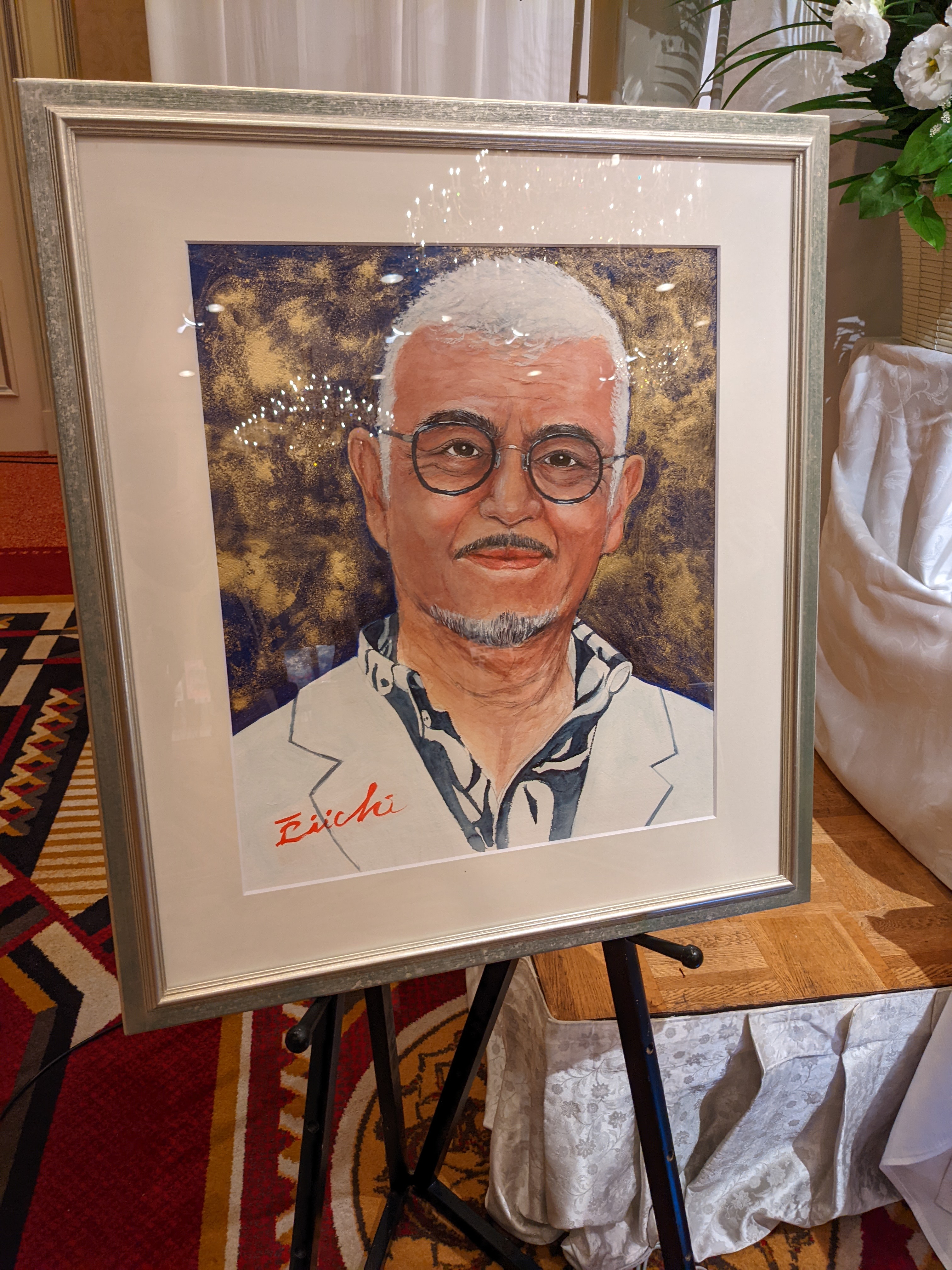
A couple of weeks ago, I received an invitation to attend a memorial celebration of the life and career of the late action star Shinichi "Sonny" Chiba, who passed away last year. A few months ago, a similar event was announced but postponed to due to the ongoing coronavirus pandemic. It was finally held on Wednesday, August 17, at the RIHGA Royal Hotel Tokyo.


The first gathering (held at 1:00 p.m.) was only for Chiba-san's friends and family. The second gathering was held at 3:00 p.m. and was reserved for Japan Action Club (a.k.a. Japan Action Enterprise) alumni and related parties. The 5:00 gathering was for general folks, like myself. 


After registering, I was given a flower by a staff member to lay in front of the floral arrangement. As I entered the room, the ending theme to Message from Space (1978) was playing, which I thought was an appropriate selection. After that, a variety of Japanese and Western pop songs played throughout the event. 


There were posters from Chiba-san's movies on display, as well as some photographs from his personal collection. (No photos were allowed there). 


At one point, I saw Chiba-san's daughter, Juri Manase, but it was a fleeting glimpse, and I didn't see her again. It was probably just as well, as I'm sure she had a lot on her mind. 


I'm glad I had an opportunity to celebrate Chiba-san's life and career in such a classy way. He was always a true gentleman when I was privileged to be in his company.

I couldn't think of a more appropriate way to celebrate the life and career of Sonny Chiba. I hope these photos convey even a fraction of how well organized the event was.

Rest in peace, Chiba-san.

Sunday, March 1, 2020

An Evening with a Legendary Cinematographer!

With Daisaku Kimura.

Tonight, I attended an event with legendary Japanese cinematographer Daisaku Kimura, whose credits include several classic Akira Kurosawa movies, as well as tokusatsu greats as Submersion of Japan (1973), Blue Christmas (1978), and Virus (1980). One thing's for sure: Kimura-san certainly doesn't hold back in expressing himself!


It was certainly an enlightening experience. Kimura-san is truly one of the greats of Japanese cinema.

Monday, November 4, 2019

DAY OF RESURRECTION! An Evening with Cinematographer Daisaku Kimura!

Daisaku Kimura. Photo by Brett Homenick.

On Sunday, November 3, I took in a screening of the all-star, end-of-the-world epic Virus (a.k.a. Day of Resurrection, 1980) in glorious 35mm. Suffice it to say, I'd never seen it in 35mm before (and really, I don't know many others who have), and it was a joy to watch. I noticed a lot of small details, such as a hand-drawn picture of Ultraman hanging in a young boy's bedroom. I thoroughly enjoyed the picture, even if some of the situations (such as a massive earthquake hitting Washington, D.C.) seemed more than a bit contrived to move the plot along.


The guest of honor was a true legend of the Japanese film industry: cinematographer Daisaku Kimura. His credits include: Submersion of Japan (1973), Blue Christmas (1978), the aforementioned Virus, and Station (1981), among many others. In 1958, Kimura-san joined Toho Studios and worked as an assistant cameraman under Akira Kurosawa, during which time his most prominent credit was Yojimbo (1961). In 1973, he became a cinemtographer in his own right. He also once came pretty darn close to becoming the cinematographer on a Godzilla film, but that's a story for another day.

Overall, it was a great evening, and I was fascinated by all the stories from the set of Virus, particularly the ones about the Western cast. Needless to say, fun was had by all.

Sunday, January 6, 2019

VIVA CHIBA! Shinichi "Sonny" Chiba Appears at a Showa Hero Event!

Sonny Chiba. Photo by Brett Homenick.

 Today, I was able to attend a special Showa Hero event headlined by none other than Shinichi "Sonny" Chiba, one of Japan's most famous action stars of all time. Chiba-san is set to turn 80 years old this month, but you'd never know it by looking at him. Chiba-san is still in incredible shape!


While waiting in line, I spoke with a Japanese fan who'd been waiting a long time to get his Kill Bill posters signed by Chiba-san. Another fan got nearly nearly 10 shikishi boards signed by Chiba-san. Suffice it to say, a lot of fans were eager to meet him.


When it was my turn, Chiba-san saw me and said thanked me for my continuous support. I was quite pleased he recognized me, even though I hadn't seen him for about a year. Chiba-san is always cool with his fans, and he certainly made this afternoon one for the scrapbook.

Sunday, January 21, 2018

AN EVENING WITH A CINEMATIC LEGEND! Meeting Cinematographer Daisaku Kimura!

Daisaku Kimura. Photo by Brett Homenick.

Earlier this evening, I attended a special dinner event with cinematographer Daisaku Kimura. A good case could be made that he is the greatest cinematographer in Japanese film history. A quick look at some of his credits ought to be an indicator: Submersion of Japan (1973), Blue Christmas (1978), Virus (a.k.a. Resurrection Day, 1980), and Station (1981), among many others. 

In 1958, Kimura-san joined Toho Studios and worked as an assistant cameraman under Akira Kurosawa, during which his most prominent credit was Yojimbo (1961). In 1973, he became a cinemtographer in his own right. 


Blue Christmas and Station are two of the best-looking movies I've ever seen, and Kimura-san filmed both. Suffice it to say, it was a true honor to meet him. At the end of the event, I was saying my goodbyes when Kimura-san asked where I lived. When I mentioned my neighborhood, he told me it wasn't too far from his home, and so he invited me to ride in the car with him. (It sure beat taking the train back, that's for sure!) It was certainly a unique experience, and thankfully the driver didn't seem to mind the short detour to my neighborhood.

What a cool evening!

Monday, September 19, 2016

CHIBA THE BODYGUARD! He Shall Lay His Vengeance Upon Thee!


On Saturday evening, I was invited to a dinner with Toei action star Sonny Chiba. I was fortunate to sit next to Chiba-san during the evening, and we spoke together in English. I asked him about some of his memories of making classic tokusatsu films, and he aked me a few questions about where I live and life in Japan. We also talked about American food vs. Japanese food. Suffice it to say, it was quite an evening!

Sonny Chiba tells a story to dinner attendees. Photo by Brett Homenick.

The dinner invitation was rather sudden, but what a memorable evening it was. When I mentioned his movie version of Golgo 13, he pulled up the poster image in his smartphone and showed it to me. (He also showed me his personal photos with Samuel L. Jackson and other Hollywood stars.) He also told me about the various Japanese foods we were served that evening. To say the absolute least, this kinds of evenings are rare, and they are never forgotten. Many thanks to Chiba-san and everyone else who helped make this possible!

Monday, February 29, 2016

Remembering George Kennedy


I woke up this morning and found out that George Kennedy, an Academy Award-winning actor whose presence in a movie always took it to the next level, has passed away at age 91. For many years, I was fascinated by Mr. Kennedy's appearance in the Japanese end-of-the-world tale Virus (1980), and for a long time I tried to arrange an interview with him. My persistence eventually paid off, and in late 2011, we finally began communication.

I had just woken up early in the morning in Nakatsugawa, Gifu, to prepare a long trip to Tokyo to take part in a special Mechagodzilla event at the long-gone Cine Pathos Theater in Ginza in November 2011. Before leaving, I checked my e-mail and was floored to find one from Mr. George Kennedy himself, accepting my request for an interview.

We set up the date not long after that, and I called him up to ask my questions. Unfortunately, Mr. Kennedy was rather hard of hearing at this point, and his wife had to assist us with the questions. Just before Mr. Kennedy asked his wife to help, he said in passing that this interview was important to him, so he wanted to make sure he understood my questions. Suffice it to say, I was amazed that a man I grew up watching in countless films would say that about an interview with me, but Mr. Kennedy was truly an amazing man.

Japan was very special to him, and I think my interview gave him a chance to talk about it. He was interested in my life and experiences there, so we ended up swapping stories. After the interview, we stayed in contact, and I was very honored that he accepted my Facebook friend request.

I have posted my interview with George Kennedy on Vantage Point Interviews, so I'd encourage anyone interested in his life and career to read it. I'd also strongly recommend picking up a copy of his autobiography Trust Me, which is a great read.

Rest in peace, Mr. Kennedy. I'll always remember and appreciate the kindness you showed me.

Sunday, November 9, 2014

A Salute to Michael Lennick

Michael Lennick on the set of Kinji Fukasaku's Virus (1980). Photo courtesy of Michael Lennick.

I'm very sorry to report the passing of Michael Lennick. Michael was a special effects technician/supervisor and documentary filmmaker, who worked on films like Videodrome (1982), The Dead Zone (1983), and Dick (1999).

I interviewed Michael several years ago for G-FAN about his involvement with Virus (a.k.a. Fukkatsu no hi, 1980), a Japanese end-of-the-world sci-fi film directed by Kinji Fukasaku. He had many great memories about making the film, and he sent me a few behind-the-scenes photos, including this one of him on the Palmer Station set.

According to Michael's friend Robert J. Sawyer, Michael died yesterday after being diagnosed with an aggressive brain tumor just a month ago. He was 61. Rest in peace, Michael.

Friday, July 29, 2011

Sakyo Komatsu, 1931-2011

The late Sakyo Komatsu (with his friend and associate Kenju Shimomura) pose with a copy of G-FAN #80, in which his interview with yours truly appears, in 2007. Photo courtesy of Kenju Shimomura.

The celebrated author Sakyo Komatsu died on July 26, 2011, of pneumonia, reports The Japan Times. He was 80 years old.

Often called the Arthur C. Clarke of Japan, Mr. Komatsu wrote the novels on which the movies Submersion of Japan (1973 and 2006), Espy, Virus (1980), and Sayonara Jupiter were based. Mr. Komatsu even had a large hand in the production of the film version of Sayonara Jupiter.

In honor of his passing, I'm posting the interview I conducted with Mr. Komatsu (by correspondence) in 2007. The translation was provided by Kenju Shimomura.

Brett Homenick: What got you interested in the science fiction genre?
Sakyo Komatsu: Japan has experienced two atomic bombs on Hiroshima and Nagasaki in World War II. I knew the word “atomic bomb” when I was only ten years old. There was a description about atomic bomb in the novel which I have read in my favorite newspaper for children. When I first read that, I thought it was nonsense and complete nonsense. But four years after, I was shocked to find that this atomic bomb was actually dropped on Japan and taken thousands of life. I think that was the first time I started to feel interest in the relation between imagination and reality.

After I grew up, I was inspired by literature. However, I have soon faced the problem. I found it difficult to express what I really feel by writing mainstream literature. And then I have read The Prize of Peril by Robert Sheckley. I was shocked. It really opened my eyes. I have realized that philosophical problems, emotions, and psychology cannot be separated from the modern society, and modern society also cannot be formed without science and technology.

When I think about the meaning of my existence, science fiction is something that enables me to express what myself and mankind is. And science fiction united my interest in science and human imagination without discrepancy.

By the way, I majored in Italian literature in university. I think Piradello, whom I have chosen as a theme for my thesis, and literature such as Divine Comedy by Dante have a strong essence of science fiction. I like this kind of literature which will give pleasure to the readers by telling tales with grand scale imagination.

BH: How did you get started as a novel writer?
SK: In 1903, the Wright brothers' first airplane, which looked like a monster paper craft, flew in the air. Two years later in 1905, Einstein presented his special theory of relativity. Forty years after, in 1945, B29 bomber plane flew to Japan and dropped an atomic bomb. The B29 bomber and the atomic bomb can trace their origins back to 1903 and 1905. The creative power of mankind is considerable. But just like this example, it can create something unpredictable when they are combined. The creative power made by mankind also affects mankind. Taking all these aspects into consideration, I wanted to think about what mankind is. And writing a story about mankind was the best way to understand mankind.

BH: What did you think of the 1973 movie version of your novel Nippon Chinbotsu (a.k.a. Submersion of Japan)?
SK: I started to write Nippon Chinbotsu in 1964, and it took 9 years to complete.
Let me discuss why I wrote that novel. Until 15th of August 1945, when the Showa Emperor officially declared the end of the war to the Japanese nation, all the Japanese, especially a teenager like me, believed in governmental slogans such as “honorable death for all hundred million Japanese nations” or “decisive battle is when Americans landed on mainland Japan.” We all made up our mind for the coming death. However, once the war was over, Japanese overcame the consequence of defeat so easily, and by the 1960s, people were happy about the rapid economical growth of the country. When I saw those circumstances, I wanted to reconsider the meaning of what “Japan” is and what “Japanese” are. That is why I wrote Nippon Chinbotsu.

I was quite surprised when Toho had completed the film just after the book was published. The movie was quite faithful to the original story, and I was quite satisfied. I know that the movie was heavily re-edited and made into a disaster movie and released in U.S. with the title of Tidal Wave. However, the original story depicts the natural and calamity environments of Japan and the Japanese way of thinking which is based on such environment.

BH: Similarly, what did you think of Kinji Fukasaku's adaption of Fukkatsu no hi (a.k.a. Virus, 1980)?
SK: This is one of my favorite movies. The staff went all the way to Antarctica to shoot the film, used a real submarine, and famous overseas actors and actresses participated in the film. The contrast between human drama and vast natural view was well depicted. I also liked the visual beauty of the film.

BH: How did you get the job to co-direct the movie version of your novel Sayonara Jupiter?
SK: I would like you to read the article in this issue for the details. (Kenju Shimomura offers a complete account of the making of Sayonara Jupiter in G-FAN #80.) When I was asked by Tomoyuki Tanaka, the producer of Godzilla and Nippon Chinbotsu (1973 version), to make a story like Star Wars for his movie, I had a feeling that I did not want to do a rip-off. I felt, if I could make a movie set in space, I wanted to make something which can make the audience feel the theme of “Universe and mankind” visually. I have assembled various Japanese science fiction writers to create the film. Eventually I decided to be an executive producer of the film. I thought I have a responsibility to all the science fiction writers who gave me ideas and advice.

BH: What needed to be changed from the novel when making the film?
SK: Due to the limited time and budget, the scenes which were set on the moon were all cut out. Also scenes on Earth were cut out except for the Jupiter Beach sequence. As for the story, the past of Eiji and Maria, political struggles, were all cut out.

BH: How did you and your co-director Koji Hashimoto share directing duties?
SK: I tried not to say my opinion in the actual shooting of the film. I only said my opinion when director Koji Hashimoto needed my opinion to make his decision.

BH: What did you find easy and difficult about directing Sayonara Jupiter?
SK: Sayonara Jupiter was the first featured Japanese film to use computer graphics. In those days, it took 1 million yen to create 1 second computer graphic image. It was hard but also fun to think out how we can reduce the price for computer graphics without losing its quality. Also, it was the first attempt to bring the video camera into the shooting studio. Video cameras were still rare at that time. It was very useful to check the position of props, etc., from cut to cut.

BH: Do you have any interesting memories from the set of Sayonara Jupiter that you would like to share?
SK: I was present when the soundtrack music was recorded. It was interesting to listen to what the composer was saying to the orchestra. I was impressed that this talented composer also had a talent in expressing himself by words.

I wrote a lyric for the song used in the film and asked musician to compose a melody for it. I did this work together with musician staying overnight in the lodge. I was very happy when our approach toward the music was suddenly united and completed the music in that very night.

BH: What did you think of the completed film?
SK: As for the special effects, it expressed the vast scale and beauty of universe very well. I think the style of special effects we have achieved in Sayonara Jupiter was innovative for the Japanese film at that time. As for the live action scenes, I think we dealt very well with non-Japanese casts as well, and designs of interior sets were also wonderful. For me, the best achievement was the process of making film. I got lots of ideas and suggestions from various people, and I also shared a hardship with these people. As for the completed film, it is true that I had to compromise a lot. But all the people who participated in this movie did their best and their effort is reflected in the completed film. Most of all, the theme of the movie, which is “Courage and sadness of mankind which has to go ahead into the universe,” was visually depicted well.

BH: Do you have any closing remarks for readers of G-FAN magazine?
SK: I understand that one of the motivations of this magazine is Godzilla. I recognize that Japanese special effects (tokusatsu) films were influenced by classic American films like King Kong and Lost World. As for our future, let's exchange ideas and opinions actively in order to make a high quality science fiction movies.

(Translation by Kenju Shimomura. Special thanks to Peggy Rae Sapienza, Atsushi Morioka, Tamie Inoue, and Hiroaki Inoue of Nippon Worldcon.)