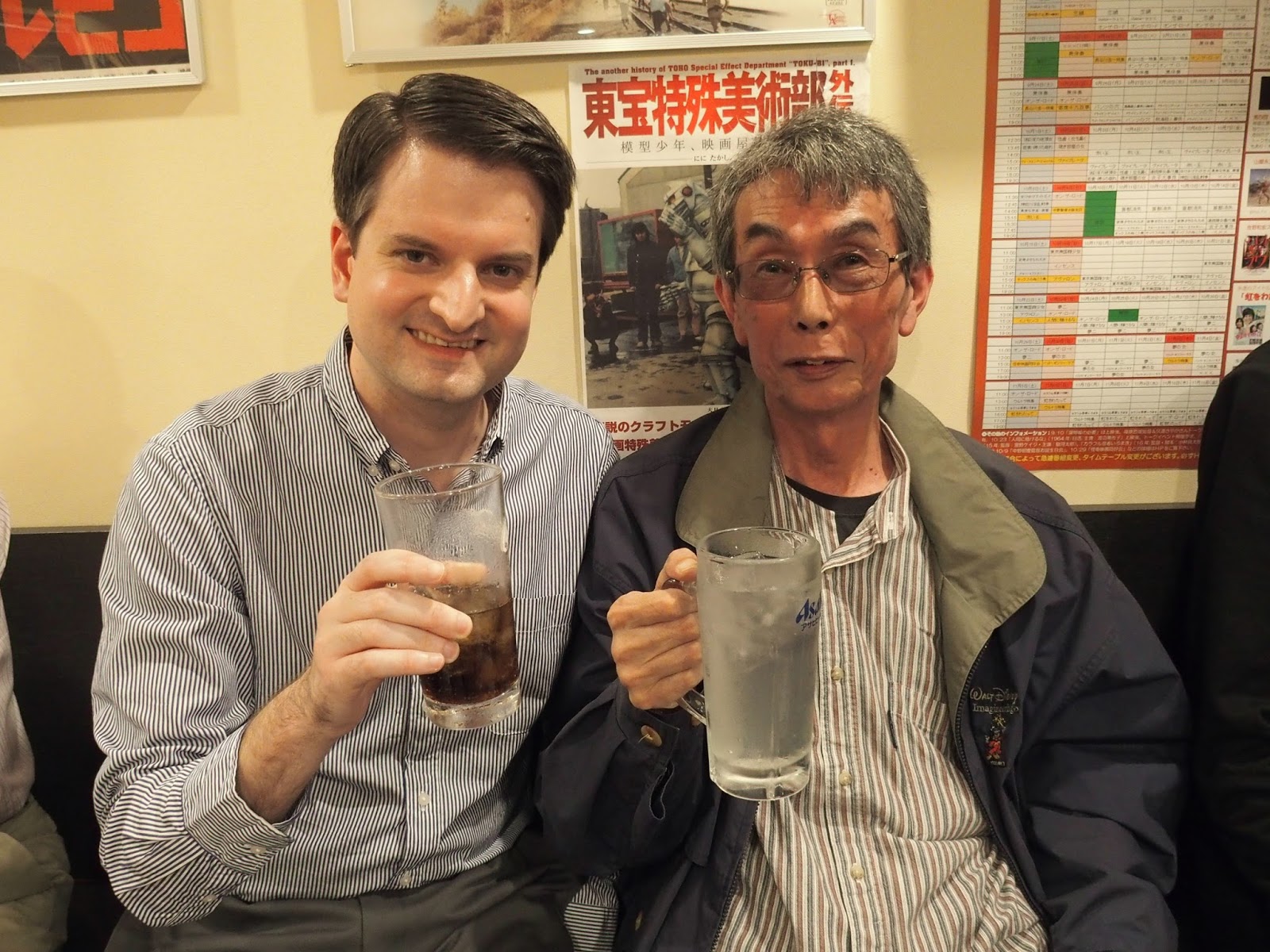
The late Sakyo Komatsu (with his friend and associate Kenju Shimomura) pose with a copy of G-FAN #80, in which his interview with yours truly appears, in 2007. Photo courtesy of Kenju Shimomura.
The celebrated author Sakyo Komatsu died on July 26, 2011, of pneumonia, reports
The Japan Times.
He was 80 years old.
Often called the Arthur C. Clarke of Japan, Mr. Komatsu wrote the novels on which the movies
Submersion of Japan (1973 and 2006),
Espy,
Virus (1980), and
Sayonara Jupiter were based. Mr. Komatsu even had a large hand in the production of the film version of
Sayonara Jupiter.
In honor of his passing, I'm posting the interview I conducted with Mr. Komatsu (by correspondence) in 2007. The translation was provided by Kenju Shimomura.
Brett Homenick: What got you interested in the science fiction genre?
Sakyo Komatsu: Japan has experienced two atomic bombs on Hiroshima and Nagasaki in World War II. I knew the word “atomic bomb” when I was only ten years old. There was a description about atomic bomb in the novel which I have read in my favorite newspaper for children. When I first read that, I thought it was nonsense and complete nonsense. But four years after, I was shocked to find that this atomic bomb was actually dropped on Japan and taken thousands of life. I think that was the first time I started to feel interest in the relation between imagination and reality.
After I grew up, I was inspired by literature. However, I have soon faced the problem. I found it difficult to express what I really feel by writing mainstream literature. And then I have read
The Prize of Peril by Robert Sheckley. I was shocked. It really opened my eyes. I have realized that philosophical problems, emotions, and psychology cannot be separated from the modern society, and modern society also cannot be formed without science and technology.
When I think about the meaning of my existence, science fiction is something that enables me to express what myself and mankind is. And science fiction united my interest in science and human imagination without discrepancy.
By the way, I majored in Italian literature in university. I think Piradello, whom I have chosen as a theme for my thesis, and literature such as
Divine Comedy by Dante have a strong essence of science fiction. I like this kind of literature which will give pleasure to the readers by telling tales with grand scale imagination.
BH: How did you get started as a novel writer?
SK: In 1903, the Wright brothers' first airplane, which looked like a monster paper craft, flew in the air. Two years later in 1905, Einstein presented his special theory of relativity. Forty years after, in 1945, B29 bomber plane flew to Japan and dropped an atomic bomb. The B29 bomber and the atomic bomb can trace their origins back to 1903 and 1905. The creative power of mankind is considerable. But just like this example, it can create something unpredictable when they are combined. The creative power made by mankind also affects mankind. Taking all these aspects into consideration, I wanted to think about what mankind is. And writing a story about mankind was the best way to understand mankind.
BH: What did you think of the 1973 movie version of your novel
Nippon Chinbotsu (a.k.a.
Submersion of Japan)?
SK: I started to write
Nippon Chinbotsu in 1964, and it took 9 years to complete.
Let me discuss why I wrote that novel. Until 15th of August 1945, when the Showa Emperor officially declared the end of the war to the Japanese nation, all the Japanese, especially a teenager like me, believed in governmental slogans such as “honorable death for all hundred million Japanese nations” or “decisive battle is when Americans landed on mainland Japan.” We all made up our mind for the coming death. However, once the war was over, Japanese overcame the consequence of defeat so easily, and by the 1960s, people were happy about the rapid economical growth of the country. When I saw those circumstances, I wanted to reconsider the meaning of what “Japan” is and what “Japanese” are. That is why I wrote
Nippon Chinbotsu.
I was quite surprised when Toho had completed the film just after the book was published. The movie was quite faithful to the original story, and I was quite satisfied. I know that the movie was heavily re-edited and made into a disaster movie and released in U.S. with the title of
Tidal Wave. However, the original story depicts the natural and calamity environments of Japan and the Japanese way of thinking which is based on such environment.
BH: Similarly, what did you think of Kinji Fukasaku's adaption of
Fukkatsu no hi (a.k.a.
Virus, 1980)?
SK: This is one of my favorite movies. The staff went all the way to Antarctica to shoot the film, used a real submarine, and famous overseas actors and actresses participated in the film. The contrast between human drama and vast natural view was well depicted. I also liked the visual beauty of the film.
BH: How did you get the job to co-direct the movie version of your novel
Sayonara Jupiter?
SK: I would like you to read the article in this issue for the details. (
Kenju Shimomura offers a complete account of the making of Sayonara Jupiter
in G-FAN #80.) When I was asked by Tomoyuki Tanaka, the producer of
Godzilla and
Nippon Chinbotsu (1973 version), to make a story like
Star Wars for his movie, I had a feeling that I did not want to do a rip-off. I felt, if I could make a movie set in space, I wanted to make something which can make the audience feel the theme of “Universe and mankind” visually. I have assembled various Japanese science fiction writers to create the film. Eventually I decided to be an executive producer of the film. I thought I have a responsibility to all the science fiction writers who gave me ideas and advice.
BH: What needed to be changed from the novel when making the film?
SK: Due to the limited time and budget, the scenes which were set on the moon were all cut out. Also scenes on Earth were cut out except for the Jupiter Beach sequence. As for the story, the past of Eiji and Maria, political struggles, were all cut out.
BH: How did you and your co-director Koji Hashimoto share directing duties?
SK: I tried not to say my opinion in the actual shooting of the film. I only said my opinion when director Koji Hashimoto needed my opinion to make his decision.
BH: What did you find easy and difficult about directing
Sayonara Jupiter?
SK: Sayonara Jupiter was the first featured Japanese film to use computer graphics. In those days, it took 1 million yen to create 1 second computer graphic image. It was hard but also fun to think out how we can reduce the price for computer graphics without losing its quality. Also, it was the first attempt to bring the video camera into the shooting studio. Video cameras were still rare at that time. It was very useful to check the position of props, etc., from cut to cut.
BH: Do you have any interesting memories from the set of
Sayonara Jupiter that you would like to share?
SK: I was present when the soundtrack music was recorded. It was interesting to listen to what the composer was saying to the orchestra. I was impressed that this talented composer also had a talent in expressing himself by words.
I wrote a lyric for the song used in the film and asked musician to compose a melody for it. I did this work together with musician staying overnight in the lodge. I was very happy when our approach toward the music was suddenly united and completed the music in that very night.
BH: What did you think of the completed film?
SK: As for the special effects, it expressed the vast scale and beauty of universe very well. I think the style of special effects we have achieved in
Sayonara Jupiter was innovative for the Japanese film at that time. As for the live action scenes, I think we dealt very well with non-Japanese casts as well, and designs of interior sets were also wonderful. For me, the best achievement was the process of making film. I got lots of ideas and suggestions from various people, and I also shared a hardship with these people. As for the completed film, it is true that I had to compromise a lot. But all the people who participated in this movie did their best and their effort is reflected in the completed film. Most of all, the theme of the movie, which is “Courage and sadness of mankind which has to go ahead into the universe,” was visually depicted well.
BH: Do you have any closing remarks for readers of G-FAN magazine?
SK: I understand that one of the motivations of this magazine is Godzilla. I recognize that Japanese special effects (tokusatsu) films were influenced by classic American films like
King Kong and
Lost World. As for our future, let's exchange ideas and opinions actively in order to make a high quality science fiction movies.
(Translation by Kenju Shimomura. Special thanks to Peggy Rae Sapienza, Atsushi Morioka, Tamie Inoue, and Hiroaki Inoue of Nippon Worldcon.)