Showing posts with label Ultra Q. Show all posts

Sunday, March 17, 2024

Celebrating an American Classic with Three Tsuburaya Productions Legends!

Masao Nakabori. Photo by Brett Homenick.

Today (Sunday, March 17), I received a very kind invitation from former Tsuburaya Productions script supervisor Atsuko Tanaka to join a special event in Jimbocho. The topic of the event was a breakdown of the various film techniques used to create Citizen Kane (1941), hosted by Japanese cinematographer Masao Nakabori. 

What made this invitation special in particular is that she offered to meet me about 40 minutes before the start of the event so that we could spend some time together prior to the event. She also invited me to the after-party, which was even more generous of her. But, as it turned out, that wasn't all.

Atsuko Tanaka. Photo by Brett Homenick.

She told me that another Tsuburaya Productions script supervisor, Noriko Shishikura (a.k.a. Noriko Suzuki) would be joining her. Shishikura-san doesn't do many appearances at events in Japan, and I'm not aware of her appearing at any other gathering. Suffice it to say, it was a rare opportunity!

Miyanobu Inori. Photo by Brett Homenick.

First, let's take a closer look at the day's VIPs. Atsuko Tanaka is a former Tsuburaya Productions scripter (known these days as a script supervisor), who worked on Ultra Q (1966), Ultraman (1966-67), Ultra Seven (1967-68), The Space Giants (1966-67), and Kaiju Booska (1966-67). In fact, when I showed her my Kaiju Booska DVD sleeve for her to sign, she was quite amused by it.

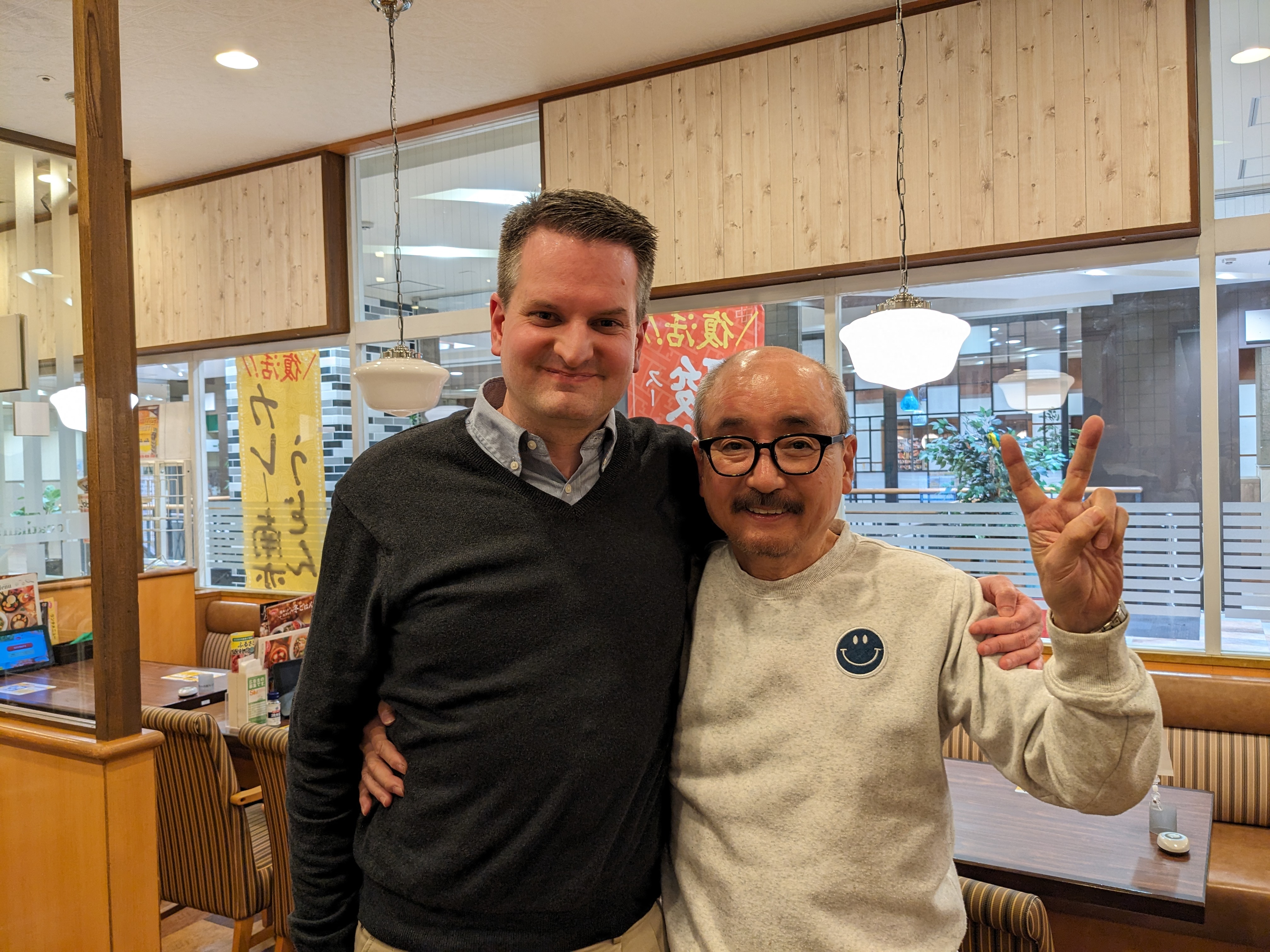
With Noriko Shishikura.

Masao Nakabori is a cinematographer whose credits include UltramanUltra SevenOperation: Mystery! (1968-69), Silver Kamen (1971-72), and Ultraman Taro (1973-74). On the big screen, Mr. Nakabori frequently collaborated with director Akio Jissoji, including the films Tokyo: The Last Megalopolis (1988) and Ultra Q: The Movie (1990).


Noriko Shishikura (born in 1937) has worn many hats in the Japanese film and television industry, having worked at different times as a scripter, screenwriter, director, and a producer. She was formerly married to Ultra-series director Toshitsugu Suzuki.

Atsuko Tanaka signs a Kaiju Booska DVD sleeve. Photo by Brett Homenick.

As a scripter, Shishikura-san has worked on Ultra QUltramanUltra SevenSilver KamenTokyo: The Last Megalopolis, and a bevy of Nikkatsu films from the 1960s, going as far back as 1961. After that, she directed Ultraman: Great Monster Decisive Battle (1979), which is essentially a clip show of previous Ultraman episodes with some new footage edited into it.

Noriko Shishikura signs an Ultraman DVD sleeve. Photo by Brett Homenick.

She also produced the Tsuburaya Productions TV series Star Wolf (1978), Nobuhiko Obayashi's Cute Devil (1982), Ultra Q: The Movie, and Ultraman Tiga (1996-97), though only with director Jissoji.


An even bigger surprise was meeting Miyanobu Inori, who worked on three Akira Kurosawa movies in the camera and electrical department. Inori-san had a few stories to share about his experiences. 

On Dreams (1990), the staff had to create realistic-looking cherry blossoms. Kurosawa was pleased with the results and gave about one bottle per six staff members of White Horse, Kurosawa's favorite whiskey, for a job well done.


For the scene depicted on the poster of Rhapsody in August (1991), Inori-san was personally involved in putting film lights under the water to create the desired effect. (I didn't realize one would even do such a thing!)

Kurosawa liked shooting from far away with a zoom lens. On Madadayo (1993), there was an open set in Gotemba for a scene that took place right after the war. As you might imagine, it's difficult to light a scene from far away. They used a spotlight, with which the actors were fine. But Kurosawa didn't like it because it was too shiny and didn't look realistic.

A lot to write about, but that only scratches the surface! I had a great time today, and I must thank Tanaka-san for the invitation. It was truly remarkable!

Wednesday, February 28, 2024

A Toho Legend Celebrates His 85th Birthday!

Yasuhiko Saijo. Photo by Brett Homenick.

Today (Wednesday, February 28), I was privileged to spend a couple of hours in the company of former Toho actor Yasuhiko Saijo. Saijo-san is best known for his co-starring role in the Tsuburaya Productions series Ultra Q (1966) as Ippei Togawa, though he also plays Suzuki in Son of Godzilla (1967) and a Moonlight SY-3 crew member in Destroy All Monsters (1968). (Japanese sources seem to disagree about his character name in DAM, with some books naming his character Fujita while others dub him Tani.)

Saijo-san celebrated his 85th birthday on February 20, so he and his wife took a two-day trip to Hakone. In fact, he would be just returning from the trip when meeting up with me, which ended up leading to a bit of a delay.

It turns out that the train Saijo-san was using encountered an accident along the way, which caused him to arrive quite late. Thankfully, he asked a friend of his to meet me at Bishamonten Zenkoku-ji Temple, our usual meeting spot. We then went to the cafe together where Saijo-san would eventually join us.


A bit more than an hour later, Saijo-san and his wife entered the cafe. I was worried that, after such a lengthy return trip, he would be completely worn out. Thankfully, though, that would prove not to be the case at all, and he was still full of energy. All those unforeseen delays did nothing to hamper the enjoyment of the afternoon.

One interesting tidbit was, despite the cold and extremely windy weather Tokyo had experienced in the last couple of days, Saijo-san said Hakone's weather was just fine, which is the opposite of what you might expect, given its climate. I told him he was lucky because the weather in the city was just awful!

Saijo-san's wife was surprised to see how young I was. (Well, looks can be deceiving there.) I wish she would have stayed longer, but she left a bit early, which is understandable since she was literally just returning home from a trip.


After that, Saijo-san discussed his acting career for more than an hour. As usual, it was fascinating stuff. He was also kind enough to sign a few things for my collection, including a DVD sleeve of Gorath (1962), which looks especially good with his signature on it.

I brought Saijo-san two omiyage boxes as birthday presents, but I also insisted on paying for our drinks at the cafe. Saijo-san protested and even seemed a little upset that he wouldn't pay, but I felt it was the least I could do -- not only because of his recent birthday but because he went above and beyond for me today. It was my privilege.

Saijo-san is sort of like the boss of the neighborhood. It's amazing how many locals know who he is. I called him shacho, which seemed to amuse him.

Saijo-san and I walked together for a bit as I was headed toward the station, and he was heading home. Before we parted ways, he said, "Come back to me," in English, which I certainly hope to do in the future. Many thanks to Saijo-san for all his kindness today!

Tuesday, February 13, 2024

All the World's a Stage ... Even in Japan!

Hiroyasu Yamaura. Photo by Brett Homenick.

Yesterday (Monday, February 12), I attended a special performance written by and co-starring Hiroyasu Yamaura. It'd been quite a while since Yamaura-san's last performance, so it was a wonderful opportunity to visit with him again.

Hiroyasu Yamaura. Photo by Brett Homenick

The play's title could be translated as "Counseling Macbeth and His Wife," which, I'm sure you can guess, is based on the Shakespeare play. In this version, King Macbeth and Lady Macbeth visit a psychosomatic clinic to deal with their various issues.

Hiroyasu Yamaura. Photo by Brett Homenick

In a funny twist, the counselor was played by Yamaura-san himself. It's always a lot of fun seeing Yamaura-san act in the plays he writes, and this time he's basically onstage the whole time.

Hiroyasu Yamaura. Photo by Brett Homenick

The staging was quite intriguing. The actors were always facing the audience, yet they were supposed to be speaking face to face. Obviously, you can't have an actor with his or her back to the audience when delivering lines, so I thought this was a clever workaround. So long as you bring your suspension of disbelief, it's not that distracting.


When I entered the venue, Yamaura-san, who was already seated onstage from which he would perform, got up and approached me to shake my hand. Naturally, when he offered me his hand, I stood up to shake it I'd already told Yamaura-san about my plans for March. Since the show was still being set up at the time, he didn't have much time to chat, but thankfully there would be ample time afterward.


Yamaura-san ended his performance by quoting Shakespeare's famous line, "All the world's a stage," in Japanese. After the show, Yamaura-san asked me how to say the line in English, which I told him. 

I asked Yamaura-san to sign some postcards from the Godzilla Store with a lobby card design. He was a bit curious and asked me about them. He was surprised to see that they were just postcards and to hear how cheap they were. They certainly do look impressive!

Yamaura-san informed me of the sad reason he took a break from doing these shows, which was depressing to hear. But he pointed out that he still has many friends in his social circle and that writing still gives him purpose. I was overjoyed to see Yamaura-san doing well and doing what he loves.

Many thanks to Yamaura-san for spending those precious moments with me after the performance!

Friday, January 26, 2024

A Legendary Evening with a Legend of TV Tokusatsu!

Akihide Tsuzawa poses with a signed shikishi board. Photo by Brett Homenick.

Last night (Thursday, January 25), I was lucky to spend a fun evening with former child actor Akihide Tsuzawa. Tsuzawa-san is best known for playing Isamu Hoshino on the original Ultraman (1966-67) TV series. 

I called Tsuzawa-san from the train station as soon as I arrived, and shortly thereafter he met me at the station. From there, we headed to a nearby Jonathan's family restaurant and ordered our food. Without any prompting from me, Tsuzawa-san brought a shikishi board with him and signed it for me. I usually don't collect these boards (if you have too many, they can start to take up too much room), but this is one I'll certainly cherish.


During our conversation, I was surprised to learn that Tsuzawa-san has an older brother who lives in Paris with his French wife. The couple has a daughter together, and Tsuzawa-san showed me a couple of photos of his older brother and his Parisian family. 


Tsuzawa-san also enjoys driving long distances, including to places like Okutama, with which I'm pretty familiar myself. He takes his mother, Masako, with him on trips, whom he takes care of in her old age. According to Wikipedia, his mother, who is a well-known haiku poet, was born in 1927, but thankfully she's still going strong. 

Akihide Tsuzawa with his script for The Birth of Ultraman (1966). Photo by Brett Homenick.

Tsuzawa-san brought along a few scripts, including the one for The Birth of Ultraman (1966) TV special, as well as the one for Ultra Q (1966) episode 12, "I Saw a Bird," in which he played the young boy Saburo. It was fascinating to thumb through these treasures of tokusatsu history. In addition, he pulled out a plastic bag that contained New Year's greeting cards from the likes of directors Toshihiro Iijima, Nobuo Nakagawa, and Eizo Yamagiwa, all of whom Tsuzawa-san had worked with in the 1960s. Tsuzawa-san received these cards around the time he had worked with these directors in the '60s.

The script for The Birth of Ultraman. Photo by Brett Homenick.

As if all that weren't enough, Tsuzawa-san also brought a few photo albums with him to our dinner. Many of the photos were taken by his mother on set and on various filming locations. For example, there was a photo of Tsuzawa-san with Kenji Sahara at the filming location for Ultra Q.

Akihide Tsuzawa with his script for Ultra Q (1966) episode 12 (which was called "Unbalance" at the time). Photo by Brett Homenick.

When I asked Tsuzawa-san what Sahara-san was like, he said that Sahara-san was a star who had that kind of aura around him. For what it's worth, director Harunosuke Nakagawa was also included in the photo album, and Tsuzawa-san commented that he was kind.

The script for Ultra Q episode 12. Photo by Brett Homenick.

One interesting aspect of the photo albums he brought is that they contained many photos taken of their home TV set whenever Tsuzawa-san was onscreen. Naturally, his appearances on Ultraman were well represented among these snapshots, but so were assorted commercials he was on. In those pre-VHS days, there was no other way to record such broadcasts, which is why his mother took those photos whenever Tsuzawa-san was on TV.


Tsuzawa-san was quite proud of the photos he had with famed Japanese pro wrestler Rikidozan on the set of the TV series Champion Futoshi (1962-63). Speaking of which, it was actually on this show where Tsuzawa-san worked with Eizo Yamagiwa, who was an assistant director at the time.

In fact, there was a photo of Yamagiwa-san in one of the albums taken at the time of Champion Futoshi, which was my first time to see Yamagiwa-san when he was young. Coincidentally, Yamagiwa-san would go on to direct many episodes of the Ultra-series in the 1970s.


But we also talked about things not related to Tsuzawa-san's entertainment career. For example, he was quite interested to get the proper pronunciation of my first and last name, which is quite difficult for most Japanese. He was also interested in my family history and background. 


What was particularly fun for me was when Tsuzawa-san took pictures of and with me. It's always great when I'm not the only one snapping photos!

When it was all said and done, I insisted on paying for dinner, even though Tsuzawa-san did his best to convince me to let him pay. That wasn't going to happen, so, when the waiter left the bill on the table, I made sure to snatch it before Tsuzawa-san could. It was my privilege.

At the end of the evening, Tsuzawa-san walked me back to the train station. He took a couple of photos of me after I entered the ticket gate, and we waved to each other until I went down the escalator and was completely out of sight. All I can say is that Tsuzawa-san is a true gentleman, and this was one of the best evenings I've had in years.

Wednesday, November 1, 2023

A Legendary Afternoon in the Company of a Toho Legend!

Yasuhiko Saijo. Photo by Brett Homenick.

Earlier today (Wednesday November 1), I had the distinct privilege of spending an afternoon with former Toho and Tsuburaya Productions actor Yasuhiko Saijo, best known for playing Ippei Togawa on the groundbreaking TV series Ultra Q (1966), as well as a bevy of Toho films, including Son of Godzilla (1967) and Destroy All Monsters (1968). 

Yasuhiko Saijo. Photo by Brett Homenick.

We met Saijo-san at a historic temple in his neighborhood as scheduled, after which we moved on to a nearby cafe run by a family friend. I brought my friend Jacob to meet Saijo-san, who of course was very excited to meet him. Considering I hadn't seen Saijo-san in four years, I was rather excited, too.

We met at 2:00, and I expected the meeting to last somewhere between 30 minutes to an hour. Would you believe we spent just under three hours together? I hope you would because we did! During the first part of the afternoon, Saijo-san regaled us with stories about his acting career and early life, talking about the various roles he had, as well as the other Toho actors he knew and worked with. 

Yasuhiko Saijo. Photo by Brett Homenick.

After that, Saijo-san graciously signed some items we brought and took pictures inside the cafe. Jacob brought some car magazines from the U.S. as gifts, knowing that Saijo-san loves cars. He was especially interested in the photos of vintage cars, as those are the ones he prefers. 

Afterward, Saijo-san took us around the neighborhood. I was fascinated by just how many people he knew. He was very much a man about town. During our walk, I was captivated by Saijo-san's sense of humanity. He doesn't like modern technology very much -- computers, smartphones, etc. -- and instead prefers people. When I heard Saijo-san explain his thoughts, and, when I saw him interact with the other residents of his neighborhood, I understood exactly what he was saying. 

While the discussion was mostly fun and lighthearted, Saijo-san did share some of his memories during the war and immediately after it, as well as his thoughts on some of the goings-on around the world. Suffice it to say, I was mesmerized by our discussion.

I was over the moon to see Saijo-san doing so well. He pointed out that he turns 85 in February next year, but you'd never know it to look at him. I told him he's looking well, and he responded by saying that he is doing well. Now that's what I wanted to hear!

Saijo-san is a true legend. Jacob and I took many photos with Saijo-san, and he was more than happy to oblige our requests. In the above photo, he was trying to get closer to my height, which you can probably see in his expression. I should also point out that, when we were leaving the cafe, I intended to pay the bill, but the owner told us the bill had already been taken care of. I tried to protest, but it did me no good. They just don't make folks like this anymore. 

What a day. It exceeded all my expectations by far. It would've been incredible just to share a few moments with Saijo-san at the cafe. But to get a guided tour of his neighborhood afterward was simply amazing. The three hours flew by in what seemed like a third of the time. I'm still processing it all. 

Thank you very much, Saijo-san! This day was truly one for the history books!

Sunday, August 13, 2023

A Reunion of Two Toho and Tsuburaya Pro Legends!

Bin Furuya poses with actress Wakako Tanabe in front of a Gamera Super Monster (1980) poster. Photo by Brett Homenick.

Saturday, August 12, was an interesting day for me. I had to work that day, as usual, but I also committed to attend a dinner in Daikanyama with some of my work colleagues. After I agreed to attend, however, I found out about an event with Bin Furuya, the original Ultraman (1966-67) suit actor himself, and actress Wakako Tanabe to be held in Jimbocho. I was in luck, however, because the timing of the event ensured that I had just enough time to finish work, stop by Jimbocho for about an hour, and then head over to my dinner. Ultimately, everything worked out according to plan. 

Naturally, I arrived a bit late. Shortly after I took my seat (toward the back of the room), Furuya-san saw me and gave me a shout-out in the middle of his interview. After Furuya-san wrapped up talking about his days at Toho, it was time for Tanabe-san to talk about her days as an actress at Toho and Tsuburaya Productions.

Tanabe-san would be best remembered by kaiju fans in the U.S. as the unfortunate victim who gets eaten by Gaira at the airport in War of the Gargantuas (1966). She played Torahata's companion while he speaks to Kumayama on the phone in Godzilla vs. the Thing (a.k.a. Mothra vs. Godzilla, 1964), as well as a Kilaak in Destroy All Monsters (1968). Her other action/tokusatsu credits include: The Lost World of Sinbad (1963), Ironfinger (1965), episode 19 of Ultra Q (1966), episode 45 of Ultra Seven (1967-68), episode 21 of Fight! Mighty Jack (1968), episode 8 of Operation: Mystery! (1968-69), Konto 55: Space Adventure (1969), and episode 12 of Horror Theater Unbalance (1973).

In between Wakako Tanabe and Bin Furuya.

Tanabe-san presented a slideshow featuring photos taken in more recent years with actors Yosuke Natsuki and Hisaya Morishige, as well as director Shue Matsubayashi. She described her relationship with these Toho legends toward the end of their lives and what they were like offscreen.

When I got close enough in line for Tanabe-san to see me, she said "Wow!" and instantly recognized me, even though we'd only met twice before (including our 2018 interview). When I knelt down next to her to take our photo, she asked if I recognized her, which obviously I did. (I mean, how could I not?!) The only downside is that there wasn't much -- OK, any -- time to chat, as the line had to keep moving, and I had to leave. But it was well worth it, even if our interaction was all too brief.

With director Minoru Kawasaki. Photo by Brett Homenick.

And, as an added bonus, director Minoru Kawasaki showed up, too, to join the festivities. All in all, it was a great event (especially for the limited time I was able to spend there), and I'm relieved the timing worked out as well as it did. I hope to see Tanabe-san for a longer period of time soon!

Sunday, April 23, 2023

Ultraman Flies into Ginza!

A familiar location to fans of tokusatsu. Photo by Brett Homenick.

Yesterday (Sunday, April 23), I went to Ginza to attend an event hosted by Bin Furuya. Entitled "Ultra Live Concert," the event was mostly a performance of tokusatsu music. A five-member band played mostly electronic renditions of well-known tunes from the Toho and Tsuburaya Productions world.

Bin Furuya addresses the audience. Photo by Brett Homenick.

Naturally, recordings of the performances weren't allowed. I'd say the most authentic-sounding rendition was that of the Ultra Q (1966) theme. It was basically spot-on. The other music was obviously well performed, but it wasn't like hearing an orchestral rendition of it. Many cues from Ultra Q, Ultraman (1966-67), and Ultra Seven (1967-68) were performed, as were marches and other tracks from King Kong vs. Godzilla (1962), Ghidrah the Three-Headed Monster (1964), Monster Zero (1965), and The War of the Gargantuas (1966), all of which feature Furuya-san in small roles. 

Bin Furuya. Photo by Brett Homenick.

In between sets, Furuya-san held a Q&A during which he talked about some of his more recent outings. The event also served as an early 80th birthday celebration (at least it was billed that way -- he doesn't turn 80 until July 5), and Furuya-san shared his thoughts about turning 80. He asked the audience if there was anyone who was also 80, and I'm sure you can guess the answer.

He also shared some behind-the-scenes info about developing the fighting style of Ultraman, such as incorporating the karate chops of famed Korean-born Japanese wrestling star Rikidozan. During one amusing moment, Furuya-san noticed the lack of picture-taking of his session (due to the rules regarding the concert) and started encouraging folks to take pictures during his interview.


During an intermission, Furuya-san came up to my seat to greet me. I told him I was also 80 years old, but he didn't seem to believe me. I'm not sure why. As we were leaving the event, I got this quick selfie with him.

And that's a wrap! I can only wonder if there will be a more proper birthday event for Furuya-san as we get closer to his real birthday, but only time will tell.

Wednesday, March 8, 2023

Godzilla Series Actress Machiko Naka Passes Away at Age 86

Machiko Naka in October 2021. Photo by Brett Homenick.

It's being reported by film researcher Toshiaki Sato that former Toho actress Machiko Naka passed away on March 4. She was 86.

Machiko Naka was born on October 12, 1936, in China under her real name Machiko Nakabayashi. After the war, her family moved to Hiroshima in 1947, and she would join the Takarazuka Revue in 1957. In 1960, she signed a contract with Toho where she became best known for playing Yuzo Kayama's younger sister Teruko in the Young Guy series. 

Nami Tamura, Hiroko Sakurai, Machiko Naka, and Yasuhiko Saijo celebrate Saijo-san's birthday in February 2016. Photo by Brett Homenick.

But she became best known around the world for playing Ichiro's busy mother in Godzilla's Revenge (1969). She only appears in two scenes in the film, but her second scene is one of the most emotional of the Showa era.

Naka-san also appears in episode 22 of Ultra Q (1966), episode 2 of Ultra Seven (1967-68), and episode 36 of Ultraman Tiga (1996-97). 

In between Machiko Naka and Nami Tamura in February 2016.

I was fortunate enough to meet Naka-san several times over the years. Before I ever met, I was able to do an interview with her via correspondence, which you can find here

Teruyoshi Nakano and Machiko Naka in November 2017. Photo by Brett Homenick.

In October 2021, I conducted a much more in-depth interview that should come out sometime later this year. Last fall, I contacted her manager about doing a photoshoot with Naka-san but was told that she was not doing so well at the time. Given her age, I was worried about the seriousness of her condition, and unfortunately it seems that it was as serious as I feared.

With Machiko Naka in October 2021.

I'll certainly miss seeing her at events and other such gatherings. What a sweet lady she was. RIP, Naka-san.
UPDATE (3/12): Naka-san's official website confirms that she passed away on March 4 due to old age.

Her website also announced that it will close on March 25. Such a shame. It would have made a wonderful memorial to her life and career.