Showing posts with label Izumi Yukimura. Show all posts

Sunday, November 5, 2023

THE STAR GALLERY! Toho Stars Triumphantly Return to Hibiya!

The Star Gallery in Tokyo Midtown Hibiya. Photo by Brett Homenick.

By sheer coincidence, I found The Star Gallery in the basement of Tokyo Midtown Hibiya. On Saturday, November 4, an advertisement for Godzilla Minus One (2023) caught my eye, and, as I approached it to take a picture of it, I suddenly discovered The Star Gallery, which was right next to it.

The Star Gallery contains all the hand casts of Toho stars that was removed from the old Hibiya Chanter Square in late 2017 in anticipation of the area's renovation. I never found out what had happened to those hand casts and figured they were tossed into storage somewhere or worse. 

So you could imagine my surprise when I accidentally stumbled upon those same hand casts on the wall of Tokyo Midtown Hibiya some six years later. I was ecstatic to find it and snapped some photos. I'll highlight some of the names below.


With Izumi Yukimura's hand cast.

With Yuriko Hoshi's hand cast.

With Frankie Sakai's hand cast.

With Yosuke Natsuki's hand cast.

With Akira Takarada's hand cast.

Wednesday, February 19, 2020

Japanese Movie Stars Give Asakusa Public Hall a Hand!

Asakusa Public Hall. Photo by Brett Homenick.

After Hibiya Chanter Square was renovated and renamed Godzilla Square, its Walk of Fame of Toho star was unceremoniously discarded. Thankfully, Asakusa Public Hall still maintains its Plaza of Stars, a similar area honoring many of Japan's biggest names in entertainment. Among them are a few performers familiar to readers of this blog. Let's check them out.

Asakusa Public Hall's Plaza of Stars. Photo by Brett Homenick.


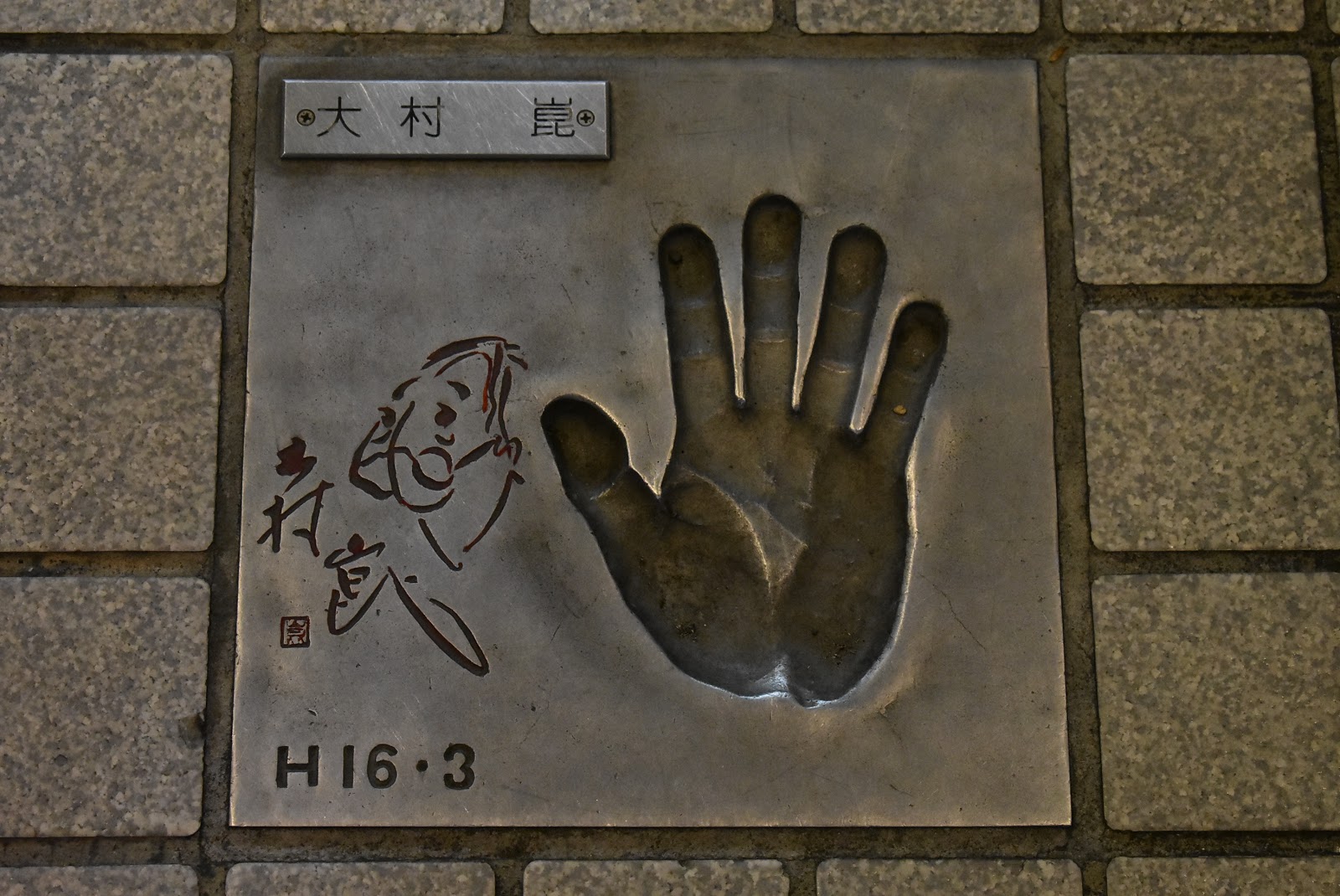
Kon Omura, star of Gamera vs. Guiron (1969) and Gamera vs. Jiger (1970).


Izumi Yukimura, star of The Princess of Badger Palace (1958), Desperado Outpost (1959), Ichimatsu Travels with Ghosts (1959), and You Can Succeed, Too (1964).


Norihei Miki, star of Songoku: The Road to the West (1959), The Three Treasures (1959), and Deathquake (1980).


Toshiro Mifune, star of Rashomon (1950), Seven Samurai (1954), and The Three Treasures (1959).


Frankie Sakai, star of The Last War (1961) and Mothra (1961).


Machiko Kyo, star of Rashomon, Gate of Hell (1953), and Ugetsu (1953).


Yuzo Kayama, star of the Young Guy series and Espy (1974).

Wednesday, April 17, 2019

Portrait of Brothers

 Signage at the Portrait of Brothers press screening. Photo by Brett Homenick.

I was invited to attend a press screening of Shinichi Yanagisawa's newest film, Portrait of Brothers, which I attended today. The film is set to open in Japan on May 25. Shinichi Yanagisawa, one of the movie's stars, would be best known to readers of this blog as the comic-relief character Miyamoto in The X from Outer Space (1967), though his other work at Nikkatsu and Shochiku studios is certainly more prestigious. Yanagisawa co-stars with Choei Takahashi, who played the male lead in Toho's vampire thriller Lake of Dracula (1971).


Portrait of Brothers is a drama about two elderly brothers who reunite in the small town in which they grew up after the death of their 100-year-old father. The focus is mostly on Takahashi's character, a quiet, serious man who still lives in the small countryside town in which he grew up. Yanagisawa plays the older brother, a more worldly bon vivant living in Tokyo. Yanagisawa's character returns to his hometown after their father passes away, but the completely different lifestyles of the two brothers cause more than a few clashes among them.

Those who enjoy the family dramas of Yasujiro Ozu and Mikio Naruse will probably enjoy this movie. More often than not, the movie moves at a slow, deliberate pace, which will no doubt put off some Western viewers. But the portrait of countryside life in Japan in Portrait of Brothers is authentic, and if you're interested in seeing a slice of life from a point of view not often reflected in the movies, I would recommend this film. Besides, those countryside scenes are absolutely stunning.

I would also like to point out that the always lovely Izumi Yukimura (the leading lady of Toho's all-star musical You Can Succeed, Too) has a brief cameo at the very end of the film. It's a very short scene, but she's always a welcome presence in any film in which she appears.

The trailer for Portrait of Brothers is below. I hope those interested in Japanese cinema will give it a look.

Monday, June 25, 2018

CONCERT TIME! Attending a Live Performance by One of Japan's Living Legends!

Izumi Yukimura. Photo by Brett Homenick.

On Friday, June 22, I had the distinct privilege of attending another live performance by Izumi Yukimura. Yukimura-san sang many of her old favorites, and by now I've become quite familiar with them. Of course, I mainly know Yukimura-san for her acting roles at Toho, which include Kihachi Okamoto's Desperado Outpost (1959) and the all-star musical You Can Succeed, Too (1964).


Yukimura-san has been one of my favorite folks to visit in Japan. But I have to confess: Before I came to Japan, I had no idea who she was! Thankfully, that was quickly corrected, and I've been her fan ever since.

Thursday, May 17, 2018

A Toho All-Star Flick in Ikebukuro

Arashi o yobu gakudan at Ikebukuro's Shin-Bungeiza. Photo by Brett Homenick.

Last night, I went to the Shin-Bungeiza theater in Ikebukuro to take in a late-night screening of Arashi o yobu gakudan (1960), an all-star Toho musical with several notable actors from the studio. Among the featured players are: Akira Takarada, Tadao Takashima, Izumi Yukimura, Tatsuyoshi Ehara, and Shinichi Yanagisawa.

I've known about this movie for years but have never had to chance to see it ... until last night. It's a mostly light-hearted take on a jazz band that organically comes together and achieves almost overnight success. However, love (and egos) get in the way, and soon the members break up and go their separate ways. But will they get back together before the ending?

It was an enjoyable film, and I especially enjoyed seeing Shinichi Yanagisawa in a Toho movie. (Yanagisawa-san is better known for his Nikkatsu and Shochiku roles.) Folks who need monsters in their Toho movies are really missing out. Last night was a great night at the movies.

Friday, December 22, 2017

CHRISTMAS WITH IZUMI YUKIMURA! The Celebrated Actress-Singer Performs Live in Roppongi!

Izumi Yukimura. Photo by Brett Homenick.

Tonight, I attended a special Christmas dinner show performed by Izumi Yukimura, one of Japan's most popular singers of the postwar era. She also starred in numerous Toho movies during the 1950s and '60s, including Kihachi Okamoto's classic Desperado Outpost (1959) and the all-star musical You Can Succeed, Too (1964). Not only that, but her credits include Ichimatsu Travels with Ghosts (1959) and The Princess of Badger Palace (1958), which owe more to the genre we're all interested in.


I'm glad I got to spend time with Yukimura-san after the show. She is doing very well and was in high spirits, even joking around a bit. I certainly hope there's another show next Christmas. If so, I'll most certainly be there!

Monday, May 8, 2017

WHO'S WHO IN HIBIYA CHANTER! Identifying the Japanese Actors!

 The Godzilla statue in Hibiya Chanter. Photo by Brett Homenick.

Hibiya Chanter is known to fans in the West for its Godzilla statue, which was erected there in 1995. There's also an area very similar to Hollywood's Walk of Fame, which honors several Japanese actors. But who are they? Which ones might Westerners want to see? Here's a handy guide.


Akira Takarada -- the star of Godzilla (1954), Godzilla vs. the Thing (1964), Monster Zero (1965), and Godzilla vs. the Sea Monster (1966).


Yosuke Natsuki -- the star of Ghidrah the Three-Headed Monster (1964), Dogora the Space Monster (1964), and Godzilla 1985 (1984).


Toshiro Mifune -- the star of numerous Akira Kurosawa films, as well as The Three Treasures (1959), The Lost World of Sinbad (1963), Adventure in Kigan Castle (1966), and Princess from the Moon (1987).


Izumi Yukimura -- the Japanese singing star who appeared in many films for Toho, including the genre-ish The Princess of Badger Palace (1958) and Ichimatsu Travels with Ghosts (1959).


Keiju Kobayashi -- one of the stars of Submersion of Japan (1973) and Godzilla 1985.


Ken Takakura -- one of Japan's most popular leading men, whose yakuza films are still widely seen in Japan.


Tadao Takashima -- the star of King Kong vs. Godzilla (1962), Atragon (1963), Frankenstein Conquers the World (1965), and Son of Godzilla (1967).


Ken Uehara -- one of Japan's leading men in the 1930s, but better known in the West for his supporting roles in Mothra (1961), Gorath (1962), and Atragon.


Hisaya Morishige -- one of Toho's most bankable actors during the Showa era, starring in the long-running Shacho series. He appears in Sayonara Jupiter (1984) as the Earth Federation President.


Yuzo Kayama -- the handsome star of Toho's Young Guy series, who also appeared in several war films with SFX by Eiji Tsuburaya.


Yuriko Hoshi -- the female lead of The Last War (1961), Godzilla vs. the Thing, and Ghidrah the Three-Headed Monster.


Frankie Sakai -- a successful comedy actor whom Westerners would know best as the star of the original Mothra.


Yasuko Sawaguchi -- Godzilla 1985's leading lady, who also had turns in Godzilla vs. Biollante (1989) and Orochi the Eight-Headed Dragon (1994).


Kyoko Kagawa -- one of the stars of Yasujiro Ozu's seminal Tokyo Story (1953) and the sci-fi classic Mothra.

Tuesday, December 13, 2016

IZUMI YUKIMURA SINGS JAZZ! A Christmas Concert in Tokyo!

Yours truly with actress-singer Izumi Yukimura.

Tonight, I had the distinct privilege of seeing a live performance by Izumi Yukimura, the legendary singer and actress. She was a member of the enormously popular singing trio Sannin Musume with Hibari Misora and Chiemi Eri, with whom she starred in several musicals at Toho Studios during the 1950s. She also appeared in movies for director Kihachi Okamoto, including the all-star war actioner Desperado Outpost (1959).


Yukimura-san even appeared in some genre (or perhaps "genre-ish") films for Toho, including the lighthearted fantasy The Princess of Badger Palace (1958) and Ichimatsu Travels with Ghosts (1959).


It was so nice to see Yukimura-san again after such a long time. Her English is very good, which naturally makes communication with her a breeze. She's also very friendly and open-minded. She very kindly signed a couple of DVD sleeves for me. I just hope it won't be so long before I see her again!

Wednesday, May 27, 2015

TOHO HISTORY IN HIBIYA CHANTER! Chiyoda Pays Tribute to Toho's Best!

The Godzilla statue in Hibiya Chanter. Photo by Brett Homenick. 

Today I went to Ginza, and among the things I did, I paid another visit to Hibiya Chanter, which is overflowing with Toho history. Most of us know about the Godzilla statue which was erected in 1995, but what is not as well known are the various hand prints of celebrities that decorate the square, almost like the Hollywood Walk of Fame. While there are many familiar Toho stars who are recognized among the hand prints, I will highlight the stars that have been regularly spotlighted on this blog.

Izumi Yukimura's hand print in Hibiya Chanter.

Yosuke Natsuki's hand print in Hibiya Chanter. 

Akira Takarada's hand print in Hibiya Chanter. 

Yuriko Hoshi's hand print in Hibiya Chanter. 

Godzilla stands tall above Hibiya Chanter.