Showing posts with label Frankie Sakai. Show all posts

Wednesday, November 22, 2023

Catching a Screening of 'Mothra' in 35mm!

The Laputa Asagaya. Photo by Brett Homenick.

Earlier today (Wednesday, November 22), I was privileged to catch a screening of the Toho classic Mothra (1961) in 35mm at the Laputa Asagaya. The screening is part of a special program celebrating the 25th anniversary of the theater with new film prints of specially selected works.


When Mothra saw its 4K screenings at Toho Cinemas around Tokyo a while back, I decided not to go, which I now deeply regret. Chalk it up to laziness -- I just didn't want to get up that early in the morning to see it. So, in a way, this screening makes up for the fact that I missed the 4K version. The 35mm print had a few scratches and imperfections here and there, but otherwise it looked in pristine shape. It was a great way to see the film!

Today's film lineup. Photo by Brett Homenick.

Regarding the film itself, what could I say that hasn't been said a thousand times already? It's a classic, and I feel very fortunate I was able to see such a wonderful 35mm print of it. I didn't notice very many fun details that I've seen in other such theatrical screenings, but it was a joy to take in all the tokusatsu greatness onscreen. 


There were quite a few people at the screening, but the theater was only about half full. I was kind of worried about a sellout (there were some screenings earlier this year that came dangerously close to one), but in retrospect I needn't have worried. All in all, it was a fun way to spend an afternoon.

Sunday, November 5, 2023

THE STAR GALLERY! Toho Stars Triumphantly Return to Hibiya!

The Star Gallery in Tokyo Midtown Hibiya. Photo by Brett Homenick.

By sheer coincidence, I found The Star Gallery in the basement of Tokyo Midtown Hibiya. On Saturday, November 4, an advertisement for Godzilla Minus One (2023) caught my eye, and, as I approached it to take a picture of it, I suddenly discovered The Star Gallery, which was right next to it.

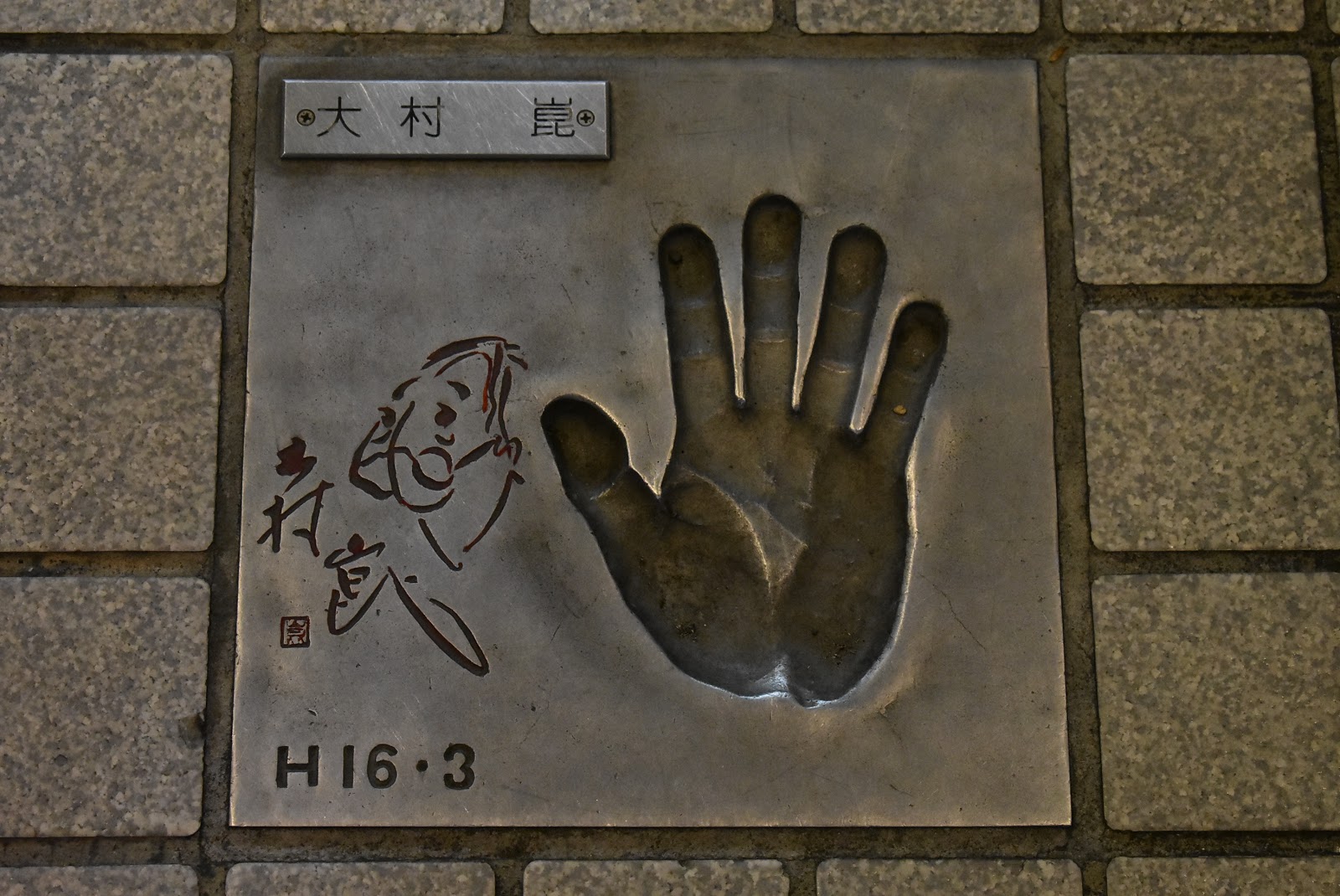
The Star Gallery contains all the hand casts of Toho stars that was removed from the old Hibiya Chanter Square in late 2017 in anticipation of the area's renovation. I never found out what had happened to those hand casts and figured they were tossed into storage somewhere or worse. 

So you could imagine my surprise when I accidentally stumbled upon those same hand casts on the wall of Tokyo Midtown Hibiya some six years later. I was ecstatic to find it and snapped some photos. I'll highlight some of the names below.


With Izumi Yukimura's hand cast.

With Yuriko Hoshi's hand cast.

With Frankie Sakai's hand cast.

With Yosuke Natsuki's hand cast.

With Akira Takarada's hand cast.

Monday, October 2, 2023

Jerry London Talks 'Shogun' on Vantage Point Interviews!

Director Jerry London poses with a samurai helmet during the making of Shogun. Photo © Jerry London.

Shogun (1980) is one of the most successful TV miniseries of all time. It was completely shot in Japan, partially at Toho Studios, and starred the likes of Toshiro Mifune, Frankie Sakai, and many other familiar faces from the golden age of Japanese cinema. Jerry London directed the miniseries, and he shares his memories of the shoot in a brand-new Q&A with Vantage Point Interviews. Check it out today!

Thursday, March 2, 2023

A Double Feature at the Laputa Asagaya!

Signage for the Laputa Asagaya's Yuzo Kawashima Retrospective. Photo by Brett Homenick.

Tonight -- that's Thursday, March 2 -- I returned to the Laputa Asagaya a bit earlier than I expected. A new film program has started, the Yuzo Kawashima Retrospective. As you've probably gathered, the retrospective focuses on the career of director Yuzo Kawashima. Tonight's film was a 35mm print of Romance Express (1961), a comedic ensemble featuring several notable Toho performers. I've wanted to see the film for a while, having seen some publicity stills that make the flick look like a lot of fun. The timing was good, so I went to the theater to check it out.

Publicity material for Romance Express (1961) in the theater lobby. Photo by Brett Homenick.

The film stars Frankie Sakai, who in the story is in a relationship with the leading lady, Reiko Dan. Sakai plays a cook working the dining car of a Kodama limited express train, and Dan plays a waitress who also works on the train. There's a bit of a love triangle involving Yumi Shirakawa, who plays a train attendant.

Reiko Dan wants to marry Frankie Sakai, but, because she wants to open a bento shop after they get married, Sakai isn't sure about the proposal. So he has six and a half hours -- the time it takes for the train to travel from Tokyo to Osaka -- to make his decision.

In addition, a lot of assorted kookiness takes place on the train, including the shenanigans of a lecherous company president, a loud, drunken weirdo, and pickpocket gang. As if that weren't enough, there's also a bomb scare to top things off. 

If that sounds even remotely serious, don't worry; it's not. In fact, Frankie Sakai has a slapstick fight with the pickpockets toward the end of the movie, complete with over-the-top, cartoonish sound effects. It's all done for entertainment and laughs. The movie is presented in black and white, but I think a movie this metaphorically colorful would have easily benefited from some literal color.

Oh, and I briefly spotted Shigeo Kato standing on a train platform and Haruo Nakajima as the Kodama driver. Fun stuff!

A Romance Express poster in the theater lobby. Photo by Brett Homenick.

Another note of interest is that the score was composed by Riichiro Manabe. Kaiju fans typically don't think of Manabe as having scored Toho movies during the golden age, but here's an example of his having done just that. The score itself matches the light-hearted tone of the proceedings, and it even reminded me a bit of the score to Roger Corman's The Little Shop of Horrors (1960) in places. 

The last scene takes place completely without dialogue. The camera is positioned outside the train, so the audience can only see the action take place inside the train, but it follows the characters as they move around inside. In this scene, Frankie Sakai gives Reiko Dan his answer about their getting married. It's all cleverly done, and it's a fun visual experience.


After the movie, I decided to hang around and catch another screening of Goke Body Snatcher from Hell (1968) -- again, in glorious 35mm -- as part of the Science Fiction Film Festival. Even though I literally just saw it a few days ago, I was up for another screening. I don't have anything to add to my blog post from a few days ago, other than to say I never got bored watching it again so soon after the last time and enjoyed it immensely again. What a great film! 

Wednesday, February 19, 2020

Japanese Movie Stars Give Asakusa Public Hall a Hand!

Asakusa Public Hall. Photo by Brett Homenick.

After Hibiya Chanter Square was renovated and renamed Godzilla Square, its Walk of Fame of Toho star was unceremoniously discarded. Thankfully, Asakusa Public Hall still maintains its Plaza of Stars, a similar area honoring many of Japan's biggest names in entertainment. Among them are a few performers familiar to readers of this blog. Let's check them out.

Asakusa Public Hall's Plaza of Stars. Photo by Brett Homenick.


Kon Omura, star of Gamera vs. Guiron (1969) and Gamera vs. Jiger (1970).


Izumi Yukimura, star of The Princess of Badger Palace (1958), Desperado Outpost (1959), Ichimatsu Travels with Ghosts (1959), and You Can Succeed, Too (1964).


Norihei Miki, star of Songoku: The Road to the West (1959), The Three Treasures (1959), and Deathquake (1980).


Toshiro Mifune, star of Rashomon (1950), Seven Samurai (1954), and The Three Treasures (1959).


Frankie Sakai, star of The Last War (1961) and Mothra (1961).


Machiko Kyo, star of Rashomon, Gate of Hell (1953), and Ugetsu (1953).


Yuzo Kayama, star of the Young Guy series and Espy (1974).

Monday, May 8, 2017

WHO'S WHO IN HIBIYA CHANTER! Identifying the Japanese Actors!

 The Godzilla statue in Hibiya Chanter. Photo by Brett Homenick.

Hibiya Chanter is known to fans in the West for its Godzilla statue, which was erected there in 1995. There's also an area very similar to Hollywood's Walk of Fame, which honors several Japanese actors. But who are they? Which ones might Westerners want to see? Here's a handy guide.


Akira Takarada -- the star of Godzilla (1954), Godzilla vs. the Thing (1964), Monster Zero (1965), and Godzilla vs. the Sea Monster (1966).


Yosuke Natsuki -- the star of Ghidrah the Three-Headed Monster (1964), Dogora the Space Monster (1964), and Godzilla 1985 (1984).


Toshiro Mifune -- the star of numerous Akira Kurosawa films, as well as The Three Treasures (1959), The Lost World of Sinbad (1963), Adventure in Kigan Castle (1966), and Princess from the Moon (1987).


Izumi Yukimura -- the Japanese singing star who appeared in many films for Toho, including the genre-ish The Princess of Badger Palace (1958) and Ichimatsu Travels with Ghosts (1959).


Keiju Kobayashi -- one of the stars of Submersion of Japan (1973) and Godzilla 1985.


Ken Takakura -- one of Japan's most popular leading men, whose yakuza films are still widely seen in Japan.


Tadao Takashima -- the star of King Kong vs. Godzilla (1962), Atragon (1963), Frankenstein Conquers the World (1965), and Son of Godzilla (1967).


Ken Uehara -- one of Japan's leading men in the 1930s, but better known in the West for his supporting roles in Mothra (1961), Gorath (1962), and Atragon.


Hisaya Morishige -- one of Toho's most bankable actors during the Showa era, starring in the long-running Shacho series. He appears in Sayonara Jupiter (1984) as the Earth Federation President.


Yuzo Kayama -- the handsome star of Toho's Young Guy series, who also appeared in several war films with SFX by Eiji Tsuburaya.


Yuriko Hoshi -- the female lead of The Last War (1961), Godzilla vs. the Thing, and Ghidrah the Three-Headed Monster.


Frankie Sakai -- a successful comedy actor whom Westerners would know best as the star of the original Mothra.


Yasuko Sawaguchi -- Godzilla 1985's leading lady, who also had turns in Godzilla vs. Biollante (1989) and Orochi the Eight-Headed Dragon (1994).


Kyoko Kagawa -- one of the stars of Yasujiro Ozu's seminal Tokyo Story (1953) and the sci-fi classic Mothra.

Sunday, May 25, 2014

SHINJI CHUJO RULES! The Former Mothra Child Star Rocks Japan!

Musician Masamitsu Tayama performs at the Marquee club in Nerima, Tokyo. Photo by Brett Homenick.

The Toho classic Mothra (1961) is a great film for any number of reasons. Its SFX, writing, and acting are all top-notch. While much is known about Frankie Sakai, Hiroshi Koizumi, Kyoko Kagawa, and even Jerry Ito, precious little information seems to be available about one of the film's supporting players, Masamitsu Tayama.

Masamitsu Tayama signs Mothra memorabilia for yours truly. 

Tayama-san memorably played Shinji Chujo, the pudgy, mouse-loving boy who tries to save the Shobijin from the clutches of the evil Nelson. Unlike other child actors, like Godzilla vs. Megalon's Hiroyuki Kawase, Tayama-san remains a public figure, though he has since entered a completely different line of entertainment.


Although he is now a professional singer, Tayama-san has fond memories of Mothra, especially his co-star Hiroshi Koizumi. After the concert at Marquee, I was invited to dinner with Tayama-san, who graciously signed several autographs and was happy to take photos. I enjoyed our meeting and hope to get another chance to see him again.