Showing posts with label Gorath. Show all posts

Tuesday, August 20, 2024

A New Q&A on Vantage Point Interviews!

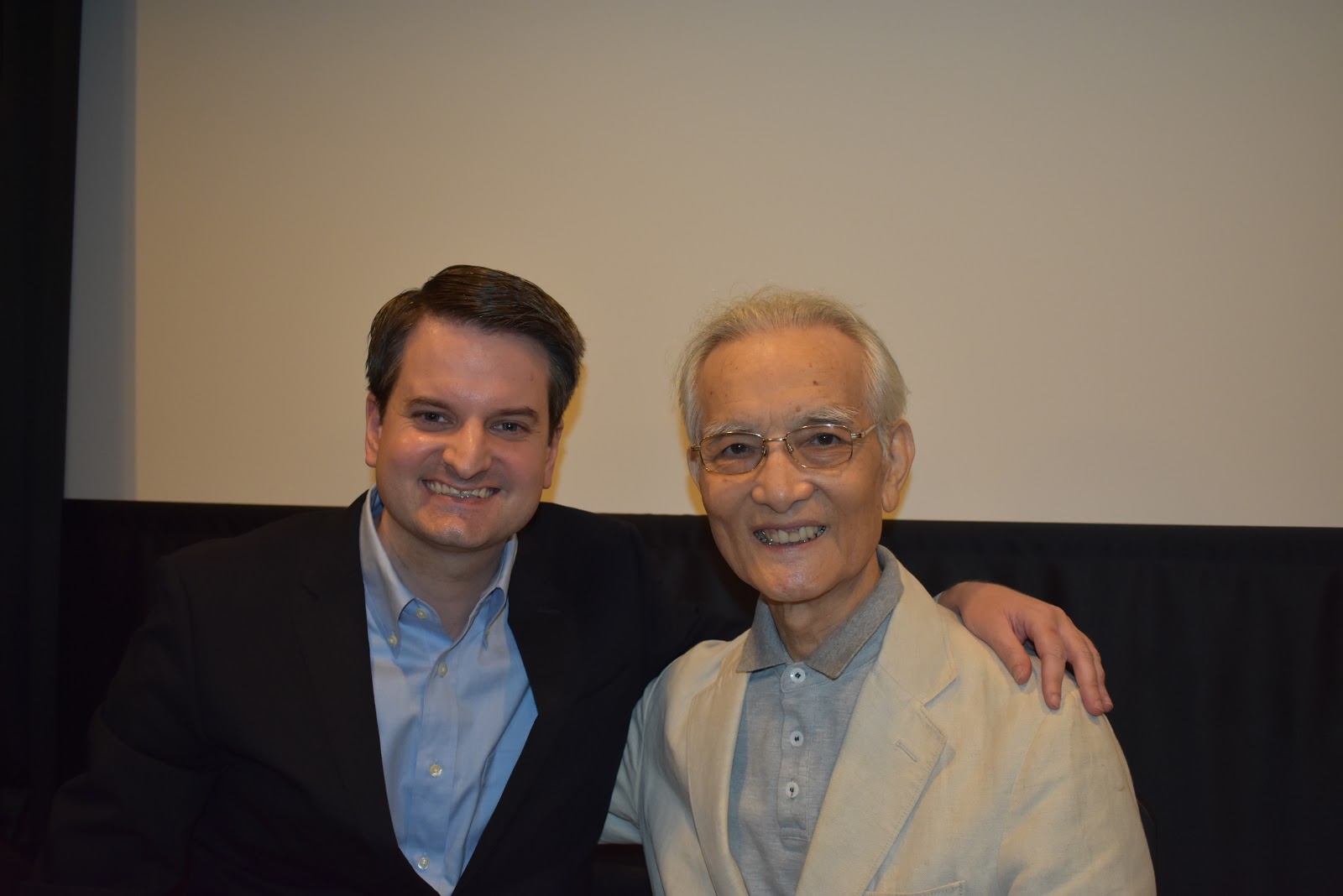
Takeshi Miyanishi in May 2022. Photo by Brett Homenick.
 
Check out the latest vintage account on Vantage Point Interviews with compositor and optical-effects technician Takeshi Miyanishi. Mr. Miyanishi began working at Toho with Gorath (1962) on the tokusatsu side. 

While his memories of the early days are no longer as strong as they once were, he has vivid memories of working with Akira Kurosawa on Kagemusha (1980) and working on Pulgasari (1985) in North Korea. 

It's all right there on Vantage Point Interviews. Don't miss it -- be there!

Tuesday, March 19, 2024

THE NAGASAWA FILTRATION PLANT REVISITED! A Filming Location for Many Tokusatsu Productions!

The Nagasawa Filtration Plant. Photo by Brett Homenick.

Today (Tuesday, March 19), I braved heavy winds to pay another visit to the Nagasawa Filtration Plant (a.k.a. the Nagasawa Purification Plant) in Kawasaki, Kanagawa. This particular building was used as a filming location for countless tokusatsu movies and TV programs dating back to the early 1960s.

Among other titles, it has been featured in Invasion of the Neptune Men (1961), Gorath (1962), episode 2 of Ultraman (1966-67), the Super Sentai series, and perhaps most famously as Jounan University's Institute of Biochemistry in Kamen Rider (1971-73).

I last visited the plant back in March 2016. Hard to believe it's been eight years, but there you go. At any rate, I clearly remember that you aren't allowed to get too close to the building without prior approval (such as joining an official tour of the facility), so I made sure to stay outside the gate. 

Still, as tokusatsu buffs, we're more concerned with the outside of the building than the inside since that's what we saw in our favorite flicks. It was great to see the plant again after so long. It isn't exactly the easiest spot to visit since it's quite far from any train station, which is the main reason it's taken me so long to return, but it's well worth seeing if you have the chance. Here are my snapshots from earlier today. Enjoy! 


Sunday, March 12, 2023

Feeling the Wrath of 'Gorath' in 35mm!

The National Film Archive of Japan. Photo by Brett Homenick.

Today (Sunday, March 12), I had the distinct privilege of seeing the Toho classic Gorath (1962) in 35mm on the big screen for the first time. It was screened as part of the National Film Archive of Japan's Women Who Made Japanese Cinema [Part 1]: From the Silent Era to the 1960s program. 

Which women in Japanese cinema does this screening honor? In particular, the pamphlet singles out Reiko Kaneko, who edited many of Ishiro Honda's films from the late 1950s through the '60s, as well as Kiyoko Ishii, who specialized in editing tokusatsu for the Tsuburaya group. Also noted in the pamphlet are SFX scripter Keiko Hisamatsu, costume designer Etsuko Yagyu, and costume staff member Setsuko Asaki. 

The screening was actually a double feature. The first movie screened was Female Detective Story: Woman S.O.S. (1958). This is a 58-minute, black-and-white comedy directed by Hisanobu Marubayashi, starring Yumi Shirakawa, Kenji Sahara, Yoshio Tsuchiya, and Akihiko Hirata. This movie marks another pairing of Shirakawa and Sahara, but, unlike their previous outings together, this is truly Shirakawa's movie, and Sahara is basically her sidekick.

As the title would suggest, the story centers around a female detective played by Shirakawa. While she was often cast as an Audrey Hepburn-style leading lady around this time, here she gets to show her acting range, playing a plucky, resourceful investigator named Nobue Ogawa of the Imperial Secret Detective Agency. In fact, her role sort of reminded me of the ones Yuriko Hoshi played in Godzilla vs. the Thing (1964) and Ghidrah the Three-Headed Monster (1964). She isn't even afraid to dole out a few slaps when getting some sass from a young female she's trying to help.

Shirakawa is asked by a prominent family to look into the background of the man their daughter Midori wants to marry. The daughter's suitor seems to be the character played by Akihiko Hirata, who also goes against type in this film, playing a crude and somewhat slovenly louse. In one scene, Hirata uses a child's dart gun to shoot a dart at the rear end of a female co-worker. However, in a surprising twist, it turns out that it's playboy Yoshio Tsuchiya who's the real villain of the film.

And what a villain he is. The film pulls no punches in showing what a cad he is with women. I won't go into details, but let's just say that Harvey Weinstein probably saw this movie and took notes. Shirakawa is hot on his trail, though, and even gets an assist from her partner, Tsuyoshi Kinoshita (played by Kenji Sahara) in her pursuit. Sahara plays a character who is good-hearted but bumbling and jealous, hardly the stuff of the leading-man roles he usually got around this time.  

Today's movies screened at the National Film Archive. Photo by Brett Homenick.

The film ends when Shirakawa and Tsuchiya enter a hotel room together with a hidden recording device planted there to record Tsuchiya's misdeeds. Sahara is monitoring the encounter in an adjoining room, but his aforementioned jealousy often crops up when listening to their rendezvous. The movie gets a little dark during the climax, as Tsuchiya tries to "MeToo" Shirakawa. Sahara comes to the rescue, and a big brawl ensues. Despite the seriousness of the subject matter, it's not handled quite that seriously and ends with Tsuchiya's jilted lover breaking a vase over his head to comedic effect. 

What an unusual movie! I'm really glad I saw this one, as I got to see all four leads playing against type. It was also fun seeing Shirakawa play a character who drove the story but was still able to maintain her femininity and sensuality. Very well done.

Almost immediately after the movie ended, Gorath started. I should point out that both films were screened in 35mm, and both films looked fantastic. I hardly noticed a flaw. They almost looked like 4K digital remasters, but they were advertised as 35mm, so I'm going to take their word for it.

I hadn't seen Gorath in many years -- maybe more than 20. I watched it quite a few times in the 1990s, and I guess you lose the impulse to watch a movie when you know it like the back of your hand. I still think the movie is quite good, but I did find that it was just a bit too talky with a few too many bland characters (played by Ryo Ikebe, Ken Uehara, and even Takashi Shimura) taking up too much screen time. I also found Magma's death scene surprisingly sad. I'm not sure how the filmmakers wanted me to feel seeing the bloody carcass of a creature that was hardly a monster lying dead after getting killed by laser beams, but it sure wasn't good. 

Overall, though, I did enjoy it. I just don't find it as successful as The Mysterians (1957) or even Battle in Outer Space (1959). It's got a great cast, and Akira Kubo really shines in it, but it gets a bit bogged down too often in talkiness to be considered one of the greats, in my humble opinion.


Oh, and while I was checking out the National Film Archives' horror movie poster gallery, I saw this sign posted as I was buying my ticket. It's for this kaiju-themed letterpress card collection. I didn't buy it, but I thought it was worth sharing.

Thursday, October 14, 2021

Hideaki Anno Exhibition in Roppongi!

Today, I ventured out to Roppongi's National Art Center to take in its Hideaki Anno Exhibition, which runs until December 19. When I first heard about the gallery, I have to admit that I had no interest in it, as I'm not particularly fond of Anno's work. That all changed when I saw that a good portion of the exhibit focused on Showa-era tokusatsu. In fact, it's almost like a small version of the Tokusatsu DNA exhibitions. That settled everything -- I was going.

I'll admit that my interest waned when the exhibition began focusing on Anno's career instead of the tokusatsu that inspired him. That said, the exhibition covers just about everything you'd ever want to know about him. If you were planning to write his biography, I'd even go so far as to say that this exhibition would be a requirement. It's extremely detailed! Anyway, let's get to the highlights.


The Mechagodzilla 2 suit from Terror of Mechagodzilla (1975).

The Moonlight SY-3 from Destroy All Monsters (1968). 

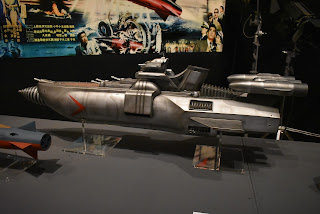
Capsule-1 from Gorath (1962).

The JX-1 Hayabusa from Gorath.

The Gohten from The War in Space (1977).

Another view of the Gohten.

Suits from Return of Ultraman (1971-72).

Flying props from Ultraman (1966-67), Godzilla vs. Megalon (1973), and Ultraseven (1967-68).

The rocket from The Space Giants (1966-67). 


Another view of the Jet Jaguar flying prop.

Spectreman, Mirrorman, Ultraseven, Jumborg Ace, and Jumborg 9 masks.


Shin Ultraman, Shin Godzilla, and Shin Kamen Rider.

Smile!


Tuesday, August 24, 2021

'Ultraman's' Masanari Nihei Passes Away at 80

Masanari Nihei in August 2015. Photo by Brett Homenick.

Actor Masanari Nihei passed away on August 21 of aspiration pneumonia at age 80. A private funeral has already been held.

Mr. Nihei was born on December 4, 1940, in Nagatacho, Tokyo. He was selected as a member of the 15th Toho New Face class in 1960 and made his film debut in 1961. He was often featured in the Young Guy series with Yuzo Kayama and various Crazy Cats flicks throughout the decade. He even turned up in several tokusatsu productions at Toho, most notably Gorath (1962). 

Masanari Nihei (right) poses with fellow Ultra-series luminary Koji Moritsugu. Photo by Brett Homenick.

Mr. Nihei would get his big break in 1966 when Ultraman (1966-67) was launched on Japanese television. Playing Science Patrol member Ito (Ide in the Japanese version), he would ultimately become one of the most recognizable characters in the Ultra-franchise.

I was privileged to meet Mr. Niehei just once. It was an event held in August 2015 with Ultra Seven’s Koji Moritsugu. Mr. Nihei was very friendly and full of energy. He was really enjoying himself at the event, so I was surprised that it seemed he never turned up anywhere else. But I’ll always remember that fun afternoon with Nihei-san.

Rest in peace, Nihei-san.

Friday, October 25, 2019

"Happy" Days Are Here Again!

Yasuhiko Saijo. Photo by Brett Homenick.

Earlier tonight, I attended a special event with actor Yasuhiko Saijo, who is best known for playing Ippei Togawa (a.k.a "Happy") in Tsuburaya Productions' Ultra Q (1966). Saijo-san got his start as a Toho actor, appearing in such tokusatsu classics as The Secret of the Telegian (1960), Gorath (1962), Son of Godzilla (1967), and Destroy All Monsters (1968).

Yasuhiko Saijo in a replica Ippei jacket and cap. Photo by Brett Homenick.

I had a very fun chat with Saijo-san. When I mentioned the "We Are Space Pilots" song from Gorath (which Saijo-san has sung at recent events in Tokyo), he almost doubled over in laughter. The conversation covered a variety of topics, including Toho directors and his Ultra Q memories.


A fun time was had by all. I've met Saijo-san several times before, and this time was certainly among the most fun. Even though I was completely exhausted after work, I thoroughly enjoyed myself. Let's do it again soon!

Monday, September 17, 2018

MATANGO! Viewing the Toho Classic in 35mm!

Akira Kubo. Photo by Brett Homenick.

Today I was lucky enough to take in a 35mm screening of the Toho classic Matango along with Toho star Akira Kubo. Matango, of course, is one of Toho's most effective horror films, and it was quite fun to be able to look over at Kubo-san's reactions during some of the key scenes.


I hadn't seen Kubo-san in close to three years, and not only did he remember me, it was wonderful to see him doing so well. All in all, it was quite a day!

Thursday, June 16, 2016

Yumi Shirakawa: One Glorious Day

Toho star Yumi Shirakawa in May 2015. Photo by Brett Homenick. 

Writing this blog entry will be difficult for a few reasons. First, there's a lot to say. Second, I don't want to say too much. Third, the news of Shirakawa-san's passing is still a bit too fresh in my mind. Still, some of my blog readers requested more details about my meeting Shirakawa-san, and I thought it was a splendid idea. Here goes.

Yumi Shirakawa breaks into laughter when presented with a piece of memorabilia for her to sign, as Yosuke Natsuki looks on. Photo by Brett Homenick. 

I met Yumi Shirakawa for the first and only time on Sunday, May 3, 2015. The event was Akira Takarada's 81st birthday celebration, which took place in a restaurant high up the Tokyo Metropolitan Government Building (a.k.a. the Tax Towers). The event was a star-studded one, and it featured several celebrity guests who rarely (if ever) make personal appearances. The luminaries included: Yumi Shirakawa, Yuriko Hoshi, Yosuke Natsuki, Machiko Naka, Akira Wakamatsu, and several others. The guest who jumped immediately out to me was Yumi Shirakawa. There's a reason for that.

Yosuke Natsuki and Yumi Shirakawa, two Toho stars who remained close friends for decades. Photo by Brett Homenick. 

Yumi Shirakawa is my favorite actress. She an aura and a presence onscreen unlike any other actress I've seen. Watch her in The H-Man (1958) and The Secret of the Telegian (1960), and you're likely to see what I mean. She was beautiful, feminine, vulnerable, and ethereal. There was something about her that appealed to me more than any other Toho actress. She seemed a bit mysterious to me, and I liked that.

In fact, when I was planning a move to Japan, Yumi Shirakawa was at the top of the list of actors and actresses I wanted to meet. No joke. She was always in the number-one spot. I knew it wouldn't be easy, but it was a challenge I couldn't refuse. It was worth doing.

A fun group shot featuring Yumi Shirakawa and many of her co-stars. Photo by Brett Homenick. 

I didn't get my opportunity until four years into my stay. Yosuke Natsuki gave me a big assist, and I will always be grateful for his help. Not only did Natsuki-san personally introduce me to her, but he invited me to sit at the table reserved for the special guests with him and Shirakawa-san. I was the only fan at the event invited to do so. So I essentially got to spend the entire afternoon with Shirakawa-san, and even though she didn't speak English, I most certainly enjoyed our time together.

Actresses Yuriko Hoshi and Yumi Shirakawa listen to a speech. Photo by Brett Homenick. 

What impressed me most was how unlike her screen persona she was. She was open-minded, down-to-earth, and friendly -- not at all like the reserved and shy presence I saw in the movies. She also seemed to have an impish sense of humor. She was very close with Natsuki-san, and I snapped many photos of the two of them together on her camera. Of course, I was more than happy to make myself available to her for anything she needed.

Bin Furuya and Yumi Shirakawa pose for pictures. Photo by Brett Homenick. 

When the party moved to a nearby restaurant, Shirakawa-san was the only female guest to join us. When attendees and guests were taking seats, I intentionally tried to sit at a different table from Shirakawa-san and Natsuki-san (in order to give other fans a chance), but Natsuki-san wouldn't hear of it, and he insisted I sit with them. At the restaurant, Shirakawa-san posed for many photos (including a few with Bin Furuya) and signed many shikishi boards and DVDs. She seemed amused by seeing so many fans of her movies. When I asked a few of my friends who their favorite guest of the day was, they unanimously said Yumi Shirakawa. I agreed.

Yours truly with Yumi Shirakawa.

Look at this picture, and you'll see why. A picture truly does speak a thousand words -- and more. I couldn't tell you how excited I was to meet her, but she looks much more excited than I do! Unfortunately for them, a lot of tokusatsu fans in the Western world never seemed very interested in Shirakawa-san, probably because she never starred in a Godzilla movie. Those people truly missed out on an exceptional person, someone I am honored to have met.

And now she's gone. I took the news of her passing pretty hard. She gave me a lot to look forward to, as I was confident our paths would cross again. The world seems like a darker place without her. Seems like? Okay, I'll say it. It is a darker place without her.

Rest in peace, Shirakawa-san. Your life brought joy to so many others. I'll always remember.

Wednesday, June 15, 2016

Yumi Shirakawa Remembered

Yumi Shirakawa poses with a fan at gathering in Tokyo. Photo by Brett Homenick.

On June 14, Toho actress Yumi Shirakawa died of heart failure at the age of 79. She starred in such Toho classics as Rodan (1956), The Mysterians (1957), The H-Man (1958), The Secret of the Telegian (1960), The Last War (1961), and Gorath (1962). In 1964, she married Nikkatsu star Hideaki Nitani, who would later star in the Tsuburaya Productions TV series Mighty Jack (1968).  

Yuriko Hoshi, Yosuke Natsuki, and Yumi Shirakawa pose for pictures. Photo by Brett Homenick. 

I had the distinct honor (a word I most certainly don't use lightly) to meet Shirakawa-san at an event in Tokyo in May 2015. It was billed by the organizers as a once-in-a-lifetime event, and I couldn't disagree with that assessment. Stars like Shirakawa-san, Yuriko Hoshi, Yosuke Natsuki, Akira Takarada, Machiko Naka, and others gathered to celebrate Takarada-san's 81st birthday. Thanks to Natsuki-san, I was able to spend quite a bit of time around Shirakawa-san.


I'd always hoped to visit Shirakawa-san again, but I will always cherish the memories of that afternoon when I was able to meet my favorite actress in person. I couldn't have asked for a nicer, warmer person to meet.

Rest in peace, Shirakawa-san.