Saturday, June 3, 2017

NARA PARK! Feeding Wild Deer Some Delicious Shika Sembei!

 Signage in Nara Park warns visitors of the potential dangers of interacting with the wild deer. Photo by Brett Homenick.

During my trip to Kansai, I made a brief visit to Nara, which is accessible from Kyoto on the JR Nara Line. One of my goals was to visit Nara Park where wild sika deer roam freely and can be fed shika sembei (deer crackers) that can be purchased by visitors at the park. While some deer are well behaved and perform a bow to show their desire for a cracker, others are not so calm. It's not uncommon for deer to tug at your shirt or to try to snatch the crackers from your hand. Remember, these are wild animals. Treat them as such. 

Here are my photos from my wild sika deer encounter. Enjoy!


Friday, June 2, 2017

FUSHIMI INARI TAISHA! Walking Through a Sea of Torii Gates in Kyoto!

Kyoto's Fushimi Inari Taisha. Photo by Brett Homenick.

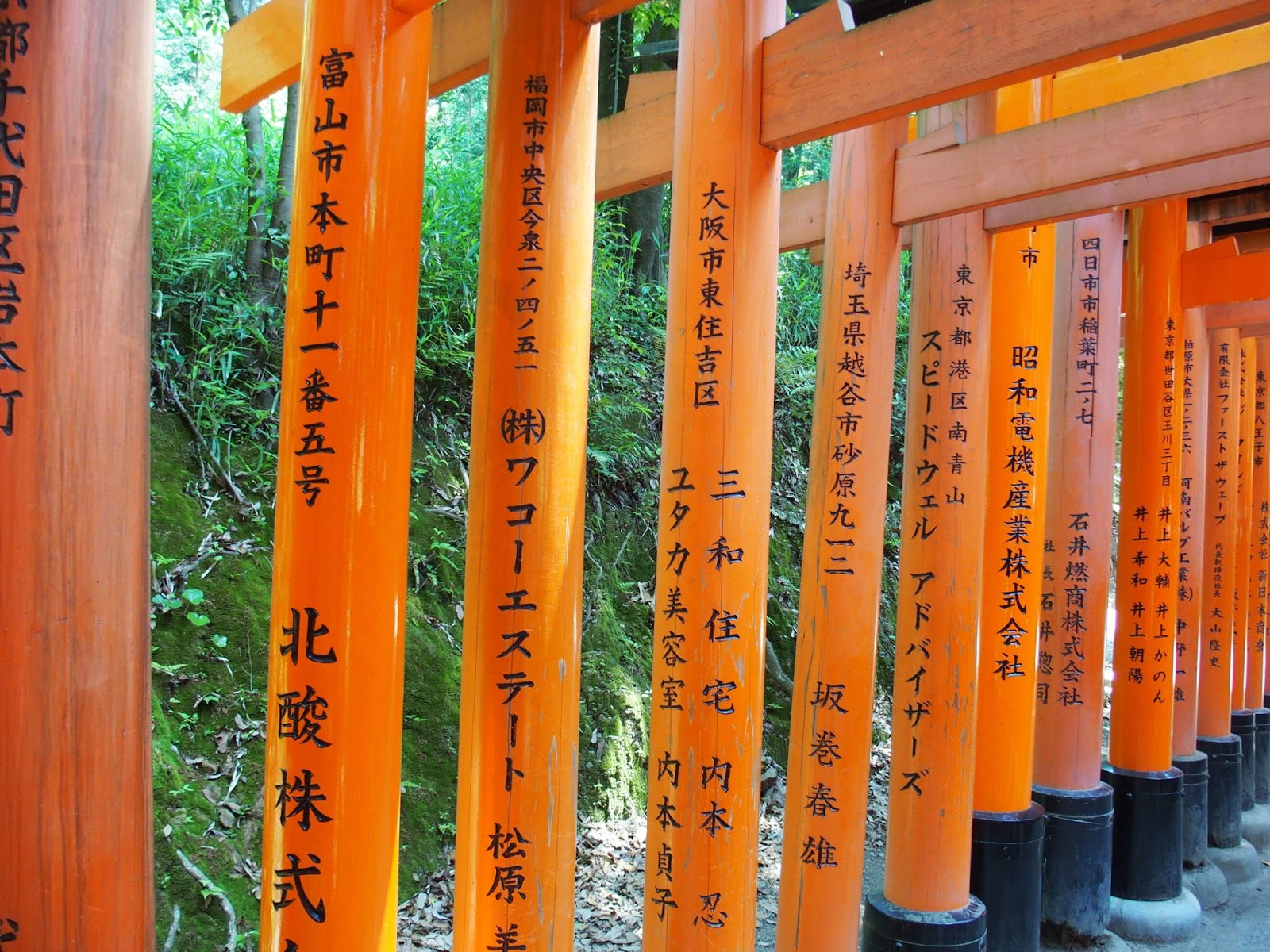
Despite having visited Kyoto in the past, one tourist location that I'd missed was Fushimi Inari Taisha, located just outside of Inari Station on the JR Nara Line. What sets this shrine apart from all the rest are the seemingly endless torii gates you pass through on the hike along Inariyama. While Fushimi Inari Taisha may not be as well known as the Golden Pavilion or many of the the other more famous tourist spots in Kyoto, it still gets very crowded. Luckily, I was able to take a few photos of the torii gates without any tourists in them -- but just a few!


GODZILLA VS. BIOLLANTE LOCATIONS! Godzilla Invades Osaka!

Twin 21 in Osaka Business Park. Photo by Brett Homenick.

While in Osaka, I visited several locations seen in the Heisei series classic Godzilla vs. Biollante (1989), particularly those situated in and around Osaka Business Park. Godzilla attacks the area when the JSDF tries to infect the King of the Monsters with Anti-Nuclear Energy Bacteria (ANEB). Godzilla ends up destroying Twin 21 (seen above) after Gondo fires a rocket containing ANEB into Godzilla's mouth.

 The entrance to Twin 21. Photo by Brett Homenick.

During Godzilla's raid on Osaka, Gondo and his soldiers converge on Twin 21. The above location can be seen in the film.

The atrium inside Twin 21. Photo by Brett Homenick. 

Above is another location used in Biollante. The JSDF enters Twin 21 and gets into position to try to infect Godzilla with ANEB.

The big screen has been updated over the years, but it's still there. Photo by Brett Homenick.

Once the JSDF enters Twin 21, a big screen inside the atrium broadcasts Godzilla's approach. The screen may not be the exact same one from 1989 (for rather obvious reasons), but it's still in the same position.

 Sumitomo Castle Tower (left) and Hotel New Otani (right). Photo by Brett Homenick.

Within a short walking distance of Twin 21 is the Hotel New Otani, an unusually shaped hotel, over which the Super X2 flies during Godzilla's attack on Osaka. Sumitomo Castle Tower looms over the hotel.

 The skyline of Osaka Business Park. Photo by Brett Homenick.

Naturally, during Godzilla's raid, you get some nice shots of Osaka Business Park's skyline. While not a perfect match (how could it be?), this is essentially what you see in the movie.


That's about all for now. It was quite fascinating to see these locations up close and personal.

OSAKA CASTLE REDUX! Paying Another Visit to This Godzilla and Gamera Location!

Osaka Castle. Photo by Brett Homenick. 

A bit less than two years ago, I made my first visit to Osaka Castle. On May 31, while I had some time left over during my recent trip to Kansai, I decided to give Osaka Castle another look. Most Godzilla fans know it from the battle Godzilla and Angilas had in Godzilla Raids Again (1955), but lest we forget, Barugon also froze it in Gamera vs. Barugon (1966). Suffice it to say, the castle has seen its share of kaiju action over the years.


During this visit, I made an effort to find specific angles used in Godzilla Raids Again. I was pleased that I was able to find a few, but there are certainly more to find. Perhaps I'll find the rest in a future trip.

Osaka Castle's Sakuramon Gate. Photo by Brett Homenick. 

Sakuramon Gate is featured in Godzilla Raids Again, as the audience sees the fierce battle between Godzilla and Angilas rage behind the gate.

Osaka Castle's Sengan Turret. Photo By Brett Homenick.

Sengan Turret is also seen in Godzilla Raids Again, as we see the two massive kaiju battle in the background, while Sengan Turret sits in the foreground.


This angle of Sengan Turret is likewise seen in the film, and once again we see Godzilla and Angilas duking it out behind the wall.

And there you have it.

KOBE PORT TOWER! Visiting a Showa Gamera Kaiju Location!

Kobe Port Tower in Kobe, Japan. Photo by Brett Homenick.

On May 31, during my three-day trip to the Kansai area, I made a special stop in Kobe, and while I certainly enjoyed sampling some authentic Kobe beef, my main purpose was to visit Kobe Port Tower, about a 20-minute walk from Motomachi Station. 


Why did I want to visit this particular building? For me, it's one of the most iconic locations in any kaiju movie. (Your mileage may vary, of course.) While Kobe Port Tower is featured prominently in episode 15 of Ultra Seven (1967-68), I'm much more familiar with it from its appearance in Gamera vs. Barugon (1966). Barugon destroys the tower with the monster's massive tongue shortly after it lands in Kobe.


I first saw the scene sometime in the late 1980s as it was featured in Gamera Super Monster (1980), and at the time, I remember thinking that the tower was a pretty strange-looking building. It's stood out to me ever since, and when I came to Japan, it was always on my list as a place to visit.


While walking around the observation deck of the tower, I noticed the above sign. I figured Mystery Science Theater 3000 fans would get a kick out of it, especially since Gamera vs. Barugon was one of the earliest films featured on the show. I may not be an MST3K fan, but even I found the connection amusing.

The view of Kobe from the observation deck of Kobe Port Tower. Photo by Brett Homenick.

All in all, I enjoyed my brief visit to Kobe, and I'm glad I can finally scratch Kobe Port Tower off my to-do list. It was a lot of fun visiting this iconic location from my childhood years in person.

Unwrapping Bob Strickland, Kyoto's Resident Mummy Actor and Restaurateur

Bob Strickland (center) poses for a photo with rock star David Bowie, who often visited Kyoto.

In 2015, I blogged about the Japanese horror TV series Kyofu no Miira (1961), which is about a reanimated mummy. The series starred an American named Bob Strickland in the role of the mummy, and shortly after I became aware of his part in the series, I set out to contact him.

After doing some research, I found that he lived in Kyoto and owned a restaurant in the area. I made a call to the restaurant and spoke with his widow, Tokiko, who informed me that Strickland had died the year before.

Bob Strickland (second from the left) at his company, Continental Trailways Bus System.

It wasn't until the end of last month that I was able to return to Kyoto and set aside enough time to visit the restaurant myself in an attempt to find out more about Bob Strickland. I was warmly welcomed by Tokiko, who made available her various scrapbooks about her late husband and their restaurant. The following information about Strickland and his restaurant were culled from the various clippings found in the scrapbooks, as well as my conversations with Tokiko.

Bob Strickland in between former Vice President Hubert Humphrey and Muriel Humphrey.

Bob Strickland was born in Capitol Hill, Oklahoma. His family moved to California during his youth. There he attended Long Beach City College and Long Beach State College, from which he graduated in 1956. During his time in Los Angeles, Strickland worked as a bank clerk.

Former President Bill Clinton and Academy Award-winning actor Tom Hanks (and his family) have been among the many patrons at Ashiya Steak House.

In the beginning, Strickland arrived in Japan with the intention of becoming a student and probably had no expectations of becoming an entertainer. After arriving, he learned Japanese for about three years at the Kyoto Japanese Language School. He also studied Japanese art history simultaneously at Kyoto University. While a student, Strickland worked various jobs in the area to earn a living.

Bob Strickland and his wife, Tokiko.

Strickland eventually became a member of a comedy troupe called Warai no Okoku (Kingdom of Laughter) in Osaka where he apprenticed under Gannosuke Ashiya, a popular Osaka comedian. This apprenticeship more or less required Bob to become a gofer for Ashiya. Together, the two appeared on TV, the stage, and in three movies, and Bob drew attention for his performing in a regional Japanese dialect.

 The outside of Ashiya Steak House in Kyoto. Photo by Brett Homenick.

Two and a half years later, Bob was presented with the stage name Ashiya Ganta, which was likely the first time an American (or even a foreigner) was given such an honor. Given the boundless appreciation that Strickland had for his mentor, Bob legally changed his name to Robert Ashiya Ganta Strickland.

Tokiko remains busy at Ashiya Steak House to this day. Photo by Brett Homenick.

Not long thereafter, Strickland became the president of Continental Trailways Bus System. Moreover, Strickland and his wife, Tokiko, also founded Ashiya Steak House in Kyoto. Strickland designed the restaurant himself down to the smallest detail. The building itself was extremely old, having been unoccupied for about 10 years. His wife wanted to modernize the restaurant, but Strickland refused and wanted it to remain as authentic as possible. He even went so far as to wear a kimono and bow to his patrons in the traditional Japanese way.

Yours truly with Tokiko at Ashiya Steak House.

The high-priced steakhouse and gallery has attracted a number of celebrities and luminaries since its opening in the 1960s, including: former U.S. Secretary of the Treasury Henry Fowler, former Senate Minority Leader Hugh Scott (R-PA), former U.S. ambassador to Italy Clare Boothe Luce, and of course many Japanese movie stars like Ken Takakura. More recently, former President Bill Clinton and actors Tom Hanks and Clint Eastwood have dined there.

I had a wonderful time meeting Tokiko at Ashiya Steak House, and I'd recommend it to anyone who can afford spending a couple of hundreds of dollars on a delicious steak dinner. (Suffice it to say, it is most certainly not for travelers on a budget.) I'm also pleased to have unwrapped the mystery of the American actor who starred as a mummy in a Japan TV series more than 50 years ago.

Thursday, June 1, 2017

CREST OF THE WOLF! Seeing This (Sort of) Horror Movie at Laputa Asagaya!

The poster for Crest of the Wolf (1973) on display in the theater lobby. Photo by Brett Homenick.

Tonight, I returned to the Laputa Asagaya for a 35mm screening of Crest of the Wolf (1973), a pseudo-horror movie that has never really enthralled me that much. Those expecting a more traditional werewolf flick will certainly be disappointed. The werewolf scenes are incidental to the film, which plays more like a violent high school drama. 


What we do see of the werewolf isn't all that impressive, either. At some points, the lead actor is simply wearing a wolf mask (and retains his ability to speak), and at other times he's a full-blown wolf, attacking his enemies and causing untold amounts of blood spray. The effects of which are never really convincing.

There are no flashy transformation scenes, either. He just suddenly appears as a wolf. The rest of the movie is pretty trashy stuff (nudity, violence, etc.), especially from Toho. As I said, though, most of the movie revolves around a gang of violent high school thugs who don't take kindly to the new "lone wolf" student who does things his own way.

Here's a nice poster for Toho's Ichi ka bachi ka (1963) that was on display. Looks like a fun flick. Photo by Brett Homenick.

Still, screenings of Crest of the Wolf are extremely rare, so I wanted to take the opportunity to see it in 35mm. I'm glad I did, even though my opinion of the film hasn't changed much. It really isn't a bad film, and it does show a bit of stylistic flair, but let's face it, we're only seeing this movie because it has a monster in it. That's what we want, but it just doesn't deliver.

In Japan, the film is most notable for marking the screen debut of Yusaku Matsuda, a popular actor who went on to star as the main villain in Ridley Scott's Black Rain (1989), and who died shortly after completing that film. (Matsuda plays the leader of the high school gang in Crest of the Wolf.)