Showing posts with label Shinji Higuchi. Show all posts

Thursday, February 26, 2026

Seeing 'Gamera 3' in 4K!

Gamera 3 (1999) at Toho Cinemas. Photo by Brett Homenick.

On Wednesday, February 25, I caught a screening of Gamera 3 (1999) at Toho Cinemas Susukino in Sapporo. I don't believe I'd seen the movie since around 2004 when there was a screening of the flick in the Southern California area. I've always found the movie overrated, so I was curious if my opinion would remain the same after giving it a fresh look.

So let's fire up the Martin Scorsese memes, open up our Letterboxd accounts, and put our hands in the proper camera-frame pose to discuss this work of true "cinema."

The movie is impressive visually, both on the drama and special-effects side, but it's when we get to the story and characters that the movie begins to fall flat. Depicting a scenario in which kaiju invade the "real world" sounds intriguing on paper, but this movie demonstrates the pitfalls of pursuing such an overly-realistic story line rather concisely.

To the extent this movie reflects reality, it's just as boring and mundane as the reality it strives to emulate. Most people you're likely to meet in real life don't lead an existence you'd want to follow onscreen for 100 minutes, let alone 100 seconds. I'm afraid that's true of the majority of the characters we see here, most of whom are bureaucrats or scientists simply doing a job or obnoxious schoolchildren you'd like to send on a field trip to the Gamera graveyard at the bottom of the ocean.

The filmmakers have gone out of their way to ensure that many of the characters look and act exactly as they would off the screen, but that only diminishes the film, not enhances it. Would you have found Godzilla Minus One (2023) more impactful or less impactful had Shikishima had simply been an average solider tasked with stopping Godzilla with no personal backstory?

The impersonal nature of these characters doesn't sink to the abysmal lows of Shin Godzilla (2016), but maybe Hideaki Anno was taking notes while making his documentary where he apparently gave Shinji Higuchi the lion's share of credit for Gamera 3's success. (I'll have to take the Internet's word on that. I've never seen the documentary and never will.)

With that said, a few other characters are wayyyy on the opposite side of the spectrum. They become cartoonish but in repulsive ways, such as Kurata, the computer programmer. His scenes don't create conflict that intrigues the audience; they create X-Pac heat. The movie can't seem to decide if it wants to live in the real world of government bureaucracy and military protocol or in a heightened reality in which cloaked cultists babble on about ancient mysticism and monologue about using giant monsters to destroy humanity.

Ticket, please! Photo by Brett Homenick.

The character with the most backstory, of course, is Ayana. I suppose we're expected to feel some semblance of empathy for her due to the tragedy that befell her family, but she's wholly unlikable essentially from the moment she removes her hands from the car window during the 1995 flashback sequence, culminating in her Kubrick death stare in the rain during the climax of the film, as her brain has been on a constant loop of "noun verb revenge" since then.

Much is made online about the little boy who, largely through coincidence, survives the Shibuya attack and credits Gamera for saving his life while so many other innocent bystanders were massacred in the battle against Gyaos. This scene is often celebrated online as a sick burn against the Showa-era, "friend of all children" depiction of the creature, heralding the arrival of an edgier, hipster Gamera who has no time for whiny kids. So it's a real head-scratcher that Gamera goes out of his way to rescue Ayana, who, probably more than any one character in the film, is the true villain of the piece and is personally responsible for the deaths of numerous others and untold amounts of destruction. Absolutely irredeemable. Given that we're now in the midst of Ultimate Badass Gamera who doesn't suffer foolish humans gladly, he should have squashed her on sight.

Irys (or Iris -- OK, seriously, why can't there ever be one spelling of a Japanese monster's name? I seem to recall we all spelled it with the "y" back in the day, but Wikizilla uses an "i," so I'll just throw up my hands and let you figure it out) is a good enemy for Gamera, but it's not used to its full potential. The threat this creature posed to humanity was never clear, as it mostly seemed to menace a handful of people at a time. In fact, the climactic battle takes place in a largely empty train station in which about five or so people are directly imperiled -- hardly the stakes one would expect from the greatest, most cinematic kaiju movie of all time.

Oh, and the tentacles scene. Yeah, it's. . . something all right. I'll point out that, the first few times I saw it, it didn't leave much of an impression on me one way or the other. Around 2003, however, I was hanging out with the editor of a kaiju-oriented fanzine who smartened me up to the world of tentacle "content," shall we say, and even showed me an example of such content. (I never asked how he came to possess such content.) But it's hard to look at that scene and not arrive at the conclusion that it was a direct inspiration or reference. In that light, it makes the sequence uncomfortable in all the wrong ways.

Finally, I think Hideaki Anno should make another documentary where he takes personal credit for the film's success. I mean, I'm sure most of his hardcore acolytes would buy it, so why not?

In sum, I think Gamera 3 is a great visual experience, but it left me wanting in pretty much every other aspect. Since most of the characters and their motivations are bland and forgettable, I remember the players to the extent that I don't like them. In addition, the antediluvian spiritualism doesn't mesh well with the overly-realistic focus on "monsters in the real world." (I mean, pick a side here!) While the movie is wildly overrated, it isn't bad. If I were to rank the Heisei Gamera trilogy, this is how it would go: 

1) Gamera: Guardian of the Universe (1995)

2) Gamera 3

3) Gamera 2 (1996)

But I would legit take Gamera Super Monster (1980) over all of them put together, so take that for what you will.

Friday, August 12, 2022

Heisei Gamera Tokusatsu DNA, Part II!

Legion is ready to attack! Photo by Brett Homenick.

The second part of my pictures from the Heisei Gamera Tokusatsu DNA exhibit at Tokyo Tower. Enjoy!


Heisei Gamera Tokusatsu DNA, Part I!

Heisei Gamera Tokusatsu DNA! Photo by Brett Homenick.

Earlier today, I returned to Tokyo Tower to check out the Heisei Gamera Tokusatsu DNA exhibit that runs through the end of the month. Here's the first part of what I saw. Enjoy!


Thursday, May 19, 2022

'Shin Ultraman' (2022)

A poster for Shin Ultraman (2022) on display at Toho Cinemas Roppongi Hills. Photo by Brett Homenick.

I finally saw Shin Ultraman after almost a week after it was released. There was no major reason for the delay, other than timing. But, having seen the film at long last, here are my impressions.

Overall, it's the second-best kaiju-related movie that's come out since 2014. (I still put Godzilla: King of the Monsters in the top slot.) But that may not be quite the praise it probably sounds like. 

The first hour is by far the more entertaining half. It's full of nostalgia and references to mid-1960s Ultra-stuff. Things start to drag in the second hour, which becomes much talkier and less dynamic. Even Ultraman's battles suffer in the second hour. It just doesn't stay interesting.

But the extent to which I can even say that Shin Ultraman is "interesting" is a bit uncertain. I enjoyed the film when it was reminding me of the original Ultraman series (and, at the very beginning of the movie, Ultra Q). It felt like a genuine love letter to the work of the original Tsuburaya Productions craftsmen. Unlike Shin Godzilla, the use of the original series' music and sound effects wasn't out of place here. It was entertaining to see Showa-style monster battles with updated special effects (even if the CG was sometimes of questionable quality).

But I can also see all the above as a demerit. If a film's highlights are the things it borrows from other sources, how good can it really be? (Maybe Quentin Tarantino can help us answer that one.) Essentially, when Shin Ultraman wasn't waving references to the original Ultraman or Ultra Q in front of my face, I just wasn't invested.

That said, I do think the characters are a step up from Shin Godzilla. There were some amusing moments from most of the main cast. Some scenes involving Masami Nagasawa, though, have already caused a bit of controversy online. If the movie gets some kind of release in the U.S., well, I'm just saying it might be a good idea to stay off Twitter for a while. 

This was a tough review for me to write because my feeling about Shin Ultraman is basically lukewarm, and I just don't have that much to say about it. It's certainly not great, but it's also not bad. The fact that it isn't terrible, though, is probably cause for a bit of celebration. But what's good about the film are things we've already seen, quite frankly, done better. I'm also not as well versed in Ultraman lore as other tokusatsu fans are, so I'm afraid I just don't have any hot takes. 

It was all right, I guess.

Monday, April 25, 2022

'Shin Ultraman' Train Advertisement!

Here's a fun advertisement for Shin Ultraman (2022), spotted in a Japanese train the other night in Yokohama.

Sunday, November 7, 2021

Legends of Millennium-Era Tokusatsu Gather for a Special Evening!

Toshio Miike, Shinji Higuchi, and Makoto Kamiya pose for pictures. Photo by Brett Homenick.

Saturday, November 6, was a great evening for those who enjoy Millennium-era tokusatsu. Three luminaries who have earned their reputations in the last couple of decades headlined a special event just days after Godzilla's 67th birthday.

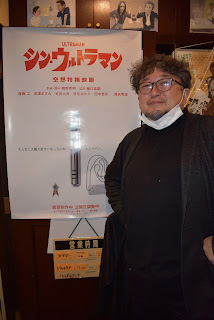
The guests in question were Shinji Higuchi, Toshio Miike, and Makoto Kamiya. Higuchi-san, fresh off directing the upcoming Shin Ultraman, was a particularly impressive guest.

Shinji Higuchi poses with a Shin Ultraman poster. Photo by Brett Homenick.

While I wasn't a fan of the film, I felt it was just too good an opportunity to pass up getting a couple of Shin Godzilla (2016) mini posters signed by one of the co-directors. It took me a while to dig them out, but I finally did after a lot of searching!

Higuchi-san was a lot of fun, and I enjoyed asking him about Ultraman: The Ultimate Hero, which he seemed fond of reminiscing about. 

Toshio Miike. Photo by Brett Homenick.

Also on hand was veteran SFX art director and production designer Toshio Miike, who has worked on: Gunhed (1989), Godzilla vs. King Ghidorah (1991), Zeiram (1991), Godzilla vs. Mothra (1992), Gamera: Guardian of the Universe (1995), Gamera 2 (1996), Gamera 3 (1999), GMK (2001), Godzilla against Mechagodzilla (2002), Godzilla: Tokyo S.O.S. (2003), Godzilla: Final Wars (2004), and Shin Godzilla (2016).

I actually didn't get to spend that much time with Miike-san this time, which was a shame, as he's one of the nicest guys around. I just happened to be seated next to Higuchi-san all evening, so it wasn't in the cards. But there's always next time!

Makoto Kamiya. Photo by Brett Homenick.

Kamiya-san, the remaining guest, was an assistant director of SFX from Godzilla vs. Biollante (1989) through Godzilla vs. Mechagodzilla II (1993), then served in the same capacity on Gamera: Guardian of the Universe (1995) through Gamera 3 (1999). After that, he became SFX director on GMK (2001) and Shinji Higuchi's Sinking of Japan (2006).


 And that's a wrap! Another night of tokusatsu history in the books. And what an evening it was!