Showing posts with label Toshiro Mifune. Show all posts

Monday, May 11, 2026

New Toho Q&A on Vantage Point Interviews!

Ryo Tamura in November 2023. Photo by Brett Homenick.

My new vintage account with Showa-era Toho actor Ryo Tamura has just been published. In his debut film, Rise Against the Sword (1966), Mr. Tamura played the younger brother of Toshiro Mifune and Makoto Sato in an epic directed by Hiroshi Inagaki. No pressure!


The interview covers a lot of ground, and it contains plenty of fascinating anecdotes about some of Japan's best-known actors and directors. Don't miss out!

Saturday, November 1, 2025

New 'Bushido Blade' Q&A at Vantage Point Interviews!

Mike Starr in April 2025. Photo by Brett Homenick.

Remember when Professor Nishiyama from The Last Days of Planet Earth (1974) and Pooter the Clown from Uncle Buck (1989) made a movie together? Actor Mike Starr certainly remembers, as The Bushido Blade (1981) was his first film! Long before Mike Starr appeared in GoodFellas (1990), Ed Wood (1994), Dumb and Dumber (1994), or even battled Russ Tamblyn in Cabin Boy (1994), he co-starred in Rankin/Bass' most obscure made-in-Japan film. Read all about it at Vantage Point Interviews!

Thursday, March 14, 2024

WARDROBE! An Afternoon with a Veteran of Toho's Costume Department!

Makoto Ikeda. Photo by Brett Homenick.

Today (Thursday, March 14), I spent a wonderful afternoon in the home of Makoto Ikeda, a former member of Toho's costume department who worked on numerous classic films from the studio, including several tokusatsu productions from the era. It was a great opportunity to learn about his life and career.

Makoto Ikeda. Photo by Brett Homenick.

Although it took just about two hours (!) of commuting to reach Ikeda-san's home from mine, I must say that the experience was well worth the effort. Ikeda-san was a generous host, and he graciously signed a few items after our talk. Little did I know that Ikeda-san had a special surprise in store.

Makoto Ikeda with his painting of a volcanic eruption. Photo by Brett Homenick.

That surprise was a painting that Ikeda-san himself painted, which he presented to me as a gift. I was more than a little surprised! Actually, I had the choice between the above painting and another one (which was a much more peaceful image of a tree), so I chose the one that was more tokusatsu-ish. The painting depicts the eruption of volcano.

Interestingly, the penciled-in dates on the back of the painting suggest that it was painted between October 10, 2013, and September 27, 2014. Of course, September 27, 2014, was the date of Mount Ontake's most recent eruption, which is also noted on the back.  


All in all, it was an incredible afternoon spent in the company with a truly unsung legend of Japanese cinema. There's no better way to learn about the history of Japanese cinema than in the homes of the people who made it!

Monday, October 2, 2023

Jerry London Talks 'Shogun' on Vantage Point Interviews!

Director Jerry London poses with a samurai helmet during the making of Shogun. Photo © Jerry London.

Shogun (1980) is one of the most successful TV miniseries of all time. It was completely shot in Japan, partially at Toho Studios, and starred the likes of Toshiro Mifune, Frankie Sakai, and many other familiar faces from the golden age of Japanese cinema. Jerry London directed the miniseries, and he shares his memories of the shoot in a brand-new Q&A with Vantage Point Interviews. Check it out today!

Wednesday, October 14, 2020

The Lost World of Rashomon!

Signage outside the National Film Archive of Japan. Photo by Brett Homenick.

Today, I took in a screening of the Toho fantasy actioner The Lost World of Sinbad (1963) at the National Film Archive of Japan, which was shown as part of its current "Toshiro Mifune Retrospective at His Centenary" film program. I hadn't seen the film since the early 2000s, which is when I wrote a fanzine article on it. The Lost World of Sinbad has never been my favorite tokusatsu film, and I think writing that article made me permanently sick of it. Familiarity breeds contempt, as they say.

A replica of the flag from Seven Samurai. Photo by Brett Homenick.

I give the movie credit for its lavish production values and all-star cast, but it otherwise feels flat and uninspired. Still, it looked glorious in 35mm, and hearing Masaru Sato's masterful score was a treat.


 After watching the film, I visited the NFAJ's "Rashomon at the 70th Anniversary" exhibit, which had  a lot of interesting memorabilia from the film, including the scripts used by Toshiro Mifune, Takashi Shimura, and script supervisor Teruyo Nogami on display. I found this exhibit much more interesting than the Shochiku one I visited a couple of months ago. It was certainly a fascinating morning and afternoon spent with the works of Toshiro Mifune.

Wednesday, February 19, 2020

Japanese Movie Stars Give Asakusa Public Hall a Hand!

Asakusa Public Hall. Photo by Brett Homenick.

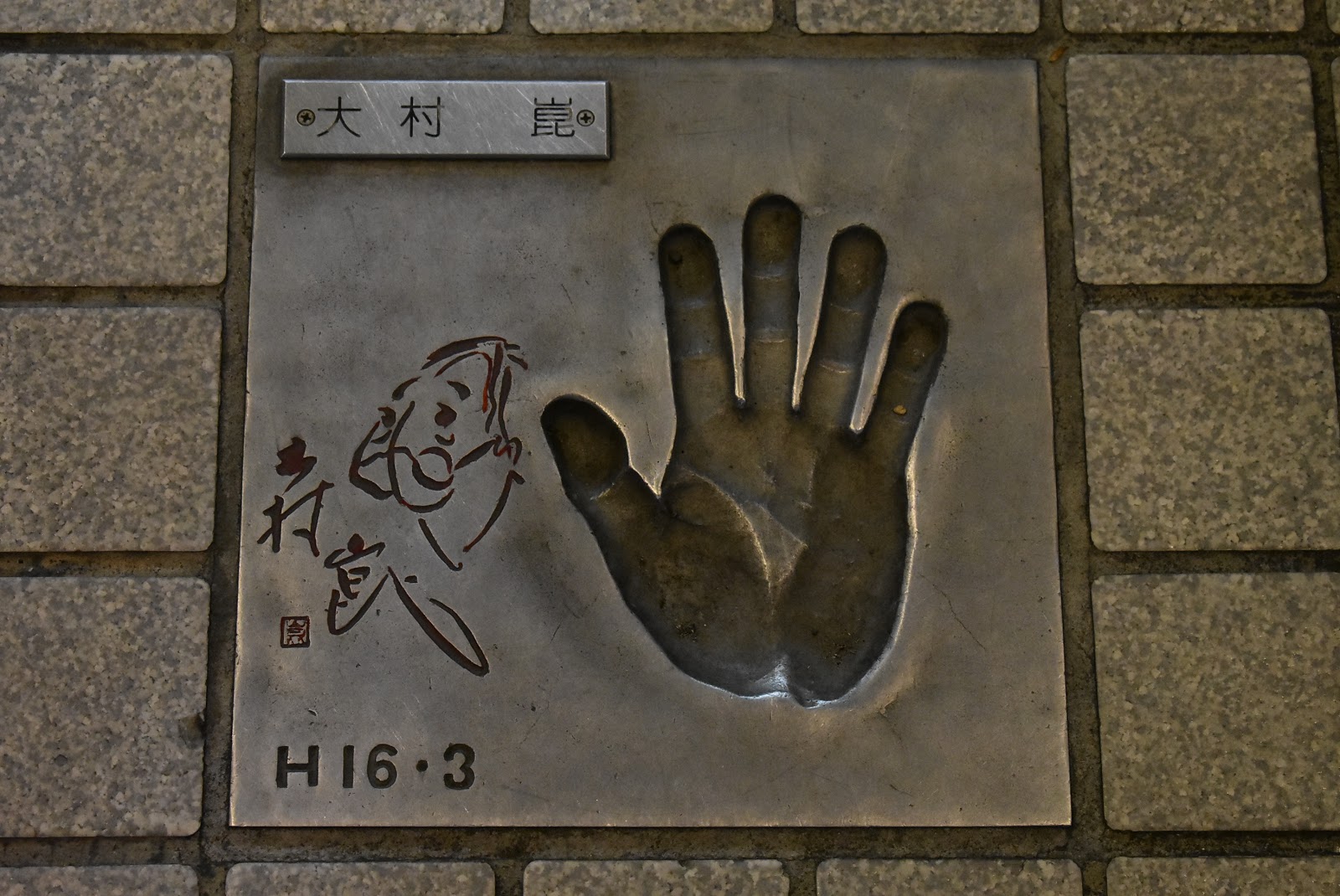
After Hibiya Chanter Square was renovated and renamed Godzilla Square, its Walk of Fame of Toho star was unceremoniously discarded. Thankfully, Asakusa Public Hall still maintains its Plaza of Stars, a similar area honoring many of Japan's biggest names in entertainment. Among them are a few performers familiar to readers of this blog. Let's check them out.

Asakusa Public Hall's Plaza of Stars. Photo by Brett Homenick.


Kon Omura, star of Gamera vs. Guiron (1969) and Gamera vs. Jiger (1970).


Izumi Yukimura, star of The Princess of Badger Palace (1958), Desperado Outpost (1959), Ichimatsu Travels with Ghosts (1959), and You Can Succeed, Too (1964).


Norihei Miki, star of Songoku: The Road to the West (1959), The Three Treasures (1959), and Deathquake (1980).


Toshiro Mifune, star of Rashomon (1950), Seven Samurai (1954), and The Three Treasures (1959).


Frankie Sakai, star of The Last War (1961) and Mothra (1961).


Machiko Kyo, star of Rashomon, Gate of Hell (1953), and Ugetsu (1953).


Yuzo Kayama, star of the Young Guy series and Espy (1974).

Monday, May 28, 2018

GENTLE WARRIOR! Toshiro Mifune Conquers Daikanyama!

A small (and temporary) Toshiro Mifune at Daikanyama T-Site. Photo by Brett Homenick.

In honor of Mifune: The Last Samurai's recent opening in Japan, a small Toshiro Mifune exhibit is being held at Daikanyama T-Site from May 10 through May 29. On May 25, I visited the exhibit after work. I'd already seen many of the items on display at last year's Mifune exhibit in Shibuya, but it was certainly great to have a chance to see them again -- a rare treat, indeed!


Thursday, October 26, 2017

70 YEARS OF TOSHIRO MIFUNE! Celebrating the Toho Star's Landmark Career in Shibuya!


From October 19 until 31, the Tokyu Department Store in Shibuya is hosting a special exhibit on the life and career of Toho star Toshiro Mifune. Entitled "The Man Who Was Called 'MIFUNE of the World,'" the exhibit commemorates the 70th anniversary of his film debut.


That movie, of course, was Snow Trail (1947), directed by Senkichi Taniguchi (The Lost World of Sinbad, The Killing Bottle). Mifune quickly became a star in the years following the release of that film, and went on to enjoy international stardom that very few Japanese actors ever get to see.


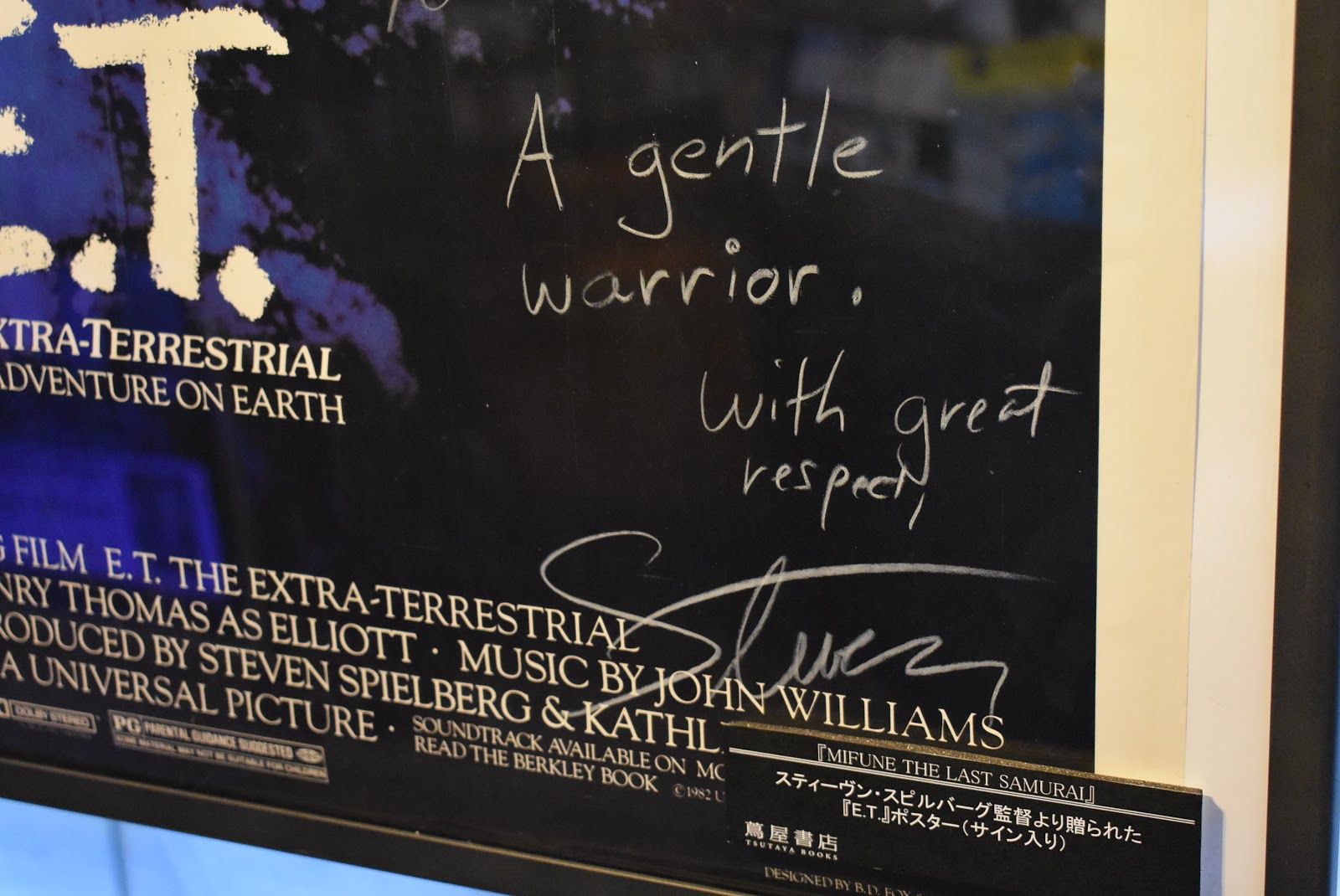
There was some rather interesting memorabilia on display. Almost immediately after you enter the exhibit, you see a poster for E.T. (1982) signed by Steven Spielberg, complete with a personalized message from the director. Who knew Mifune had such an item in his collection!


Also on hand were such personal effects as Mifune's luggage (all with "T. Mifune" embossed on the suitcases), as well as his golf clubs. His cameras were on display, too, as were some of his pipes. I was quite interested to see a photo of Mifune's meeting then-Vice President George H. W. Bush in 1984.


There were many photos in the exhibit of Mifune with Western celebrities (Spielberg, Robert De Niro, Charlie Chaplin, Robert Mitchum, etc.), but there were just as many shots of Mifune's palling around with his fellow Toho actors, such as Kaoru Yachigusa, Setsuko Hara, Keiju Kobayashi, and many others.

All in all, it was a fascinating display, and it's not the type of thing that one sees in Shibuya very often. I highly recommend it!

Monday, May 8, 2017

WHO'S WHO IN HIBIYA CHANTER! Identifying the Japanese Actors!

 The Godzilla statue in Hibiya Chanter. Photo by Brett Homenick.

Hibiya Chanter is known to fans in the West for its Godzilla statue, which was erected there in 1995. There's also an area very similar to Hollywood's Walk of Fame, which honors several Japanese actors. But who are they? Which ones might Westerners want to see? Here's a handy guide.


Akira Takarada -- the star of Godzilla (1954), Godzilla vs. the Thing (1964), Monster Zero (1965), and Godzilla vs. the Sea Monster (1966).


Yosuke Natsuki -- the star of Ghidrah the Three-Headed Monster (1964), Dogora the Space Monster (1964), and Godzilla 1985 (1984).


Toshiro Mifune -- the star of numerous Akira Kurosawa films, as well as The Three Treasures (1959), The Lost World of Sinbad (1963), Adventure in Kigan Castle (1966), and Princess from the Moon (1987).


Izumi Yukimura -- the Japanese singing star who appeared in many films for Toho, including the genre-ish The Princess of Badger Palace (1958) and Ichimatsu Travels with Ghosts (1959).


Keiju Kobayashi -- one of the stars of Submersion of Japan (1973) and Godzilla 1985.


Ken Takakura -- one of Japan's most popular leading men, whose yakuza films are still widely seen in Japan.


Tadao Takashima -- the star of King Kong vs. Godzilla (1962), Atragon (1963), Frankenstein Conquers the World (1965), and Son of Godzilla (1967).


Ken Uehara -- one of Japan's leading men in the 1930s, but better known in the West for his supporting roles in Mothra (1961), Gorath (1962), and Atragon.


Hisaya Morishige -- one of Toho's most bankable actors during the Showa era, starring in the long-running Shacho series. He appears in Sayonara Jupiter (1984) as the Earth Federation President.


Yuzo Kayama -- the handsome star of Toho's Young Guy series, who also appeared in several war films with SFX by Eiji Tsuburaya.


Yuriko Hoshi -- the female lead of The Last War (1961), Godzilla vs. the Thing, and Ghidrah the Three-Headed Monster.


Frankie Sakai -- a successful comedy actor whom Westerners would know best as the star of the original Mothra.


Yasuko Sawaguchi -- Godzilla 1985's leading lady, who also had turns in Godzilla vs. Biollante (1989) and Orochi the Eight-Headed Dragon (1994).


Kyoko Kagawa -- one of the stars of Yasujiro Ozu's seminal Tokyo Story (1953) and the sci-fi classic Mothra.